Class 7 Science Curiosity Chapter 9 Life Processes in Animals NCERT Solutions Looking for the Class 7 Science Curiosity Chapter 9 Life Processes in Animals NCERT Solutions? You’re in the right place. This chapter explains how animals perform essential life processes such as nutrition, respiration, transportation, and excretion in a simple and easy-to-understand manner. Our NCERT solutions help students understand every concept clearly and prepare effectively for school exams.
Let Us Enhance Our Learning (Page 135 – 136)
1. Complete the journey of food through the alimentary canal by filling up the boxes with appropriate parts—

Answer:
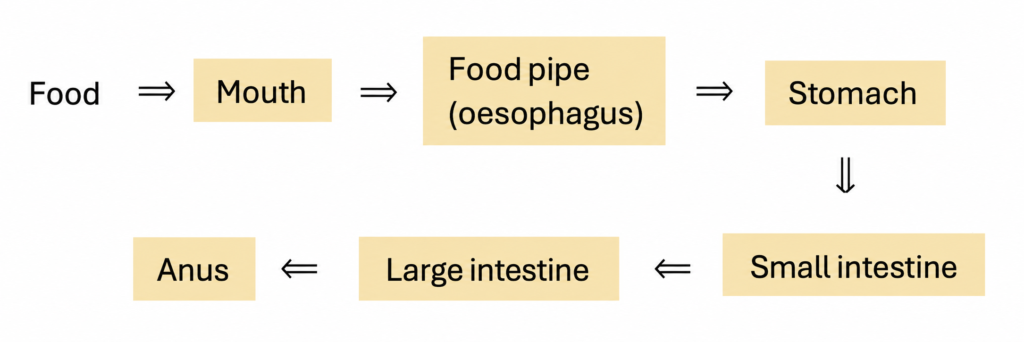
2. Sahil placed some pieces of chapati in test tube A. Neha placed chewed chapati in test tube B, and Santushti took boiled and mashed potato in test tube C. All of them added a few drops of iodine solution to their test tubes—A, B, and C, respectively. What would be their observations? Give reasons.
Answer:
Test tube A: The colour of the iodine solution will change to blue-black.
Reason: Chapati contains starch, and iodine gives a blue-black colour in the presence of starch.
Test tube B: The colour will not turn blue-black, or there is a slight colour change.
Reason: When we chew chapati, saliva mixes with it and breaks down the starch present in chapati into sugar. Since most of the starch is converted into sugar, iodine shows little or no blue-black colour.
Test tube C: The colour of the iodine solution changes to blue-black.
Reason: Boiled and mashed potato also contains starch, which reacts with iodine to give a blue-black colour.
3. What is the role of the diaphragm in breathing?
(i) To filter the air
(ii) To produce sound
(iii) To help in inhalation and exhalation
(iv) To absorb oxygen
Answer:
(iii) To help in inhalation and exhalation.
4. Match the following

Answer:

5. Anil claims to his friend Sanvi that respiration and breathing are the same process. What question(s) can Sanvi ask him to make him understand that he is not correct?
Answer:
Sanvi can ask the following questions to help Anil understand the difference between breathing and respiration:
1. Does breathing release energy?
2. Where does respiration take place — in the lungs or in the cells?
3. Can our body get energy just by breathing?
These questions will help Anil understand that breathing is a physical process of air exchange, while respiration is a chemical process that releases energy in cells.
6. Which of the following statements is correct and why?
Anu: We inhale air.
Shanu: We inhale oxygen.
Tanu: We inhale air rich in oxygen.
Answer:
Tanu’s statement is correct.
We inhale air rich in oxygen. The air we breathe in contains about 21% oxygen, along with nitrogen and other gases. When we exhale, the air contains less oxygen and more carbon dioxide.
7. We often sneeze when we inhale a lot of dust-laden air. What can be possible explanations for this?
Answer:
When we inhale a lot of dust-laden air, the dust particles get trapped in the tiny hairs and mucus present in the nasal cavity. These dust particles irritate the lining of the nasal passage, and as a protective reflex action, we sneeze to expel the dust particles and clear the passage.
8. Paridhi and Anusha of Grade 7 started running for their morning workout. After they completed their running, they counted their breaths per minute. Anusha was breathing faster than Paridhi. Provide at least two possible explanations for why Anusha was breathing faster than Paridhi.
Answer:
i) Anusha might be less physically fit than Paridhi, so her body needs to breathe faster to supply enough oxygen to the muscles while running.
(ii) She might have been running faster or exerting more effort than Paridhi, which made her breathing heavier.
9. Yadu conducted an experiment to test his idea. He took two test tubes, A and B, and added a pinch of rice flour to the test tubes, half- filled with water and stirred them properly. To test tube B, he added a few drops of saliva. He left the two test tubes for 35–45 min. After that, he added iodine solution into both the test tubes. Experimental results are as shown in Fig. 9.15. What do you think he wants to test?

Answer:
He wanted to test the presence of starch in both test tubes.
10. Rakshita designed an experiment taking two clean test tubes, A and B and filled them with lime water as shown in the figure. In test tube A, the surrounding air that we inhale was passed on by sucking air from the pipe, and in test tube B, the exhaled air was blown through the pipe (Fig. 9.16). What do you think she is trying to investigate? How can she confirm her findings?

Answer:
Rakshita is trying to investigate the difference in the amount of carbon dioxide present in inhaled and exhaled air.
The lime water in test tube B turns milky, while the lime water in test tube A remains clear. Lime water turns milky when it reacts with carbon dioxide.
This shows that exhaled air contains more carbon dioxide than inhaled air.
At schoollearners.in/, we provide accurate, step-by-step, and student-friendly NCERT Solutions prepared according to the latest NCERT syllabus. Whether you’re completing homework, revising for tests, or clearing difficult concepts, our detailed explanations make learning easier and more enjoyable.
Visit https://schoollearners.in/ for the latest Class 7 Science Curiosity Chapter 9 Life Processes in Animals NCERT Solutions, along with chapter notes, important questions, MCQs, sample papers, and other study resources—all available for free to help you score better in your exams.