Pressure, Winds, Storms, and Cyclones Class 8 Science Curiosity Chapter 6 Question Answers If you are searching for the Pressure, Winds, Storms, and Cyclones Class 8 Science Curiosity Chapter 6 Question Answers, you are in the right place. This chapter explains how air pressure creates winds, how storms develop, and how cyclones form. Understanding these concepts helps students prepare well for school exams and strengthen their science fundamentals.
Probe and ponder (Page 80)
1. Why are winds stronger on some days than on others?
Answer:
Winds are stronger on some days because the difference in air pressure between the two regions is greater. A large pressure difference makes air rush faster from high-pressure to low-pressure areas, producing stronger winds.
2. Why are water tanks usually placed at a height?
Answer:
Water tanks are usually placed at a height so that water can flow with enough pressure. The greater height increases water pressure, which allows a steady stream of water from the taps.
3. Can air pressure really crush us?
Answer:
Air pressure cannot crush us under normal conditions because the pressure inside our bodies balances the pressure from outside. Our body fluids and tissues exert an outward pressure that counteracts the atmospheric pressure, so we don’t get crushed by the weight of the air around us.
4. What causes storms and cyclones? If the Earth stopped rotating, would cyclones still form?
Answer:
Storms form when warm, moist air rises rapidly, cools, and condenses into clouds, releasing heat. This creates strong winds, rain, thunder, and lightning.
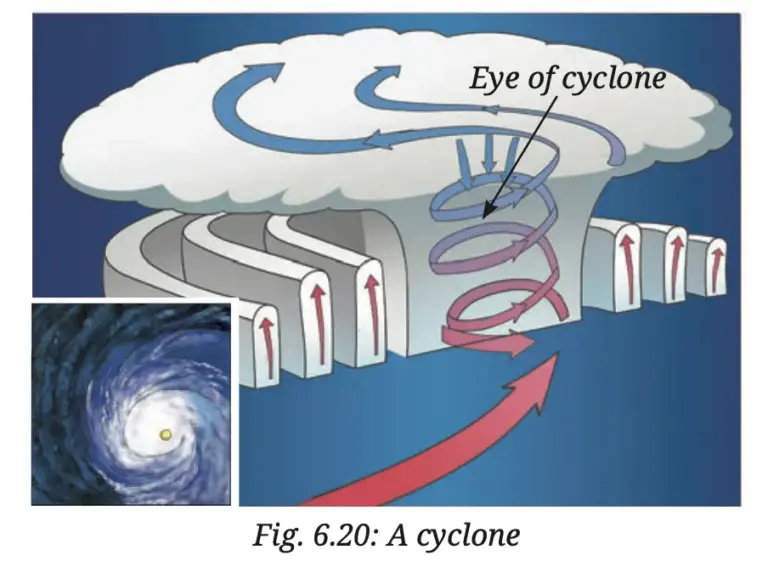
Cyclones are large, spinning storm systems that form over warm ocean waters. They are caused by:
1. Warm ocean water – provides energy in the form of heat and moisture.
2. Rising air – as warm air rises, it creates a low-pressure area.
3. Earth’s rotation – makes the winds spiral, giving cyclones their circular motion.
If the Earth stopped rotating, cyclones would not form. This is because Earth’s rotation makes cyclones spin. Without rotation, winds would move straight from high-pressure to low-pressure areas.
Keep the curiosity alive (Page 94 – 96)
1. Choose the correct statement.
(i) Look at Fig. 6.21 carefully. Vessel R is filled with water. When pouring of water is stopped, the level of water will be ____________________.
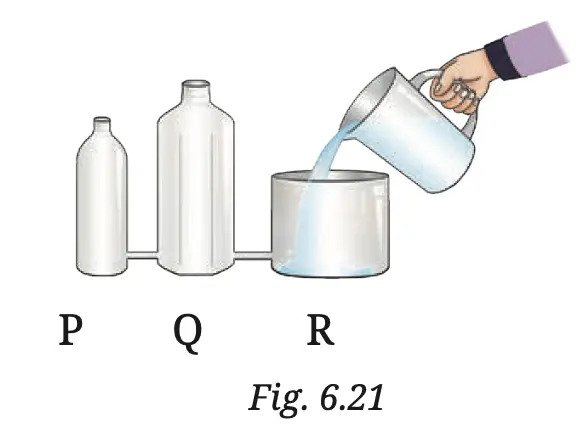
(a) the highest in vessel P
(b) the highest in vessel Q
(c) the highest in vessel R
(d) equal in all three vessels
Answer:
(d) equal in all three vessels
(ii) A rubber sucker (M) is pressed on a flat smooth surface and an identical sucker (N) is pressed on a rough surface:
(a) Both M and N will stick to their surfaces.
(b) Both M and N will not stick to their surfaces.
(c) M will stick but N will not stick.
(d) M will not stick but N will stick.
Answer:
(c) M will stick but N will not stick.
(iii) A water tank is placed on the roof of a building at a height ‘H’. To get water with more pressure on the ground floor, one has to
(a) increase the height ‘H’ at which the tank is placed.
(b) decrease the height ‘H’ at which the tank is placed.
(c) replace the tank with another tank of the same height that can hold more water.
(d) replace the tank with another tank of the same height that can hold less water.
Answer:
(a) increase the height ‘H’ at which the tank is placed.
(iv) Two vessels, A and B contain water up to the same level as shown in Fig. 6.22. PA and PB is the pressure at the bottom of the vessels. FA and FB is the force exerted by the water at the bottom of the vessels A and B.
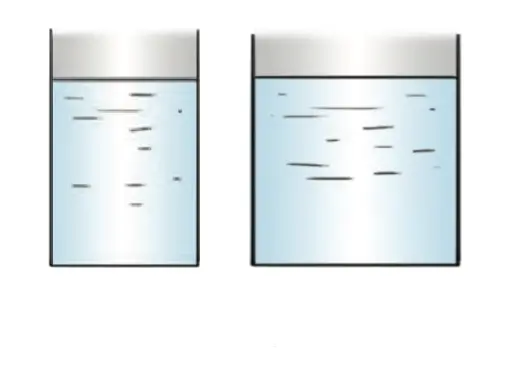
(a) PA = PB, FA = FB
(b) PA = PB, FA < FB
(c) PA < PB, FA = FB
(d) PA > PB, FA > FB
Answer:
(b) PA = PB, FA < FB
2. State whether the following statements are True [T] or False [F].
(i) Air flows from a region of higher pressure to a region of lower pressure. [ ]
(ii) Liquids exert pressure only at the bottom of a container. [ ]
(iii) Weather is stormy at the eye of a cyclone. [ ]
(iv) During a thunderstorm, it is safer to be in a car. [ ]
Answer:
(i) Air flows from a region of higher pressure to a region of lower pressure. [ T ]
(ii) Liquids exert pressure only at the bottom of a container. [ F ]
(iii) Weather is stormy at the eye of a cyclone. [ F ]
(iv) During a thunderstorm, it is safer to be in a car. [ T ]
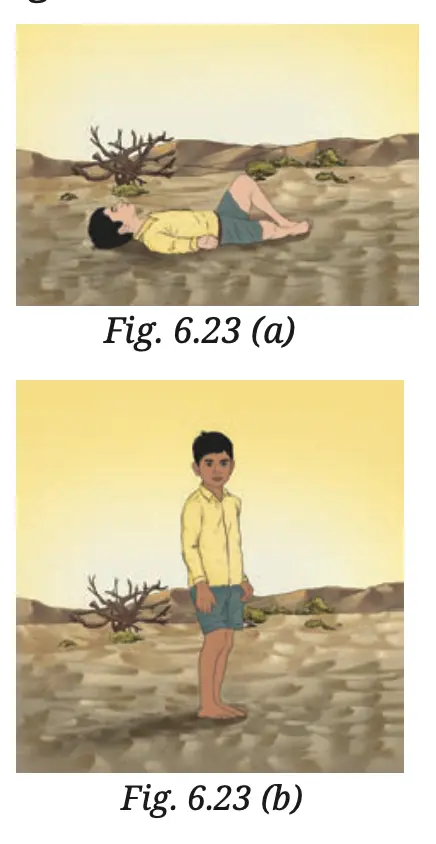
3. Fig. 6.23a shows a boy lying horizontally, and Fig. 6.23 b shows the boy standing vertically on a loose sand bed. In which case does the boy sink more in sand? Give reasons.
Answer:
In Fig. 6.23(b), the boy sinks more in sand because his entire weight acts on a smaller area (the area of his feet). In Fig. 6.23(a), the same weight is spread over a larger area (his back), so the pressure on the sand is less. Since pressure increases when the same force acts on a smaller area, the boy sinks more when standing vertically.
4. An elephant stands on four feet. If the area covered by one foot is 0.25 m2, calculate the pressure exerted by the elephant on the ground if its weight is 20000 N.
Answer:
Area of one foot = 0.25 m²
Total area of four feet = 0.25 × 4 = 1.0 m²
Weight (Force) = 20,000 N
Pressure = Force ÷ Area = 20,000 ÷ 1 = 20,000 Pa.
Therefore, the pressure exerted = 20,000 Pa.
5. There are two boats, A and B. Boat A has a base area of 7 m2, and 5 persons are seated in it. Boat B has a base area of 3.5 m2, and 3 persons are seating in it. If each person has a weight of 700 N, find out which boat will experience more pressure on its base and by how much?
Answer:
Weight of each person (Force) = 700 N
Boat A:
Base area = 7 m².
Total weight on Boat A = 5 × 700 = 3500 N.
Pressure = Force ÷ Area = 3500 ÷ 7 = 500 Pa.
Boat B:
Base area = 3.5 m².
Total weight on Boat B = 3 × 700 = 2100 N.
Pressure = Force ÷ Area = 2100 ÷ 3.5 = 600 Pa.
Difference in pressure = 600 Pa – 500 Pa = 100 Pa.
Therefore, Boat B experiences more pressure than Boat A, by 100 Pa.
6. Would lightning occur if air and clouds were good conductors of electricity? Give reasons for your answer.
Answer:
Lightning is caused by the accumulation of electric charges within a cloud, between clouds, or between a cloud and the ground. Normally, air acts as an insulator and prevents opposite charges from meeting. When the charge buildup becomes very large, the insulating property of air breaks down, and a sudden flow of charges occurs in the form of lightning.
If air and clouds were good conductors of electricity, charges would not accumulate. Instead, they would continuously neutralise each other. Therefore, no sudden discharge would take place, and lightning would not occur.
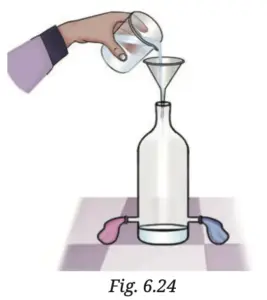
7. What will happen to the two identical balloons A and B as shown in Fig. 6.24 when water is filled into the bottle up to a certain height. Will both the balloons bulge? If yes, will they bulge equally? Explain your answer.
Answer:
The pressure at a point in water depends only on the height (depth) of the water column above that point. In the given figure, the balloons A and B are at the same depth in the water bottle. So, they will experience equal pressure. Hence, both balloons will bulge, and they will bulge equally.
8. Explain how a storm becomes a cyclone.
Answer:
A cyclone begins over warm ocean waters. As the ocean water becomes warm, the moist air above it absorbs heat and rises. When it rises, the water vapour condenses into raindrops and releases heat. This further heats the ascending air, creating even lower pressure. Air from the surroundings rushes in, and due to Earth’s rotation, it starts spinning. This cycle continues, forming a large storm with strong winds and rain, called a cyclone.
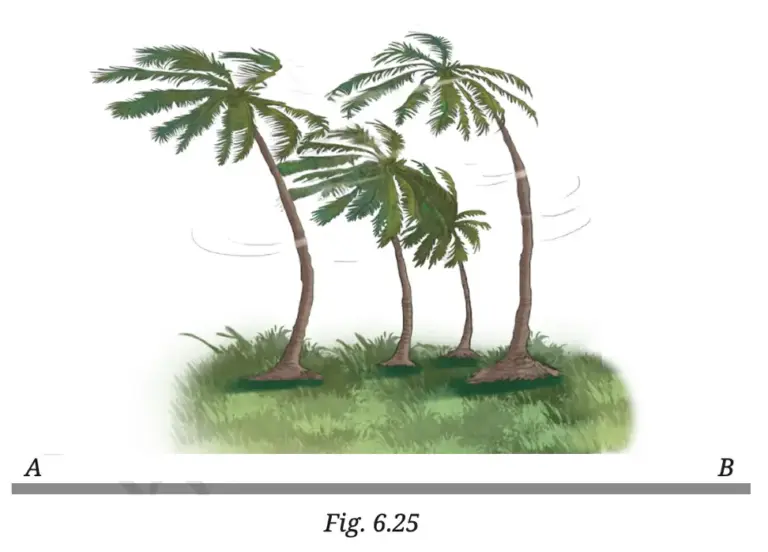
9. Fig. 6.25 shows trees along the sea coast in a summer afternoon. Identify which side is land — A or B. Explain your answer.
Answer:
In coastal areas, during the summer days, the land heats up faster than the sea. The warm air above the land rises, creating a low-pressure region. Cooler air from the sea moves towards the land, forming a sea breeze. In the figure, the trees are bending towards side A due to the wind blowing from side B. Hence, side A is land and side B is sea.
10. Describe an activity to show that air flows from a region of high pressure to a region of low pressure.
Answer:
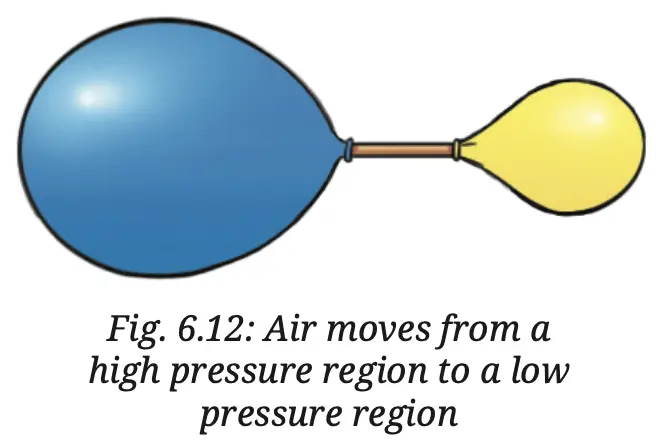
Activity to show that air flows from a region of high pressure to a region of low pressure:
1. Take two balloons and a drinking straw.
2. Fix an inflated balloon at one end of the straw and an uninflated balloon at the other end.
3. Air moves from the inflated balloon (high pressure) into the uninflated balloon (low pressure).
4. This shows that air always flows from a region of high pressure to a region of low pressure.
11. What is a thunderstorm? Explain the process of its formation.
Answer:
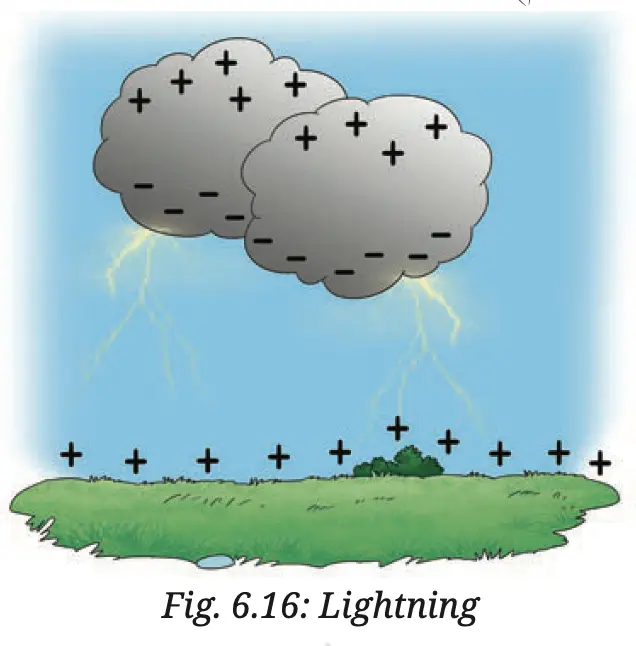
A thunderstorm is a storm accompanied by lightning, thunder, rain, and strong winds. It forms when the land gets heated, causing warm and moist air to rise. As the air rises, moisture condenses into clouds and raindrops. The strong upward and downward winds inside the clouds cause water droplets and ice particles to rub against each other, producing electric charges. The upper part of the cloud becomes positively charged, while the lower part becomes negatively charged. This induces a positive charge on the ground. When the charge buildup becomes very large, a sudden discharge occurs as lightning, which heats the air rapidly and produces thunder.
12. Explain the process that causes lightning.
Answer:
Inside a thundercloud, strong winds cause water droplets and ice particles to rub against each other, creating a separation of charges. The lighter ice particles become positively charged and move to the top, while the heavier water droplets carry negative charges at the bottom. This negative charge induces a positive charge on the ground. Normally, air acts as an insulator, but when the difference in charges becomes very large, a sudden discharge of electricity occurs between the cloud and the ground (or within clouds). This discharge is observed as lightning.
13. Explain why holes are made in banners and hoardings.
Answer:
Banners and hoardings obstruct the flow of wind, creating a pressure difference on the two sides. If this pressure becomes too high, the banner may tear or get blown away. To reduce this pressure, holes are made in banners and hoardings so that air can pass through them easily.
At School Learners, we provide easy-to-understand, accurate, and NCERT-based solutions for every question. Our answers are written in simple language so that Class 8 students can revise quickly and score better in exams.
👉 Visit our website for complete solutions: https://schoollearners.in/
On schoollearners.in/, you’ll find:
- Chapter-wise Question Answers
- NCERT Solutions
- Important Questions
- Notes and Revision Material
- Exam Preparation Resources for Class 8 and other classes
Explore the complete Pressure, Winds, Storms, and Cyclones Class 8 Science Curiosity Chapter 6 Question Answers and boost your exam preparation with School Learners.