Nature of Matter: Elements, Compounds, and Mixtures Class 8 Science Chapter 8 Questions Answers Looking for the Nature of Matter: Elements, Compounds and Mixtures Class 8 Science Chapter 8 Questions Answers? You’ve come to the right place. Understanding the difference between elements, compounds, and mixtures is one of the most important topics in Class 8 Science, and solving NCERT questions helps students strengthen their concepts and score better in exams.
Probe and ponder (Page 116)

Q. Which of the entities in the picture above consists of matter, and which of them do not?
Answer:
Entities from the picture that contain matter are trees, buildings, students, flowers, doors, metal railings, football, schoolbags, air, water bottles, walking stick, books, grass, tiffin boxes, floor, boundary wall, and students’ clothes.
Entities that don’t contain matter are light, sound, and heat.
Q. How can elements be combined to form a compound?
Answer:
A compound is formed when two or more elements combine chemically in a fixed ratio. During this chemical reaction, the elements lose their individual properties and form a new substance with entirely different properties.
Q. How could the discovery of a compound that absorbs carbon dioxide from the air contribute to solving environmental challenges?
Answer:
Carbon dioxide is a major greenhouse gas. The discovery of a compound that absorbs carbon dioxide from the air would help decrease its amount in the atmosphere and thus reduce global warming and other harmful effects on the environment.
Keep the curiosity alive (Page 131 – 132)
1. Consider the following reaction where two substances, A and B, combine to form a product C:
A + B → C
Assume that A and B cannot be broken down into simpler substances by chemical reactions. Based on this information, which of the following statements is correct?
(i) A, B, and C are all compounds and only C has a fixed composition.
(ii) C is a compound, and A and B have a fixed composition.
(iii) A and B are compounds, and C has a fixed composition.
(iv) A and B are elements, C is a compound, and has a fixed composition.
Answer:
(iv) A and B are elements, C is a compound, and has a fixed composition.
Reason:
Since A and B cannot be broken down into simpler substances by chemical reactions, they are elements. When two elements combine chemically, they form a compound. The compound C thus formed has a fixed composition and properties different from those of the elements A and B.
2. Assertion: Air is a mixture. Reason: A mixture is formed when two or more substances are mixed, without undergoing any chemical change.
(i) Both Assertion and Reason are true, and Reason is the correct explanation for Assertion.
(ii) Both Assertion and Reason are true, but Reason is not the correct explanation for Assertion.
(iii) Assertion is true, but Reason is false.
(iv) Assertion is false, but Reason is true.
Answer:
(i) Both Assertion and Reason are true, and Reason is the correct explanation for Assertion.
Explanation:
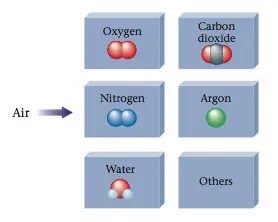
Air is a mixture of gases such as nitrogen, oxygen, carbon dioxide, and argon. These gases are physically combined in varying proportions and do not undergo any chemical change. They retain their individual properties, which shows that air is a mixture.
3. Water, a compound, has different properties compared to those of the elements oxygen and hydrogen from which it is formed. Justify this statement.
Answer:
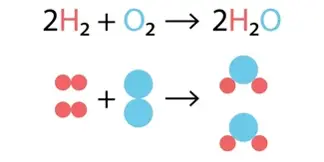
Water is a compound formed by the chemical combination of hydrogen and oxygen in a fixed ratio. The properties of water are entirely different from those of its constituent elements. For example, hydrogen and oxygen are gases at room temperature, whereas water is a liquid. This shows that when elements combine chemically to form a compound, the new substance formed has properties different from those of the elements.
4. In which of the following cases are all the examples correctly matched? Give reasons in support of your answers.
(i) Elements — water, nitrogen, iron, air.
(ii) Uniform mixtures— minerals, seawater, bronze, air.
(iii) Pure substances— carbon dioxide, iron, oxygen, sugar.
(iv) Non-uniform mixtures — air, sand, brass, muddy water.
Answer:
(iii) Pure substances — carbon dioxide, iron, oxygen, sugar
Reason:
Pure substances have a fixed composition and definite properties. Carbon dioxide, iron, oxygen, and sugar each have a uniform composition throughout and cannot be separated into simpler substances by physical methods. Therefore, option (iii) is correctly matched.
5. Iron reacts with moist air to form iron oxide, and magnesium burns in oxygen to form magnesium oxide. Classify all the substances involved in the above reactions as elements, compounds or mixtures, with justification.
Answer:
• Iron and magnesium are elements because they are made up of only one kind of atom.
• Moist air is a mixture of water vapour and gases.
• Oxygen is an element because it contains only oxygen atoms.
• Iron oxide and magnesium oxide are compounds because they are formed by the chemical combination of elements in fixed proportions.
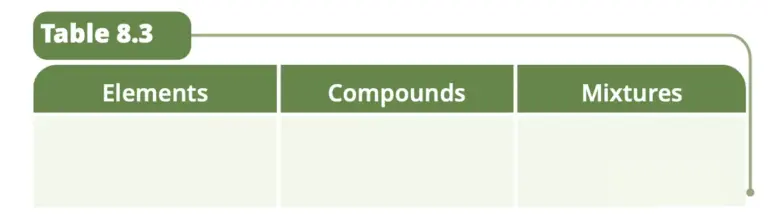
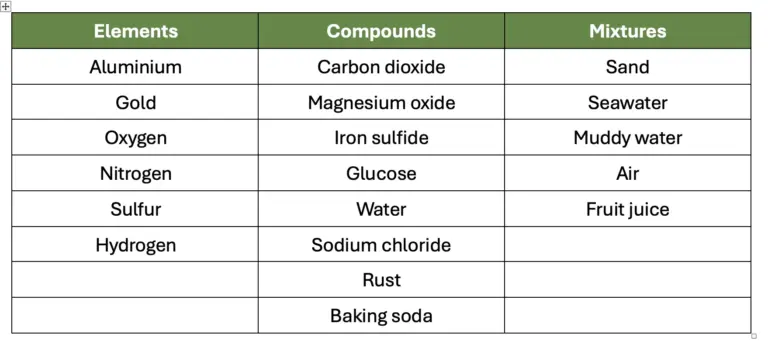
6. Classify the following as elements, compounds, or mixtures in Table 8.3.
Carbon dioxide, sand, seawater, magnesium oxide, muddy water, aluminium, gold, oxygen, rust, iron sulfide, glucose, air, water, fruit juice, nitrogen, sodium chloride, sulfur, hydrogen, baking soda.
Identify pure substances amongst these and list them below.

Answer:
Pure substances:
Carbon dioxide, magnesium oxide, iron sulfide, glucose, water, sodium chloride, rust, baking soda, aluminium, gold, oxygen, nitrogen, sulfur, and hydrogen.
7. What new substance is formed when a mixture of iron filings and sulfur powder is heated, and how is it different from the original mixture? Also, write the word equation for the reaction.
Answer:
When a mixture of iron filings and sulfur powder is heated, a black compound called iron sulfide is formed. It is not attracted by a magnet and has properties completely different from those of iron and sulfur. The elements can no longer be separated by physical methods.
Word equation:
Iron + Sulfur → Iron sulfide
8. Is it possible for a substance to be classified as both an element and a compound? Explain why or why not.
Answer:
No, a substance cannot be classified as both an element and a compound. Elements are pure substances made up of only one kind of atom and cannot be broken down into simpler substances by chemical means. Compounds, on the other hand, are formed when two or more different elements combine chemically in a fixed ratio. Hence, a substance cannot be both a single type of atom and a combination of different atoms at the same time.
9. How would our daily lives be changed if water were not a compound but a mixture of hydrogen and oxygen?
Answer:
If water were a mixture of hydrogen and oxygen, it would not have the same properties as real water. It would not exist as a liquid at normal conditions and could not support life. Thus, water would not be the lifeline for plants and animals.
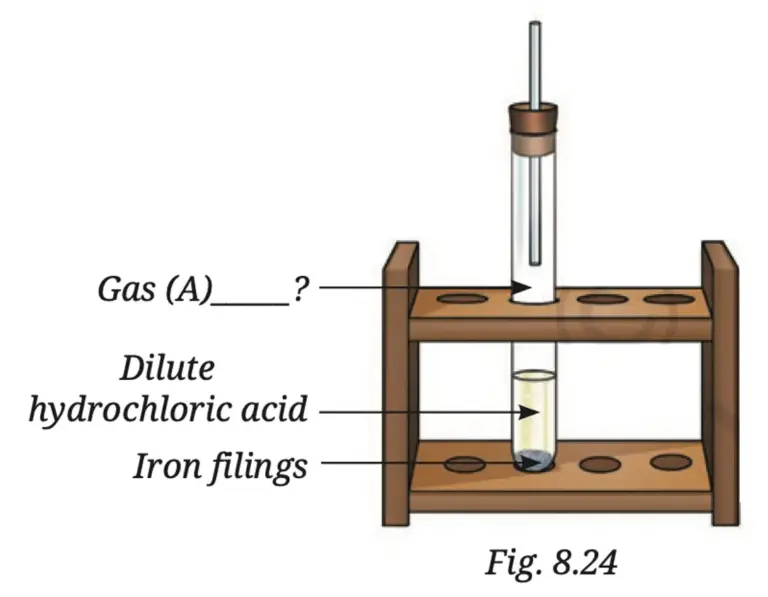
10. Analyse Fig. 8.24. Identify Gas A. Also, write the word equation of the chemical reaction.
Answer:
The Gas A will be hydrogen because the iron filings in the test tube react with the dilute sulphuric acid to form iron chloride and hydrogen gas.
The reaction can be represented as —
Iron + Dilute Hydrochloric acid → Iron chloride + Hydrogen gas
11. Write the names of any two compounds made only from non-metals, and also mention two uses of each of them.
Answer:
1. Carbon dioxide (CO₂):
• Used by plants in photosynthesis.
• Used in fire extinguishers.
2. Water (H₂O):
• Essential for all living organisms.
• Used for drinking, washing, and cooking.
12. How can gold be classified as both a mineral and a metal?
Answer:
Gold is found in nature as a mineral because it occurs naturally in the earth’s crust. It is also classified as a metal because it has metallic properties such as lustre, malleability, ductility, and good conductivity of heat and electricity.
At SchoolLearners, we provide easy-to-understand NCERT solutions, detailed explanations, important questions, MCQs, worksheets, and revision notes prepared according to the latest syllabus. Every answer is written in simple language so that students can learn quickly and revise effectively before exams.
Read the complete solutions here: https://schoollearners.in/