Class 8 Science Curiosity Chapter 9 The Amazing World of Solutes, Solvents And Solutions NCERT Solutions If you are searching for the Class 8 Science Curiosity Chapter 9 The Amazing World of Solutes, Solvents and Solutions NCERT Solutions, you are in the right place. This chapter explains the concepts of solutes, solvents, solutions, solubility, saturated and unsaturated solutions, and factors affecting dissolution in a simple and practical way.
Keep the curiosity alive (Page 149 – 151)
(i) Oxygen gas is more soluble in hot water rather than in cold water.
Answer: False.
Correction: Oxygen is more soluble in cold water and becomes less soluble as the temperature increases.
(ii) A mixture of sand and water is a solution.
Answer: False.
Correction: Sand and water do not form a uniform mixture; they form a heterogeneous mixture, not a solution.
(iii) The amount of space occupied by any object is called its mass.
Answer: False.
Correction: The amount of space occupied by an object is called its volume.
(iv) An unsaturated solution has more solute dissolved than a saturated solution.
Answer: False.
Correction: A saturated solution has more solute dissolved than an unsaturated solution.
(v) The mixture of different gases in the atmosphere is also a solution.
Answer: True.
Explanation: The atmosphere is a solution of different gases, with nitrogen as the solvent and other gases like oxygen, carbon dioxide, and argon as solutes.
2. Fill in the blanks.
(i) The volume of a solid can be measured by the method of displacement, where the solid is __________ in water and the ____________ in water level is measured.
Answer:
The volume of a solid can be measured by the method of displacement, where the solid is immersed in water and the rise in water level is measured.
(ii) The maximum amount of _______________ dissolved in _______________ at a particular temperature is called solubility at that temperature.
Answer:
The maximum amount of solute dissolved in solvent at a particular temperature is called solubility at that temperature.
(iii) Generally, the density ____________ with increase in temperature.
Answer:
Generally, the density decreases with increase in temperature.
(iv) The solution in which glucose has completely dissolved in water, and no more glucose can dissolve at a given temperature, is called a __________ solution of glucose.
Answer:
The solution in which glucose has completely dissolved in water, and no more glucose can dissolve at a given temperature, is called a saturated solution of glucose.
3. You pour oil into a glass containing some water. The oil floats on top. What does this tell you?
(i) Oil is denser than water
(ii) Water is denser than oil
(iii) Oil and water have the same density
(iv) Oil dissolves in water
Answer:
(ii) Water is denser than oil.
Explanation: Oil floats on water because its density is less than that of water. Therefore, water is denser than oil.
4. A stone sculpture weighs 225 g and has a volume of 90 cm3. Calculate its density and predict whether it will float or sink in water.
Answer:
Mass = 225 g
Volume = 90 cm3

Since the density of stone sculpture is greater than that of water, it will sink in water.
5. Which one of the following is the most appropriate statement, and why are the other statements not appropriate?
(i) A saturated solution can still dissolve more solute at a given temperature.
(ii) An unsaturated solution has dissolved the maximum amount of solute possible at a given temperature.
(iii) No more solute can be dissolved into the saturated solution at that temperature.
(iv) A saturated solution forms only at high temperatures.
Answer:
Statement (iii) is the most appropriate.
Statement (i) → False — A saturated solution can’t dissolve more solute at a given temperature.
Statement (ii) → False — An unsaturated solution can still dissolve more solute.
Statement (iv) → False — A saturated solution can form at any temperature, not only at high temperatures.
6. You have a bottle with a volume of 2 litres. You pour 500 mL of water into it. How much more water can the bottle hold?
Answer:
Total capcity of the bottle = 2 litres = 2000 mL
Water already poured = 500 mL
Water the bottle can still hold = 2000 mL − 500 mL = 1500 mL
Therefore, the bottle can hold 1500 mL (or 1.5 litres) more water.
7. An object has a mass of 400 g and a volume of 40 cm3. What is its density?
Answer:
Mass = 400 g
Volume = 40 cm3

Therefore, the density of the object is 10 g/cm³.
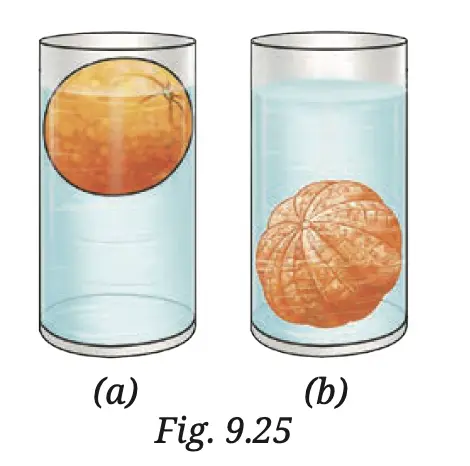
8. Analyse Fig. 9.25a and 9.25b. Why does the unpeeled orange float, while the peeled one sinks? Explain.
Answer:
The peel of the unpeeled orange has tiny air pockets that make it less dense than water. These air pockets help the orange to float.
When the orange is peeled, the air pockets are removed, making the orange denser than water, so it sinks.
9. Object A has a mass of 200 g and a volume of 40 cm3. Object B has a mass of 240 g and a volume of 60 cm3. Which object is denser?
Answer:
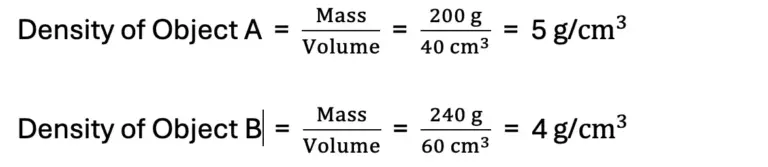
Object A is denser because its density is greater than that of Object B.
10. Reema has a piece of modeling clay that weighs 120 g. She first moulds it into a compact cube that has a volume of 60 cm3. Later, she flattens it into a thin sheet. Predict what will happen to its density.
Answer:
The density will remain the same.
Explanation:
Density depends on the mass and volume of an object. When Reema flattens the clay, its shape and volume change, but the mass remains the same.
Since the material of the clay does not change, its density remains unchanged.
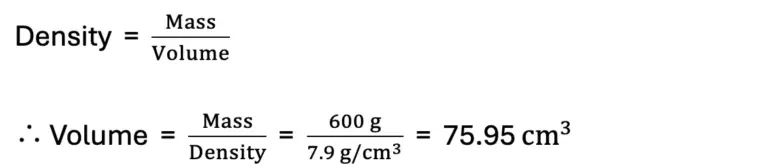
11. A block of iron has a mass of 600 g and a density of 7.9 g/cm3. What is its volume?
Answer:
Mass = 600 g
Density = 7.9 g/cm3
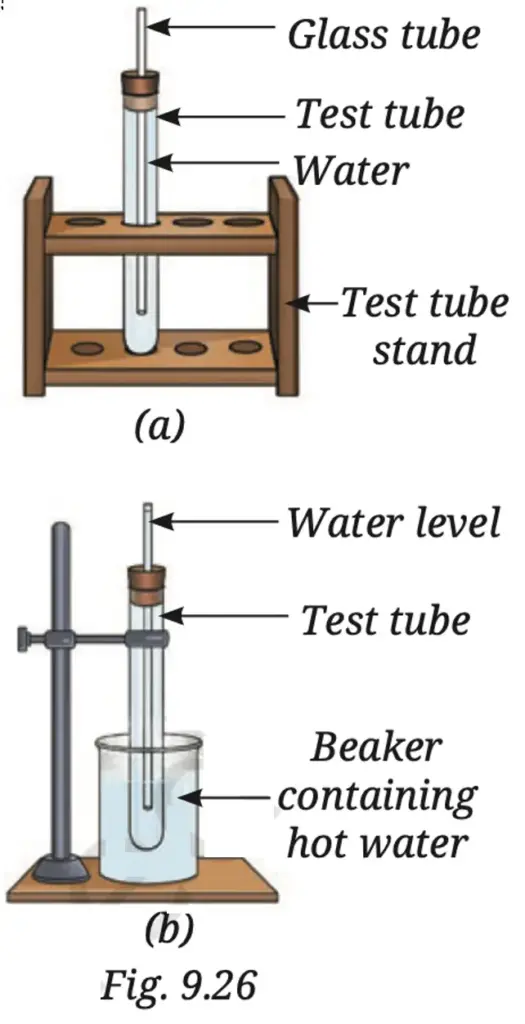
12. You are provided with an experimental setup as shown in Fig. 9.26a and 9.26b. On keeping the test tube (Fig 9.26b) in a beaker containing hot water (~70 °C), the water level in the glass tube rises. How does it affect the density?
Answer:
The density of water in setup (b) will decrease.
At School Learners, we provide easy-to-understand, accurate, and exam-oriented NCERT Solutions that help students complete their homework, prepare for school exams, and strengthen their concepts.
Read the complete NCERT Solutions here: https://schoollearners.in/
Our solutions are prepared according to the latest NCERT syllabus and include step-by-step answers in simple language, making learning easier for every student.
Visit School Learners regularly for NCERT Solutions, Notes, Important Questions, MCQs, Sample Papers, and study materials for Classes 6–12.