Class 7 Science Curiosity Chapter 7 Heat Transfer In Nature NCERT Solutions : Looking for Class 7 Science Curiosity Chapter 7 Heat Transfer In Nature NCERT Solutions? You are in the right place. At schoollearners.in/, we provide simple, accurate, and student-friendly NCERT solutions to help Class 7 students understand every concept with ease.
Let Us Enhance Our Learning
1. Choose the correct option in each case.
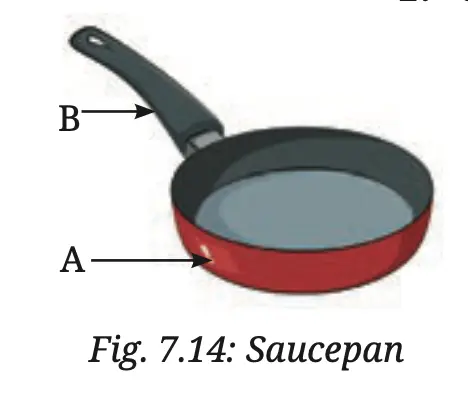
(i) Your father bought a saucepan made of two different materials, A and B, as shown in Fig. 7.14. The materials A and B have the following properties —
(a) Both A and B are good conductors of heat
(b) Both A and B are poor conductors of heat
(c) A is a good conductor and B is a poor conductor of heat
(d) A is a poor conductor and B is a good conductor of heat
Answer:
(c) A is a good conductor and B is a poor conductor of heat.
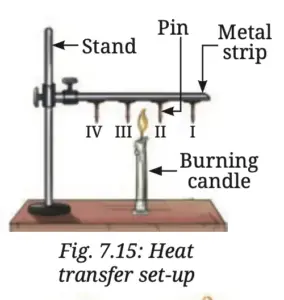
(ii) Pins are stuck to a metal strip with wax and a burning candle is kept below the rod, as shown in Fig. 7.15. Which of the following will happen?
(a) All the pins will fall almost at the same time
(b) Pins I and II will fall earlier than pins III and IV
(c) Pins I and II will fall later than pins III and IV
(d) Pins II and III will fall almost at the same time
Answer:
(d) Pins II and III will fall almost at the same time.
(iii) A smoke detector is a device that detects smoke and sounds an alarm. Suppose you are fitting a smoke detector in your room. The most suitable place for this device will be:
(a) Near the floor
(b) In the middle of a wall
(c) On the ceiling
(d) Anywhere in the room
Answer:
(c) On the ceiling.
2. A shopkeeper serves you cold lassi in a tumbler. By chance, the tumbler had a small leak. You were given another tumbler by the shopkeeper to put the leaky tumbler in it. Will this arrangement help to keep the lassi cold for a longer time? Explain.
Answer:
Yes, this arrangement will help to keep the lassi cold for a longer time. When the leaky tumbler is placed inside another tumbler, some air remains trapped between the two tumblers. The air, being a poor conductor of heat, slows down the transfer of heat from the surroundings to the lassi. This helps the lassi stay cold for a longer period.
3. State with reason(s) whether the following statements are True [T] or False [F].
(i) Heat transfer takes place in solids through convection. [ ]
Answer:
False.
In solids, heat transfer takes place mainly by conduction, not convection.
(ii) Heat transfer through convection takes place by the actual movement of particles. [ ]
Answer:
True.
(iii) Areas with clay materials allow more seepage of water than those with sandy materials. [ ]
Answer:
False.
The spaces between clay particles are very small compared to sandy particles. Therefore, water seeps more slowly in clay soil than in sandy soil.
(iv) The movement of cooler air from land to sea is called land breeze. [ ]
Answer:
True.
4. Some ice cubes placed in a dish melt into water after sometime. Where do the ice cubes get heat for this transformation?
Answer:
The ice cubes get heat from the surrounding air and the dish in which they are kept. They absorb this heat energy and melt into water.
5. A burning incense stick is fixed, pointing downwards. In which direction would the smoke from the incense stick move? Show the movement of smoke with a diagram.
Answer:
The smoke produced from a burning incense stick consists of hot gases and tiny solid particles. Since the gases are hotter and lighter than the surrounding air, they rise upward. Therefore, even if the incense stick is fixed pointing downwards, the smoke will always move upward.
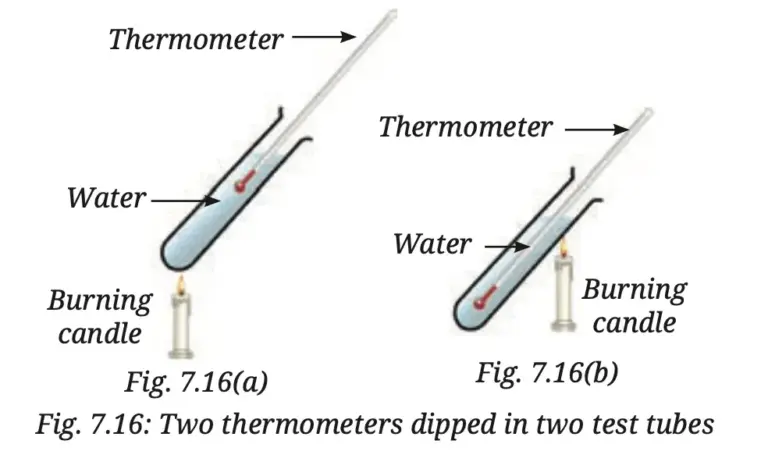
6. Two test tubes with water are heated by a candle flame as shown in Fig. 7.16. Which thermometers (Fig. 7.16a or Fig. 7.16b) will record a higher temperature? Explain.
Answer:
In Fig. 7.16(a), the thermometer is placed at the top of the test tube while the candle flame heats the water at the bottom. When water at the bottom gets heated, it becomes lighter and rises upward. This hot water reaches the top and touches the thermometer, making it record a higher temperature.
In Fig. 7.16(b), the thermometer is placed at the bottom while the candle flame heats the water from the side. The water near the flame becomes hot and rises upward without coming in contact with the thermometer at the bottom. Therefore, the thermometer in this case does not show much temperature rise.
7. Why are hollow bricks used to construct the outer walls of houses in hot regions?
Answer:
Hollow bricks have air trapped inside them, and air is a poor conductor of heat. This reduces the transfer of heat through the walls. As a result, houses made with hollow bricks remain cool in summer and warm in winter.
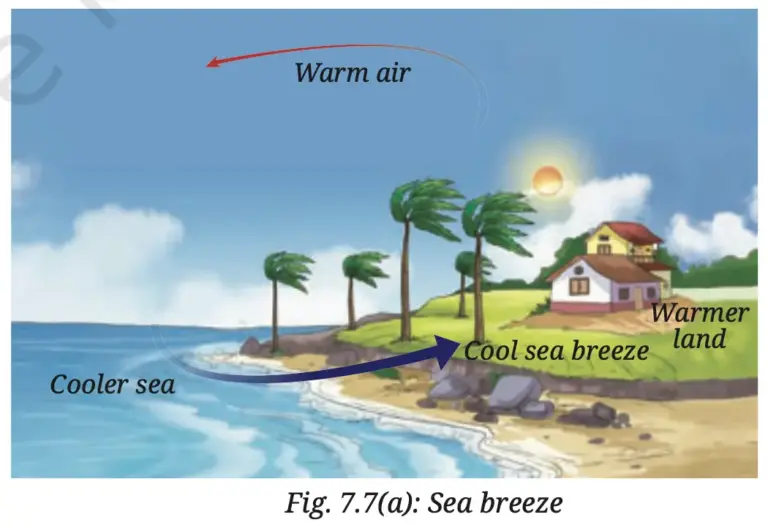
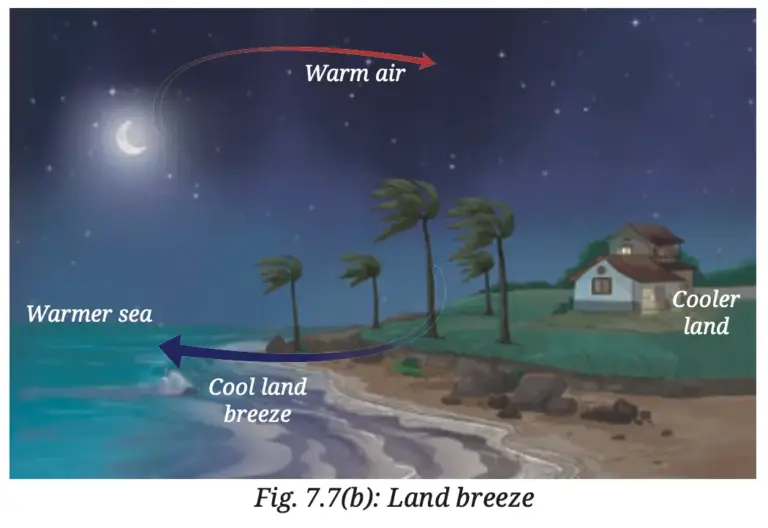
8. Explain how large water bodies prevent extreme temperature in areas around them.
Answer:
During the day, the land heats up faster than the water. The warm air above the land rises, and the cooler air from the sea moves towards the land. This is called a sea breeze, and it helps in reducing the heat during the daytime. At night, the land cools down faster than the sea. The warm air above the sea rises, and the cooler air from the land moves towards the sea. This is called a land breeze. Due to the slow heating and cooling of water, areas near large water bodies do not experience extreme temperatures, and their climate remains moderate.
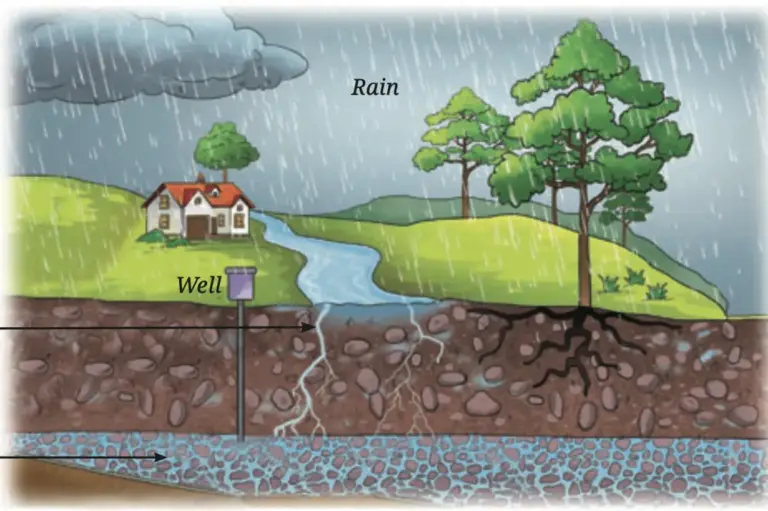
9. Explain how water seeps through the surface of the Earth and gets stored as groundwater.
Answer:
Water from the surface seeps through the soil and rocks by a process called infiltration. This water fills the empty spaces between soil particles and cracks in rocks, where it gets stored as groundwater.
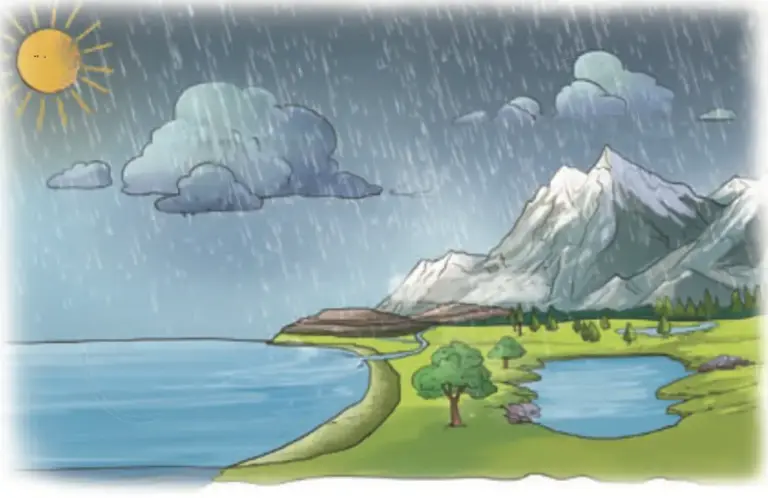
10. The water cycle helps in the redistribution and replenishment of water on the Earth. Justify the statement.
Answer:
The water cycle is the continuous circulation of water on the Earth. Water from oceans, rivers, and lakes evaporates due to the heat of the sun. The water vapour rises, cools, and condenses to form clouds. These clouds bring rain, snow, or hail through precipitation. The rainwater seeps into the soil to recharge groundwater and also flows back into rivers, lakes, and oceans. In this way, the water cycle helps in the redistribution and replenishment of water on the Earth.
Chapter 7: Heat Transfer In Nature explains how heat moves from one place to another through conduction, convection, and radiation. It also helps students understand how heat transfer occurs in our daily life and in nature. The NCERT solutions are written in easy language so that students can prepare well for school exams and strengthen their concepts.
On schoollearners.in/, you will find:
- Complete NCERT Solutions for Chapter 7
- Easy-to-understand answers
- Exam-oriented explanations
- Free study material for Class 7 Science
If you want reliable and easy NCERT solutions, visit schoollearners.in/ today and make your learning faster and more effective. Bookmark our website for the latest Class 7 Science notes, question answers, and study resources.