Class 8 Maths Ganita Prakash Chapter 5 Number Play NCERT Solutions Looking for the Class 8 Maths Ganita Prakash Chapter 5 Number Play NCERT Solutions? At School Learners, we provide accurate, easy-to-understand, and step-by-step NCERT solutions to help students prepare for exams with confidence.
Textbook Page 113
Q. Take any 4 consecutive numbers. For example, 3, 4, 5, and 6. Place ‘+’ and ‘–’ signs in between the numbers. How many different possibilities exist? Write all of them.
Eight such expressions are possible. You can use the diagram below to systematically list all the possibilities.
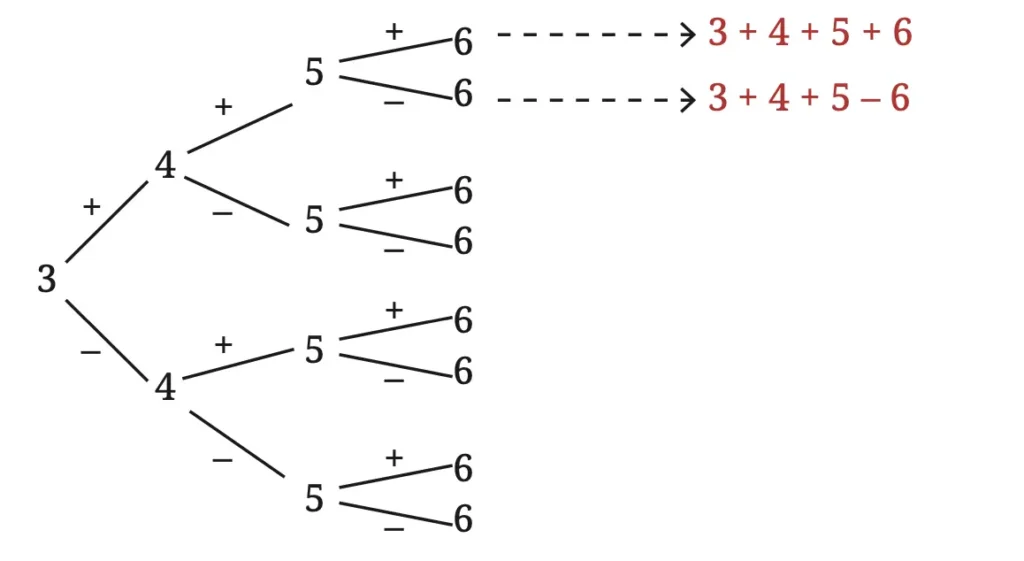
Evaluate each expression and write the result next to it. Do you notice anything interesting?
Solution:
(i) 3 + 4 + 5 + 6 = 18
(ii) 3 + 4 + 5 − 6 = 6
(iii) 3 + 4 − 5 + 6 = 8
(iv) 3 + 4 − 5 − 6 = −4
(v) 3 − 4 + 5 + 6 = 10
(vi) 3 − 4 + 5 − 6 = −2
(vii) 3 − 4 − 5 + 6 = 0
(viii) 3 − 4 − 5 − 6 = −12
Observation: All results are even numbers.
Q. Now, take four other consecutive numbers. Place the ‘+’ and ‘–’ signs as you have done before. Find out the results of each expression. What do you observe?
Solution:
Let’s pick 7, 8, 9, 10.
(i) 7 + 8 + 9 + 10 = 34
(ii) 7 + 8 + 9 − 10 = 14
(iii) 7 + 8 − 9 + 10 = 16
(iv) 7 + 8 − 9 − 10 = −4
(v) 7 − 8 + 9 + 10 = 18
(vi) 7 − 8 + 9 − 10 = −2
(vii) 7 − 8 − 9 + 10 = 0
(viii) 7 − 8 − 9 − 10 = −2
Observation: Once again, all results are even numbers.
Q. Repeat this for one more set of 4 consecutive numbers. Share your findings.
Solution:
Let’s pick 12, 13, 14, 15.
(i) 12 + 13 + 14 + 15 = 54
(ii) 12 + 13 + 14 − 15 = 24
(iii) 12 + 13 − 14 + 15 = 26
(iv) 12 + 13 − 14 − 15 = −4
(v) 12 − 13 + 14 + 15 = 28
(vi) 12 − 13 + 14 − 15 = −2
(vii) 12 − 13 − 14 + 15 = 0
(viii) 12 − 13 − 14 − 15 = −30
Findings: No matter which set of four consecutive numbers you choose, when you insert + or – signs between them in all possible ways, the results are always even numbers.
Textbook Page 114
Q. Replace any negative sign in the expression a + b – c – d with a positive sign and find the difference between the two numbers.
Solution:
Given expression: a + b – c – d
Replacing -c by c, we get: a + b + c – d
Differenec: a + b – c – d – (a + b + c – d)
= a + b – c – d – a – b – c + d
= – 2c.
Q. What do you conclude from this observation?
Solution:
The difference between the two numbers is even. So either both are even or both are odd.
Textbook Page 115
Q. We know how to identify even numbers. Without computing them, find out which of the following arithmetic expressions are even.

Solution:
(i) 43 + 37
Odd + Odd = Even
(ii) 672 – 348
Even – Even = Even
(iii) 4 × 347 × 3
4 is even, and even × anything = Even
(iv) 708 – 477
Even – Odd = Odd
(v) 809 + 214
Odd + Even = Odd
(vi) 119 × 303
Odd × Odd = Odd
(vii) 543 – 479
Odd – Odd = Even
(viii) 513³
Odd³ = Odd
Q. Using our understanding of how parity behaves under different operations, identify which of the following algebraic expressions give an even number for any integer values for the letter-numbers.

Solution:
(i) 2a + 2b
2a → Multiple of 2 → Even
2b → Multiple of 2 → Even
Even + Even = Even
(ii) 3g + 5h
Odd · g + Odd · h. This can be even or odd depending on g and h. (not always even)
(iii) 4m + 2n
Both terms are multiples of 2 → Even + Even = Even.
(iv) 2u − 4v
Both terms multiples of 2 → Even – Even = Even.
(v) 13k − 5k
Simplifies to 8k, which is a multiple of 2 → Even.
(vi) 6m − 3n
First term even, second term odd multiple. Can be even or odd depending on n.
(vii) x2 + 2
If x is even → x2 = even → Even + 2 = Even.
If x is odd → x2 = odd → Odd + 2 = Odd.
Not always even.
(viii) b2 + 1
If b is even → b2 = even → Even + 1 = Odd.
If b is odd → b2 = odd → Odd + 1 = Even.
Sometimes even, sometimes odd.
(ix) 4k × 3j
4k is a multiple of 2 → even
Even × anything → Always Even.
Textbook Page 116
Q. Write a few algebraic expressions which always give an even number.
Solution:
Examples of such expressions:
(i) 2n → Multiple of 2 → Even.
(ii) 2n + 6
2n → Multiple of 2 → Even and 6 → Even
Even + Even = Even.
(iii) 4x − 10
4x → Multiple of 2 and 10 → Even
Even – Even = Even.
(iv) 8y × 3z
8y → Multiple of 2 → Even
Even × any number = Even.
(v) 2a + 2b + 2c → Sum of even terms → Even.
(vi) 6m2 → m2 is an integer, multiplied by 6 (even) → Even.
(vii) 2(p2 + q2) → Factor 2 ensures the result is always even.
Figure it Out – Page 122
1. The sum of four consecutive numbers is 34. What are these numbers?
Solution:
Let four consecutive numbers be x, (x + 1), (x + 2) and (x + 3).
x + (x + 1) + (x + 2) + (x + 3) = 34
x + x + 1 + x + 2 + x + 3 = 34
4x + 6 = 34
4x = 34 – 6
4x = 28
x = 28/4 = 7.
So, x = 7.
(x + 1) = 7 + 1 = 8.
(x + 2) = 7 + 2 = 9.
(x + 3) = 7 + 3 = 10.
Therefore, the given four consecutive numbers are 7, 8, 9, and 10.
2. Suppose p is the greatest of five consecutive numbers. Describe the other four numbers in terms of p.
Solution:
If p is the greatest of five consecutive numbers, then the other four numbers are (p – 1), (p – 2), (p – 3), and (p – 4).
∴ p > (p -1) > (p – 2) > (p – 3) > (p – 4).
3. For each statement below, determine whether it is always true, sometimes true, or never true. Explain your answer. Mention examples and non-examples as appropriate. Justify your claim using algebra.
(i) The sum of two even numbers is a multiple of 3.
Solution:
Two even numbers = 2a and 2b.
Their sum = 2a + 2b = 2(a + b), which is even but not necessarily a multiple of 3.
Example: 2 + 4 = 6 (multiple of 3).
2 + 8 = 10 (not a multiple of 3).
Conclusion: Sometimes true.
(ii) If a number is not divisible by 18, then it is also not divisible by 9.
Solution:
Since 18 = 2 × 9
If a number is divisible by 18, it is also divisible by 9.
But the reverse is not true. A number can be divisible by 9 but not by 18.
Example: 45 is divisible by 9 but not by 18.
40 is neither divisible by 9 nor by 18.
Conclusion: Sometimes true.
(iii) If two numbers are not divisible by 6, then their sum is not divisible by 6.
Solution:
Two numbers not divisible by 6 = 1 and 5.
Sum: 1 + 5 = 6, which is divisible by 6
Conclusion: Sometimes true.
(iv) The sum of a multiple of 6 and a multiple of 9 is a multiple of 3.
Solution:
Multiple of 6 = 6a
Multiple of 9 = 9b
Sum: 6a + 9b = 3(2a + 3b) → clearly divisible by 3.
Example:
6 + 9 = 15 → divisible by 3.
12 + 18 = 30 → divisible by 3.
Conclusion: Always true.
(v) The sum of a multiple of 6 and a multiple of 3 is a multiple of 9.
Solution:
Multiple of 6 = 6a
Multiple of 3 = 3b
Sum: 6a + 3b = 3(2a + b).
This is a multiple of 3, but not necessarily a multiple of 9
Example:
6 + 3 = 9 (multiple of 9)
12 + 3 = 15 (not a multiple of 9)
Conclusion: Sometimes true.
4. Find a few numbers that leave a remainder of 2 when divided by 3 and a remainder of 2 when divided by 4. Write an algebraic expression to describe all such numbers.
Solution:
Numbers that leave a remainder 2 when divided by 3 = 3a + 2
Numbers that leave a remainder 2 when divided by 4 = 4b + 2
Numbers that leave a remainder of 2 when divided by 3 and a remainder of 2 when divided by 4 =
= (Multiple of both 3 and 4) + 2
L.C.M of 3 and 4 = 12
So, the expression to describe all such numbers = 12c + 2.
Examples:
(i) 12 × 1 + 2 = 12 + 2 = 14.
(ii) 12 × 2 + 2 = 24 + 2 = 26.
(iii) 12 × 3 + 2 = 36 + 2 = 38.
5. “I hold some pebbles, not too many, When I group them in 3’s, one stays with me. Try pairing them up — it simply won’t do, A stubborn odd pebble remains in my view. Group them by 5, yet one’s still around,
But grouping by seven, perfection is found. More than one hundred would be far too bold, Can you tell me the number of pebbles I hold?”

Solution:
Grouped in 3’s leaves 1.
Pairing (2’s) leaves 1.
Grouped by 5 leaves 1.
Grouped by 7 is perfect.
Number ≤ 100.
L.C.M of 2, 3, and 5 = 30.
So, the numbers divisible by 2, 3, and 5 with remainder 1 = 30k + 1.
For k = 1: 30 × 1 + 1 = 31 (not divisible by 7).
For k = 2: 30 × 2 + 1 = 60 + 1 = 61 (not divisible by 7).
For k = 3: 30 × 3 + 1 = 90 + 1 = 91 (divisible by 7)
So, the peebles number is 91.
6. Tathagat has written several numbers that leave a remainder of 2 when divided by 6. He claims, “If you add any three such numbers, the sum will always be a multiple of 6.” Is Tathagat’s claim true?
Solution:
A number that leaves a remainder of 2 when divided by 6 = 6k + 2.
Three such numbers are: (6a + 2), (6b + 2), (6c + 2).
Sum: (6a + 2) + (6b + 2) + (6c + 2)
= 6a + 6b + 6c + 2 + 2 + 2
= 6a + 6b + 6c + 6
= 6(a + b + c + 1).
This sum is divisible by 6.
So, Tathagat’s claim is true.
Example:
Take 20, 26, 32 → sum = 78 → divisible by 6.
Take 2, 8, 14 → sum = 24 → divisible by 6.
7. When divided by 7, the number 661 leaves a remainder of 3, and 4779 leaves a remainder of 5. Without calculating, can you say what remainders the following expressions will leave when divided by 7? Show the solution both algebraically and visually.
(i) 4779 + 661 (ii) 4779 – 661
Solution:
(i) 4779 + 661
= Remainder 5 + Remainder 3
= Remainder 8
8 divided by 7 → remainder 1.
(ii) 4779 – 661
= Remainder 5 – Remainder 3
= Remainder 2
8. Find a number that leaves a remainder of 2 when divided by 3, a remainder of 3 when divided by 4, and a remainder of 4 when divided by 5. What is the smallest such number? Can you give a simple explanation of why it is the smallest?
Solution:
A number that leaves a remainder of 2 when divided by 3 = 3k + 2
A number that leaves a remainder of 3 when divided by 4 = 4k + 3
A number that leaves a remainder of 4 when divided by 5 = 5k + 4
L.C.M of 3, 4, and 5 = 60
All the numbers are the same, so 4k + 3 = 3k + 2
4x – 3x = 2 – 3
x = -1
Each remainder is 1 less than the divisor.
Hence, the number is 1 less than the L.C.M = (60 – 1) = 59.
So, 59 is the smallest number that satisfies all the given conditions.
Figure It Out – Page 126
1. Find, without dividing, whether the following numbers are divisible by 9.
(i) 123
(ii) 405
(iii) 8888
(iv) 93547
(v) 358095
Solution:
(i) 123
Sum of digits = 1 + 2 + 3 = 6.
Since 6 is not divisible by 9.
Therefore, 123 is not divisible by 9.
(ii) 405
Sum of digits = 4 + 0 + 5 = 9.
Since 9 is divisible by 9.
Therefore, 405 is divisible by 9.
(iii) 8888
Sum of digits = 8 + 8 + 8 + 8 = 32.
Since 32 is not divisible by 9.
Therefore, 8888 is not divisible by 9.
(iv) 93547
Sum of digits = 9 + 3 + 5 + 4 + 7 = 28.
Since 28 is not divisible by 9.
Therefore, 93547 is not divisible by 9.
(v) 358095
Sum of digits = 3 + 5 + 8 + 0 + 9 + 5 = 30.
Since 30 is not divisible by 9.
Therefore, 358095 is not divisible by 9.
2. Find the smallest multiple of 9 with no odd digits.
Solution:
A number is divisible by 9 if the sum of its digits is a multiple of 9.
We can use only even digits (0, 2, 4, 6, 8).
For 1 or 2 digits, the sum can’t be 9 or 18.
For 3 digits, the sum 8 + 8 + 2 = 18.
Therefore, the smallest multiple of 9 with no odd digits is 288.
3. Find the multiple of 9 that is closest to the number 6000.
Solution:
6000 ÷ 9 = 666.66…
Now,
666 × 9 = 5994
667 × 9 = 6003
Both are multiples of 9, but 6003 is closer to 6000.
So, 6003 is the multiple of 9 that is closest to the number 6000.
4. How many multiples of 9 are there between the numbers 4300 and 4400?
Solution:
4400 − 4300 = 100
Now,
100 = (9 × 11) + 1
This means that there are 11 complete multiples of 9 in a difference of 100.
Therefore, between 4300 and 4400, there are 11 multiples of 9.
Figure It Out – Page 131
1. The digital root of an 8-digit number is 5. What will be the digital root of 10 more than that number?
Solution:
Let the 8-digit number be N.
Digital root of N is 5.
Digital root of N + 10 = 5 + 10 = 15.
Digital root of 15 = 1 + 5 = 6.
∴ The digital root of 10 more than that number will be 6.
2. Write any number. Generate a sequence of numbers by repeatedly adding 11. What would be the digital roots of this sequence of numbers? Share your observations.
Solution:
Let us consider the number 23.
Adding 11 repeatedly to form a sequence, we get:
23, 34, 45, 56, 67, 78, 89, 100, 111, 122, 133, 144 ……
Observation: The digit sum starts repeating after every 9 steps.
3. What will be the digital root of the number 9a + 36b + 13?
Solution:
We know that the digital root of a multiple of 9 is 9.
So,
Digital root of 9a = 9.
Digital root of 36b = 9.
Digital root of 13 = 1 + 3 = 4.
Now,
Digital root of 9a + 36b + 13 = 9 + 9 + 4 = 22.
Then, 2 + 2 = 4.
∴ Digital root = 4
4. Make conjectures by examining if there are any patterns or relations between
(i) the parity of a number and its digital root.
(ii) the digital root of a number and the remainder obtained when the number is divided by 3 or 9.
Solution
Figure It Out – Page 132
1. If 31z5 is a multiple of 9, where z is a digit, what is the value of z? Explain why there are two answers to this problem.
Solution:
A number is divisible by 9 if the sum of its digits is a multiple of 9.
Sum of digits = 3 + 1 + z + 5 = 9 + z.
For divisibility by 9, 9 + z must be a multiple of 9.
If z = 0,
9 + z = 9 + 0 = 9. (multiple of 9)
If z = 9,
9 + z = 9 + 9 = 18. (multiple of 9)
Hence, z = 0 or 9.
There are two answers because both 3105 and 3195 make the sum of digits a multiple of 9.
2. “I take a number that leaves a remainder of 8 when divided by 12. I take another number which is 4 short of a multiple of 12. Their sum will always be a multiple of 8”, claims Snehal. Examine his claim and justify your conclusion.
Solution:
First number = 12a + 8
Second number = 12b – 4
Sum = 12a + 8 + 12b – 4 = 12(a + b) + 4.
Putting a = 2 and b = 4
12(a + b) + 4 = 12 (2 + 4) + 4 = 12(6) + 4 = 72 + 4 = 76. (not multiple of 8).
Putting a = 3 and b = 4
12(a + b) + 4 = 12(3 + 4) + 4 = 12(7) + 4 = 84 + 4 = 88. (multiple of 8).
Hence, the sum is not always a multiple of 8.
Therefore, Snehal’s claim is incorrect.
3. When is the sum of two multiples of 3, a multiple of 6 and when is it not? Explain the different possible cases, and generalise the pattern.
Solution:
Two multiples of 3 = 3a and 3b.
Sum = 3a + 3b = 3(a + b).
For 3(a + b) to be a multiple of 6, it must be divisible by both 2 and 3.
We already know it’s divisible by 3.
So, the sum will be a multiple of 6 if it is even.
If a + b is even, the sum is divisible by 6.
If a + b is odd, the sum is not divisible by 6.
Hence, the sum of two multiples of 3 is a multiple of 6 when both are even multiples of 3 or both are odd multiples of 3.
4. Sreelatha says, “I have a number that is divisible by 9. If I reverse its digits, it will still be divisible by 9”.
(i) Examine if her conjecture is true for any multiple of 9.
(ii) Are any other digit shuffles possible such that the number formed is still a multiple of 9?
Solution:
(i) Yes, Sreelatha’s conjecture is true.
If a number is divisible by 9, then its reverse will also be divisible by 9 because the sum of its digits remains the same.
(ii) Yes, other digit shuffles are also possible.
Any rearrangement of the digits of a number divisible by 9 will again be divisible by 9, as the sum of the digits does not change.
5. If 48a23b is a multiple of 18, list all possible pairs of values for a and b.
Solution:
For the number 48a23b to be a multiple of 18, it must be divisible by both 9 and 2.
Sum of digits = 4 + 8 + a + 2 + 3 + b
= 17 + a + b.
For divisibility by 9: a + b = 1.
For divisibility by 2: b must be even.
Hence, the only possible pair is (a, b) = (1, 0).
6. If 3p7q8 is divisible by 44, list all possible pairs of values for p and q.
Solution:
Since 3p7q8 is divisible by 44, it must be divisible by 4 and 11.
Divisibility by 4:
A number is divisible by 4 if the last two digits form a number divisible by 4.
Here, last two digits = q8.
Our solutions are designed according to the latest NCERT syllabus and explain every concept in simple language, making learning easier for every student. Whether you’re completing homework, revising for exams, or strengthening your concepts, our detailed answers will help you score better.
For the complete Class 8 Maths Ganita Prakash Chapter 5 Number Play NCERT Solutions, visit https://schoollearners.in/ and explore high-quality study materials, NCERT solutions, notes, and important questions for all classes.
Why Choose School Learners?
- Step-by-step NCERT Solutions
- Easy-to-understand explanations
- Updated according to the latest syllabus
- Free study resources for students
- Regularly updated educational content
Visit https://schoollearners.in/ today and make your exam preparation smarter with reliable and student-friendly learning resources.