I’m Up and Down, and Round and Round Class 9 Maths Ganita Manjari Part 1 Chapter 5 NCERT Solutions Looking for the I’m Up and Down, and Round and Round Class 9 Maths Ganita Manjari Part 1 Chapter 5 NCERT Solutions? You’ve come to the right place. This chapter explains important mathematical concepts with easy-to-understand examples and step-by-step solutions, helping students strengthen their problem-solving skills and prepare for school exams.
Exercise Set 5.1 (Page 98)
1. Draw ΔABC with AB = 5 cm, ∠A = 70°, and ∠B = 60°. Draw the circumcircle of ΔABC. Is the centre inside or outside the triangle?
Solution:
Given: AB = 5 cm, ∠A = 70°, ∠B = 60°
To Construct: △ABC and its circumcircle.
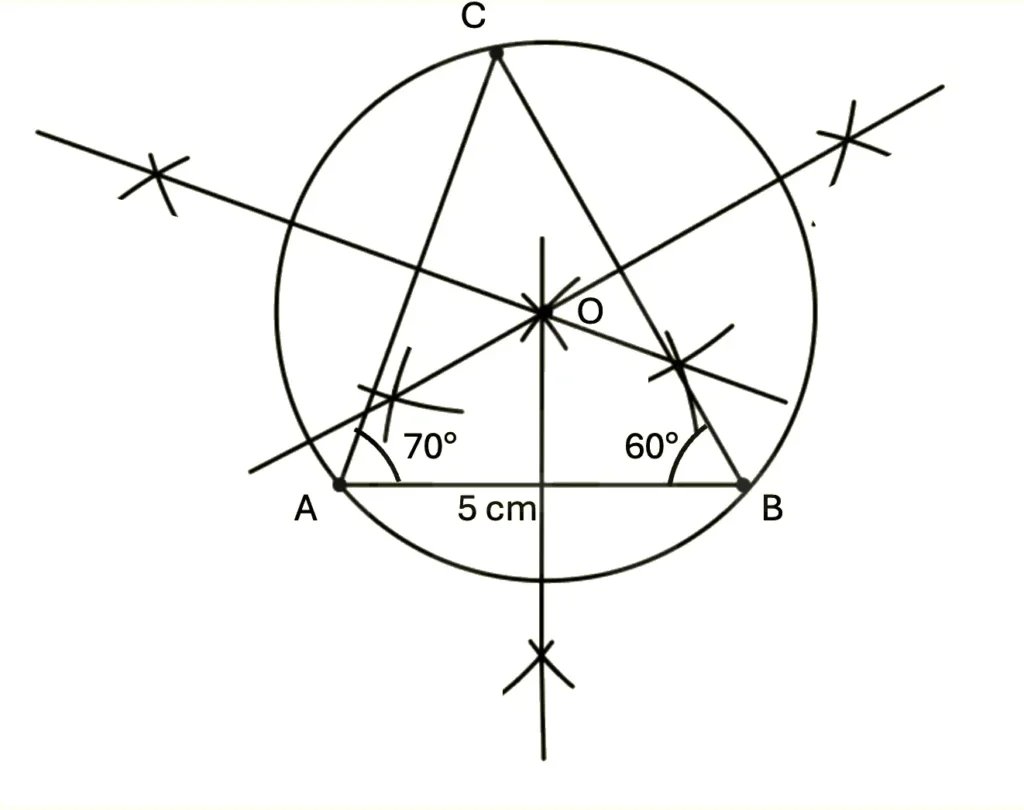
Steps of Construction:
(i) Draw a line segment AB = 5 cm.
(ii) Construct an angle of 70° at point A and an angle of 60° at point B.
(iii) Let the arms of these two angles intersect at point C.
(iv) Join AC and BC to obtain △ABC.
(v) Draw the perpendicular bisectors of sides AB, BC, and AC.
(vi) Let the perpendicular bisectors intersect at O. Then O is the circumcentre of △ABC.
(vii) With centre O and radius OA, draw a circle passing through A, B, and C. This is the circumcircle of △ABC.
Now,
∠C = 180° − (70° + 60°) = 50°
Since all the angles of △ABC are less than , the triangle is acute-angled.
Therefore, the circumcentre of an acute-angled triangle lies inside the triangle.
2. Draw ΔABC with AB = 5 cm, ∠A = 100°, and AC = 4 cm. Draw the circumcircle of ΔABC. Is the centre inside or outside the triangle?
Solution:
Given: AB = 5 cm, ∠A = 100°, AC = 4 cm
To Construct: △ABC and its circumcircle.
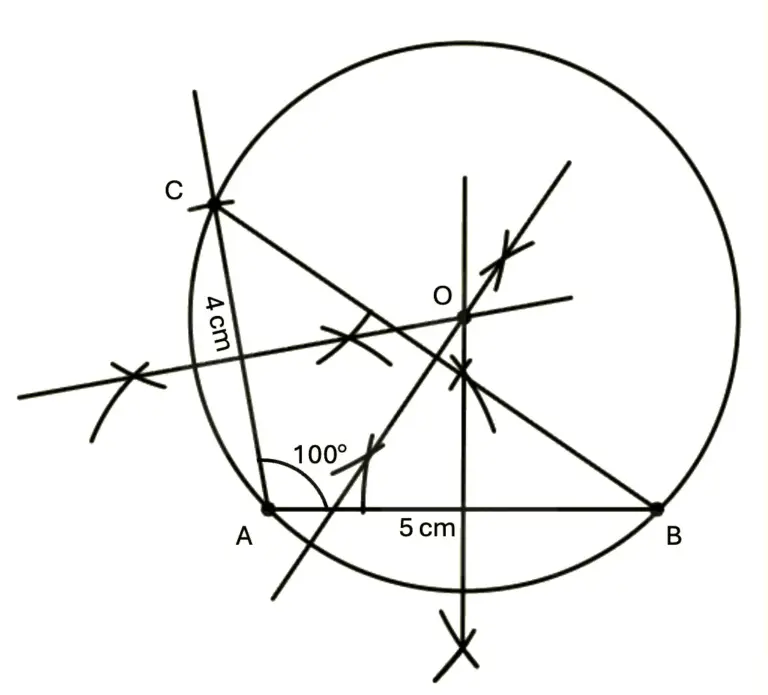
Steps of Construction:
(i) Draw a line segment AB = 5 cm.
(ii) Construct an angle of 100° at point A.
(iii) With A as centre and radius 4 cm, draw an arc cutting an arm of ∠A at C.
(iii) Join BC to obtain △ABC.
(iv) Draw the perpendicular bisector of AB, BC, and AC.
(v) Let the perpendicular bisectors intersect at O. Then O is the circumcentre of △ABC.
(vi) With centre O and radius OA, draw a circle passing through A, B, and C. This is the circumcircle of △ABC.
Since
∠A = 100° > 90°
Therefore, △ABC is an obtuse-angled triangle.
Therefore, the circumcentre of an obtuse-angled triangle lies outside the triangle.
3. Draw ΔABC, with AB = 6 cm, BC = 7 cm and CA = 7 cm. Draw the circumcircle of ΔABC. Let the circumcentre be O. Measure OA, OB, OC.
Solution:
Given: AB = 6 cm, BC = 7 cm, CA = 7 cm
To Construct: △ABC, its circumcircle and circumcentre O.

Steps of Construction:
(i) Draw a line segment AB = 6 cm.
(ii) With A as centre and radius 7 cm, draw an arc.
(iii) With B as centre and radius 7 cm, draw another arc intersecting the first arc at C.
(iv) Join AC and BC to obtain △ABC.
(v) Draw the perpendicular bisector of AB, BC, and CA.
(vi) Let the perpendicular bisectors intersect at O. Then O is the circumcentre of △ABC.
(vii) With centre O and radius OA, draw a circle passing through A. The circle will also pass through B and C. This is the circumcircle of △ABC.
Measuring the lengths OA, OB, and OC, we found that
OA = OB = OC ≈ 4 cm
4. What is the least possible radius of a circle through two points A and B?
Solution:
For any two points A and B, infinitely many circles can pass through both points. The radius of these circles depends on the position of the centre.
The least possible radius occurs when the centre of the circle is the midpoint of AB. In this case, AB becomes the diameter of the circle.
Therefore, the least possible radius is .
Hence, the least possible radius of a circle through two points A and B is half the length of AB.
Exercise Set 5.2 (Page 100)
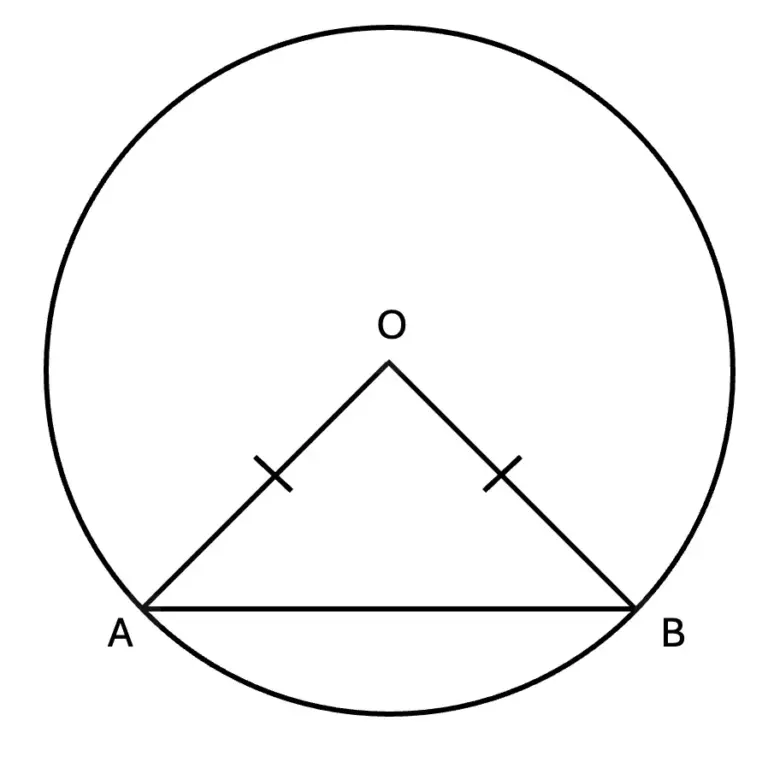
1. Show that the triangle formed by a chord and the centre of the circle is isosceles.
Solution:
Let AB be a chord of a circle with centre O. Join OA and OB.
Since OA and OB are radii of the same circle,
OA = OB.
Therefore, △OAB has two equal sides. Hence, △OAB is an isosceles triangle.
Thus, the triangle formed by a chord and the centre of a circle is isosceles.
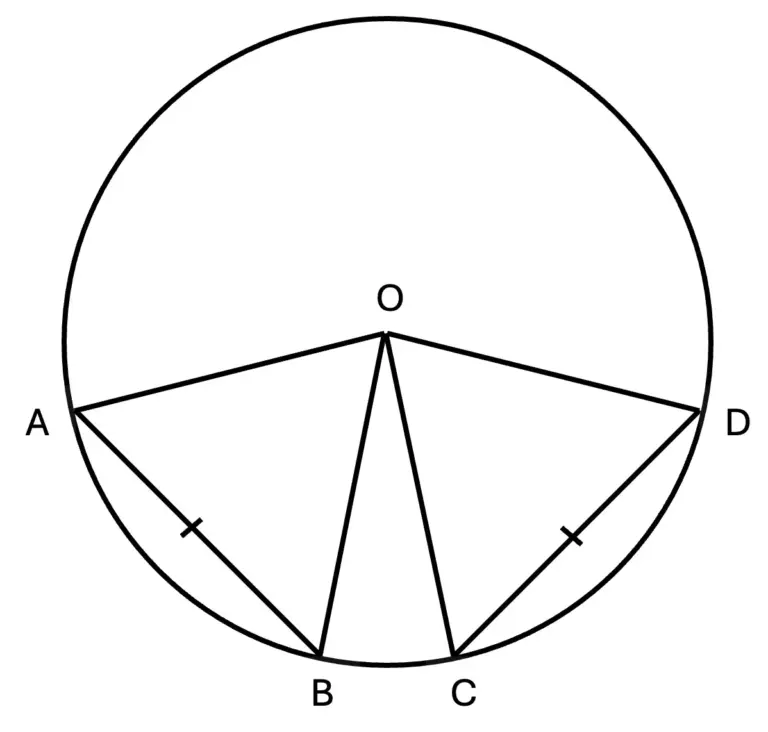
2. Show that if two such isosceles triangles (occurring in the previous question) have equal base length, they are congruent to each other.
Solution:
Let the two isosceles triangles be △OAB and △OCD, where base AB = base CD.
Since OA, OB, OC, and OD are radii of the same circle,
OA = OC and OB = OD
Also, AB = CD (given)
Therefore, by the SSS congruence △OAB ≅△OCD.
Hence, two such isosceles triangles having equal base lengths are congruent.
Exercise Set 5.3 (Page 101)
1. Can you explain why the converse to Theorem 4 is true, i.e., why does the perpendicular from the centre of a circle to a chord of the circle bisect the chord?
(Hint: Use Fig. 5.12. You are told that ∠CMA = ∠CMB = 90°. You need to show that AM = BM.)
Solution:
GIven: A circle with chord AB and centre C. CM ⟂ AB, i.e., ∠CMA = ∠CMB = 90°.
To Prove: CM bisects AB, i.e., AM = BM.
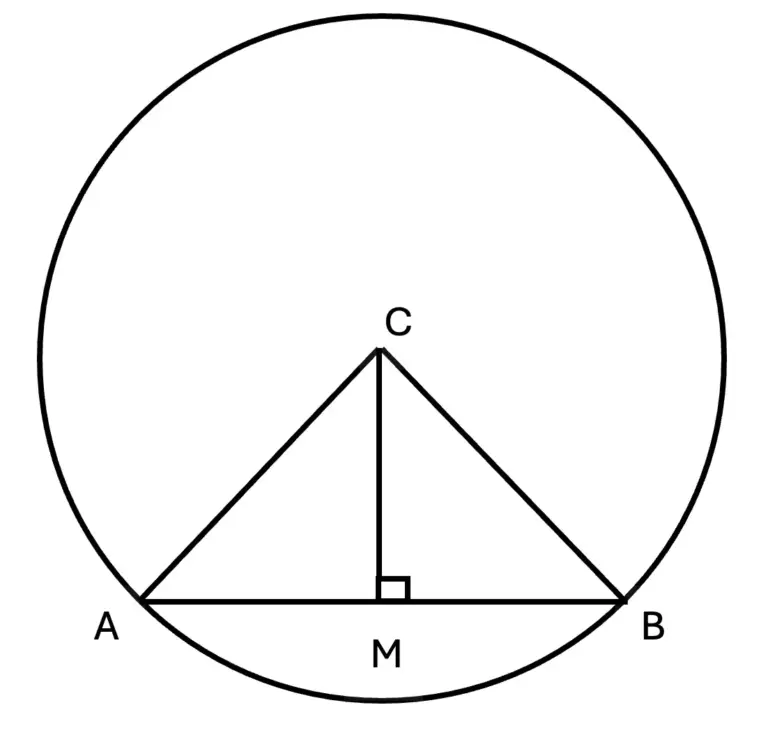
Proof:
In △CMA and△CMB,
CA = CB (radii of the same circle)
CM = CM (common)
∠CMA = ∠CMB = 90° (CM ⟂ AB)
Therefore, by the RHS congruence △CMA ≅△CMB.
Hence, corresponding sides are equal,
AM = BM.
Therefore, the perpendicular from the centre of a circle to a chord bisects the chord.
2. An isosceles triangle ABC is inscribed in a circle, with AB = AC. Show that the altitude from A to BC passes through the centre of the circle.
Solution:
Given: An isosceles triangle ABC inscribed in a circle, with AB = AC.
To Prove: The altitude from A to BC passes through the centre O of the circle.
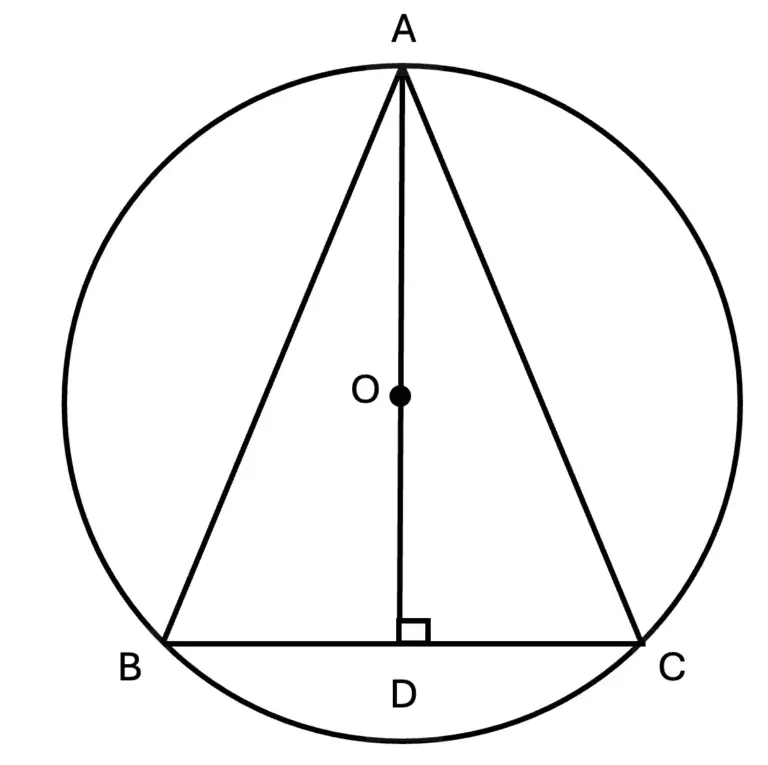
Proof: Let AD be the altitude from A to BC, meeting BC at D.
In △ABD and△ACD,
In triangles ABD and ACD:
AB = AC (given)
AD = AD (common side)
∠ADB = ∠ADC = 90°
By the RHS congruence △ABD ≅△ACD.
Hence, corresponding sides are equal,
BD = DC.
Thus, D is the midpoint of chord BC.
Since AD⊥BC, AD is the perpendicular bisector of the chord BC.
We know that the perpendicular bisector of a chord passes through the centre of the circle.
Therefore, the altitude AD passes through the centre of the circle O.
3. Two parallel chords of lengths 6 cm and 8 cm are on opposite sides of the centre of a circle. If the radius of the circle is 5 cm, find the distance between the midpoints of the chords.
Solution:
Given: AB = 6 cm and CD = 8cm are the two parallel chords on opposite sides of the centre O of the circle.
To find: Distance MN between the midpoints of the chords.
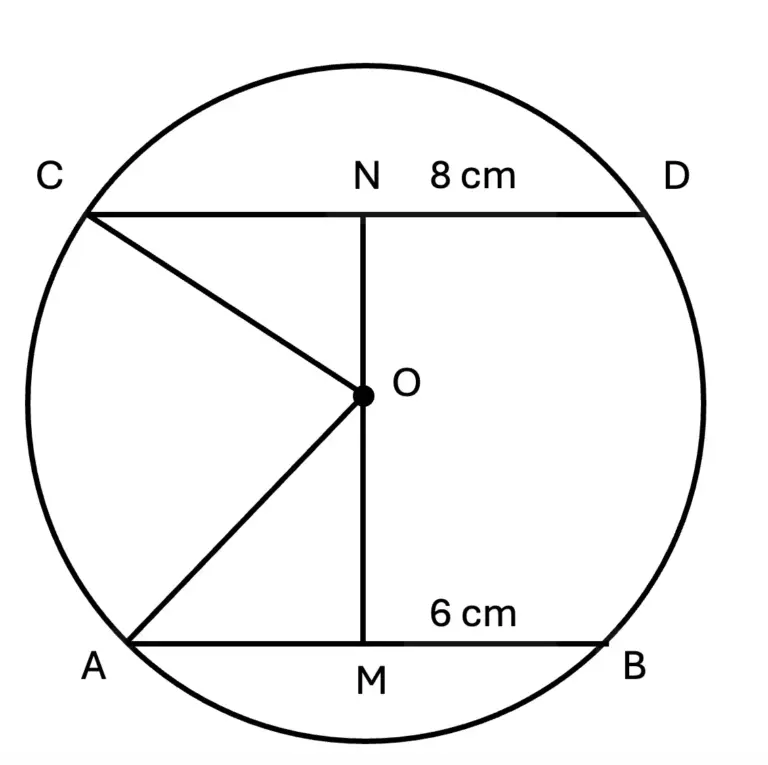
Construction: Let M and N be the midpoints of chords AB and CD, respectively.
Join OA, OC, OM, and ON.
Since the perpendicular from the centre of a circle to a chord bisects the chord,
AM = = = 3 cm
and
CN = = = 4 cm
In △OAM,
By the Baudhayana-Pythagoras theorem,
OA2 = OM2 + AM2
52 = OM2 + 32
25 = OM2 + 9
OM2 = 25 – 9
OM2 = 16
OM = 4 cm.
Similarly, in △OCN,
By the Baudhayana-Pythagoras theorem,
OC2 = ON2 + CN2
52 = ON2 + 42
25 = ON2 + 16
ON2 = 25 – 16
ON = 3 cm.
Since the chords are on opposite sides of the centre,
MN = OM + ON
MN = 4 + 3 = 7 cm.
Hence, the distance between the midpoints of the chords is 7 cm.
Exercise Set 5.4 (Page 104)
1. Use the Baudhāyana–Pythagoras theorem to show why Theorem 6 must be true.
Solution:
Given: AB and FG are two chords of a circle with centre O such that AB = FG. E and H are midpoints of AB and FG. CE ⟂ AB and CH ⟂ FG.
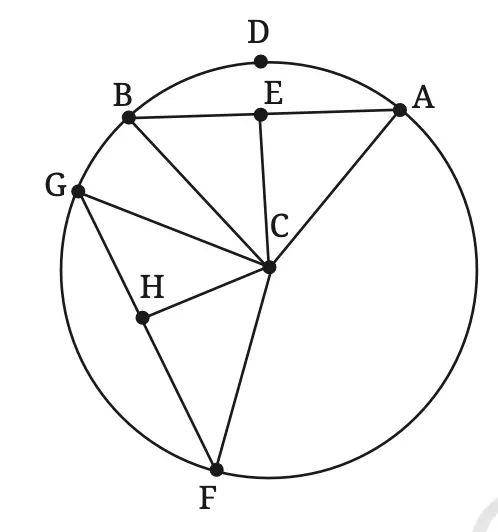
To Prove: CE = CH
Since E is the midpoint of chord AB,
AE = ……… (i)
Similarly, H is the midpoint of chord FG,
FH = ……….. (ii)
Given that AB = FG ……. (iii)
Therefore, from (i), (ii), and (iii),
AE = FH …………. (iv)
Now, in right-angled △CEA,
By the Baudhāyana–Pythagoras theorem,
CA2 = CE2 + AE2
r2 = CE2 + AE2 ……… (∵ CA = r)
AE2 = r2 – CE2 ……….. (v)
Similarly, in right-angled △CHF,
By the Baudhāyana–Pythagoras theorem,
CF2 = CH2 + FH2
r2 = CH2 + FH2 ……… (∵ CF = r)
FH2 = r2 – CH2 ………….. (vi)
From (iv), (v) and (vi),
r2 – CE2 = r2 – CH2
CE2 = CH2
Taking the square root,
CE = CH
Hence, equal chords of a circle are equidistant from the centre.
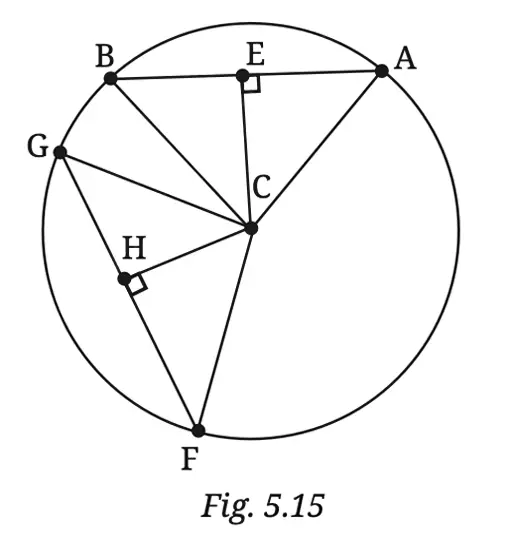
2. Consider Fig. 5.15. If CE is perpendicular to AB, CH is perpendicular to GH, and CE = CH, show that AB = GF.
Solution:
Given: AB and GF are two chords of a circle with centre O. Both chords are equidistant from the centre i.e. CE = CH. CE ⟂ AB and CH ⟂ GH.
To Prove: AB = GF
Since the perpendicular from the centre of a circle to a chord bisects the chord.
Therefore,
AE = BE
or AE = …….. (i)
Also, GH = FH
or GH = …….. (ii)
In △CEA and △CHG,
CA = CG ……… (radii of the same circle)
∠CEA = ∠CHG ………… (each 90°)
CE = CH ………. (given)
Thus by the RHS congruence △CEA ≅ △CHG.
So, AE = GH
= ……… [using (i) and (ii)]
AB = GF
Hence, the chords of a circle which are equidistant from the centre are equal.
3. Solve the previous question using the Baudhāyana–Pythagoras theorem.
Solution:
Given: AB and GF are two chords of a circle with centre O. Both chords are equidistant from the centre i.e. CE = CH. CE ⟂ AB and CH ⟂ GH.
To Prove: AB = GF
Since the perpendicular from the centre of a circle to a chord bisects the chord.
Therefore,
AE = BE
AE =
2AE = AB …….. (i)
Also, GH = FH
GH =
2GH = GF…….. (ii)
Now, in right-angled △CEA,
By the Baudhāyana–Pythagoras theorem,
CA2 = CE2 + AE2
r2 = CE2 + AE2
CE2 = r2 – AE2 ……… (iii)
Similarly, in right-angled △CHG,
By the Baudhāyana–Pythagoras theorem,
CG2 = CH2 + GH2
r2 = CH2 + GH2
CH2 = r2 – GH2 ……… (iv)
CE = CH ………. (v)
From (iii), (iv) and (v),
r2 – AE2 = r2 – GH2
AE2 = GH2
Taking the square root,
AE = GH
Multiplying both sides by 2,
2AE = 2GH
AB = GF ………. [using (i) and (ii)]
Hence, the chords of a circle which are equidistant from the centre are equal.
Exercise Set 5.5 (Page 105)
1. Find the length of the chord of a circle where the radius is 7 cm and the perpendicular distance is 6 cm.
Solution:
Let AB be the chord of a circle with centre C. Let CD⊥AB, where D is the midpoint of AB. CD = 6cm.
Join CA and CB.
Radius of circle, CA = CB = 7 cm.
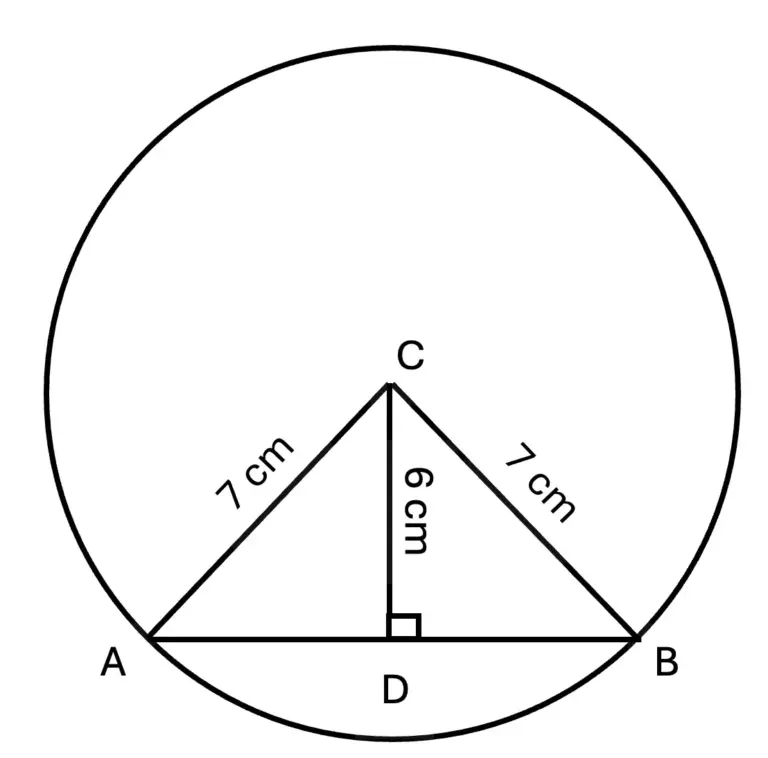
Since the perpendicular from the centre to a chord bisects the chord,
AD = BD
In right-angled △CDB,
By the Baudhāyana–Pythagoras theorem,
CB2 = CD2 + BD2
72 = 62 + BD2
49 = 36 + BD2
BD2 = 49 – 36
BD2 = 13
BD = cm
Therefore,
AB = 2BD
AB = 2cm
Hence, the length of the chord is cm.
2. Explain why the following statement is true: If the perpendicular distance of a chord from the centre is d and the radius is r, then the chord length is .
Solution:
Let AB be the chord, C the centre of the circle, and CD the perpendicular from C to AB.
CD = d and CA = r ……… (given)
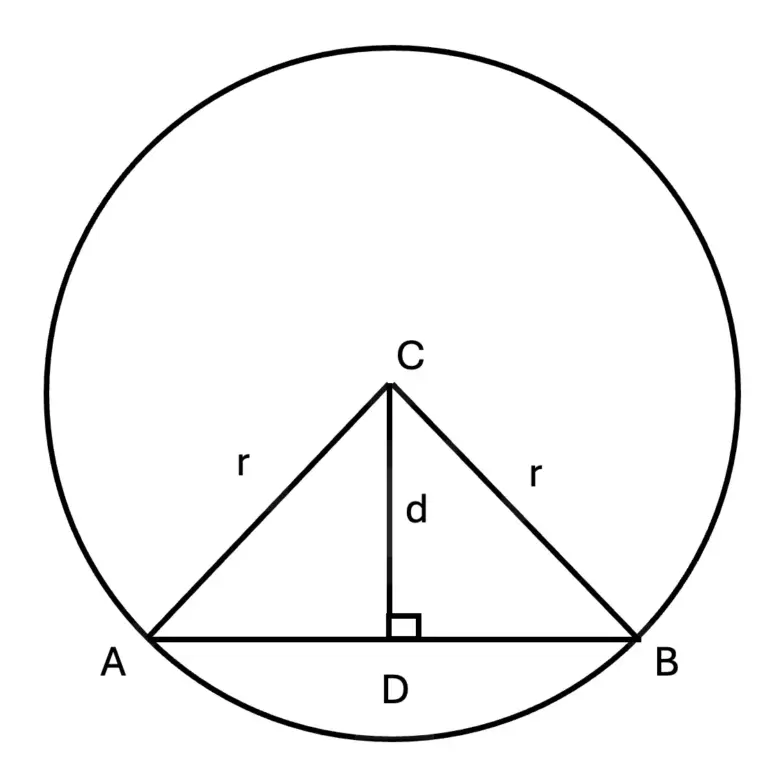
Since the perpendicular from the centre to a chord bisects the chord, D is the midpoint of AB.
Therefore,
AD =
In right-angled △CDA, by the Baudhāyana–Pythagoras theorem,
CA2 = CD2 + AD2
r2 = d2 + AD2
AD2 = r2 – d2
AD =
Hence,
AB = 2AD
AB =
Therefore, the length of the chord is .
3. In a circle, if the distance of chord AB from the centre is twice the distance of another chord CD from the centre, then can we conclude that CD = 2 AB? Give reasons for your answer.
Solution:
We know that, if the perpendicular distance of a chord from the centre is d and the radius is r, then the chord length = .
Let the distance of the chord AB and CD from the centre be 2x and x.
Thus,
AB = =
CD =
Clearly, CD ≠ 2AB.
Hence, knowing only that one chord is at twice the distance from the centre as another is not sufficient to conclude that one chord is twice the length of the other.
Exercise Set 5.6 (Page 110 – 111)
1. In a circle with centre O, the central angle AOB is 60°. If the radius of the circle is 12 cm, what is the length of the chord AB?
Solution:
Given: Radius of the circle = 12 cm
∠AOB = 60°
To Find: Length of chord AB
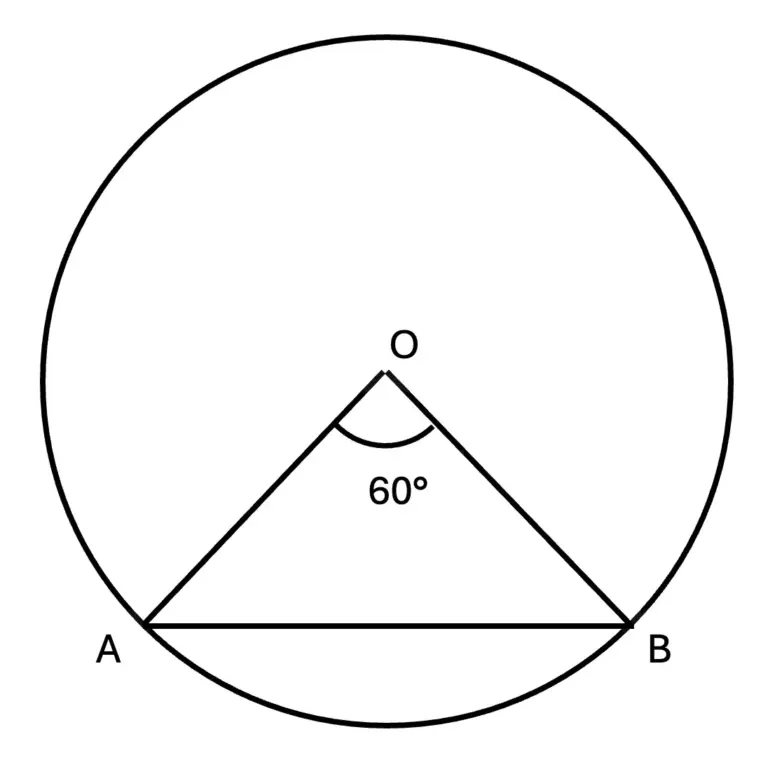
Join OA and OB.
Since OA = OB = 12 cm (radii of the same circle),
△AOB is an isosceles triangle.
∴ ∠OAB = ∠OBA ………. (angles opposite to equal sides of an isosceles triangle are equal)
In △AOB,
∠AOB + ∠OAB + ∠OBA = 180° …………. (sum of angles of a triangle)
60° + ∠OAB + ∠OAB = 180°…………. (∠OAB = ∠OBA)
2∠OAB = 180° – 60°
∠OAB = = 60°
∠OAB = ∠OBA = ∠AOB = 60°
Therefore, △AOB is an equilateral triangle.
So, AB = OA = OB = 12 cm
Hence, the length of the chord AB is 12 cm.
2. Let A and B be two points on a circle with centre O.
(i) Are there points X, Y on the circle, on the same side of AB, such that ∠AXB is different from ∠AYB?
(ii) Is it true that if ∠AXB = ∠AYB, then X and Y lie on the same side of the circle?
(iii) If ∠AXB = ∠AYB, and X and Y do not lie on the circle, does the circle through A, B and X also pass through Y?
Solution:
(i) No. Angles subtended by the same chord of a circle in the same segment are equal.
Therefore, ∠AXB = ∠AYB.
Hence, there cannot be two points X and Y on the same side of AB such that ∠AXB and ∠AYB are different.
(ii) No. If AB is a diameter, then the angle subtended by it at any point on the circle is 90°.
Thus, if X and Y lie on opposite sides of AB,
∠AXB = ∠AYB = 90°.
Therefore, equal angles do not necessarily imply that X and Y lie on the same side of the circle.
(iii) Yes. The points A, B, and X determine a circle.
Since ∠AXB = ∠AYB,
both angles stand on the same chord AB.
By the converse of the theorem “angles in the same segment of a circle are equal”, the points A, B, X, and Y are concyclic.
Therefore, the circle through A, B, and X also passes through Y.
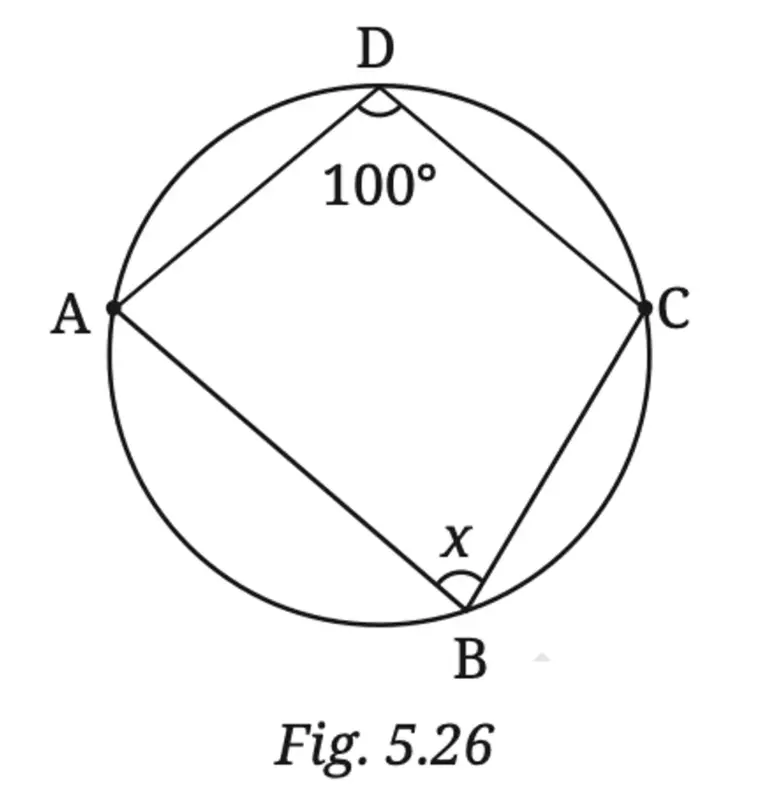
3. Find x in Fig. 5.26.
Solution:
∠ADC = 100°
Therefore, the angle subtended by the arc ABC at the centre, reflex ∠AOC = 2 × 100° = 200°.
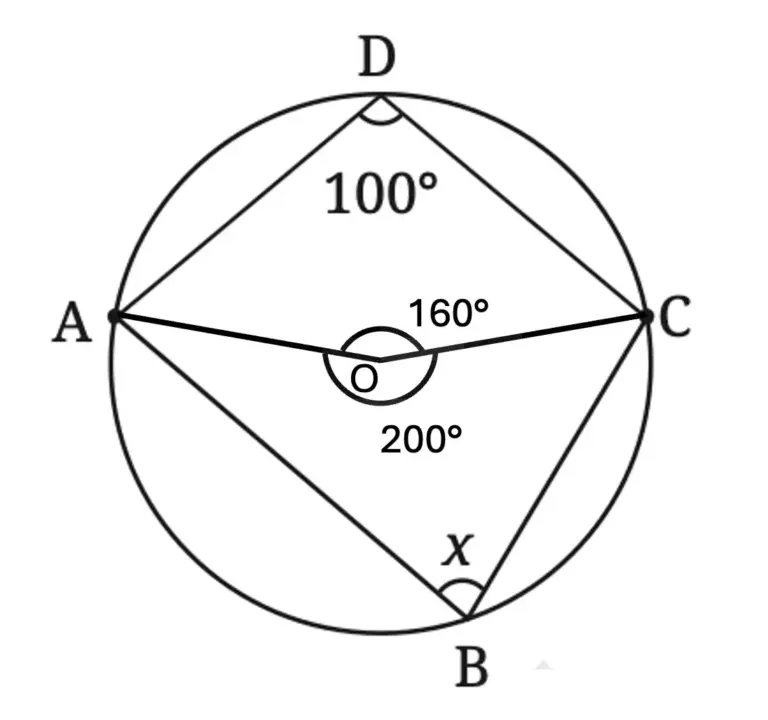
Since, ∠AOC + reflex ∠AOC = 360°
∠AOC + 200° = 360°
∠AOC = 360° – 200° = 160°
Now, ∠AOC is the angle subtended by arc ADC at the centre of the circle.
Since the angle subtended by an arc at the centre is twice the angle subtended by it at any point on the remaining part of the circle,
∴ x = = = 80°.
At School Learners, we provide accurate, simple, and exam-oriented NCERT Solutions prepared according to the latest CBSE curriculum. Every answer is explained in a clear manner so that students can easily understand the concepts instead of just memorizing them.
Whether you’re completing homework, revising for exams, or clearing your doubts, School Learners is your trusted learning partner. Visit https://schoollearners.in/ to access free NCERT Solutions, study notes, MCQs, important questions, sample papers, and other useful learning resources for Class 9 and higher classes.