The Baudhayana-Pythagoras Theorem Class 8 Maths Ganita Prakash Part 2 Chapter 2 NCERT Solutions Looking for the The Baudhayana–Pythagoras Theorem Class 8 Maths Ganita Prakash Part 2 Chapter 2 NCERT Solutions? You are in the right place! This chapter introduces one of the most important theorems in mathematics, which helps students understand the relationship between the sides of a right-angled triangle and solve various geometry problems with ease.
Figure it Out (Page 39)
1. Earlier, we saw a method to create a square with double the area of a given square paper. There is another method to do this in which two identical square papers are cut in the following way.
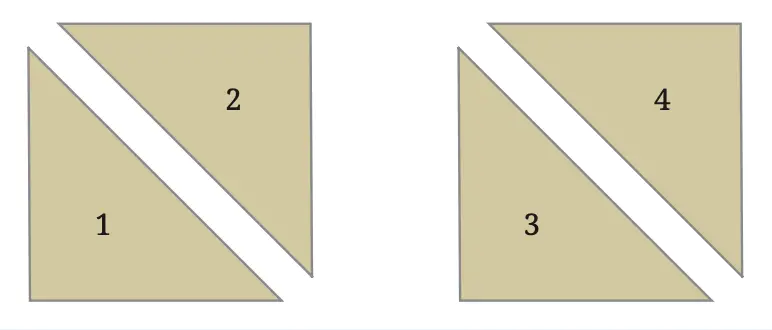
Can you arrange these pieces to create a square with double the area of either square?
Solution:
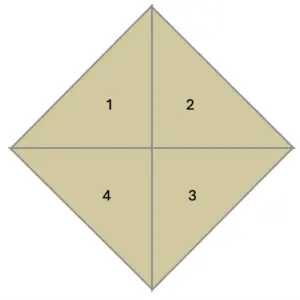
A diagonal divides a square into two equal-area triangles:
△1 = △2 , △3 = △4
Original square = △1 + △2 = △3 + △4
Resultant square = △1 + △2 + △3 + △4
Resultant square = 2 × Original Square
Hence, the given triangles can be arranged to create a square with double the area of either square.
2. The length of the two equal sides of an isosceles right triangle is given. Find the length of the hypotenuse. Find bounds on the length of the hypotenuse such that they have at least one digit after the decimal point.
(i) 3 (ii) 4 (iii) 6 (iv) 8 (v) 9
Solution:
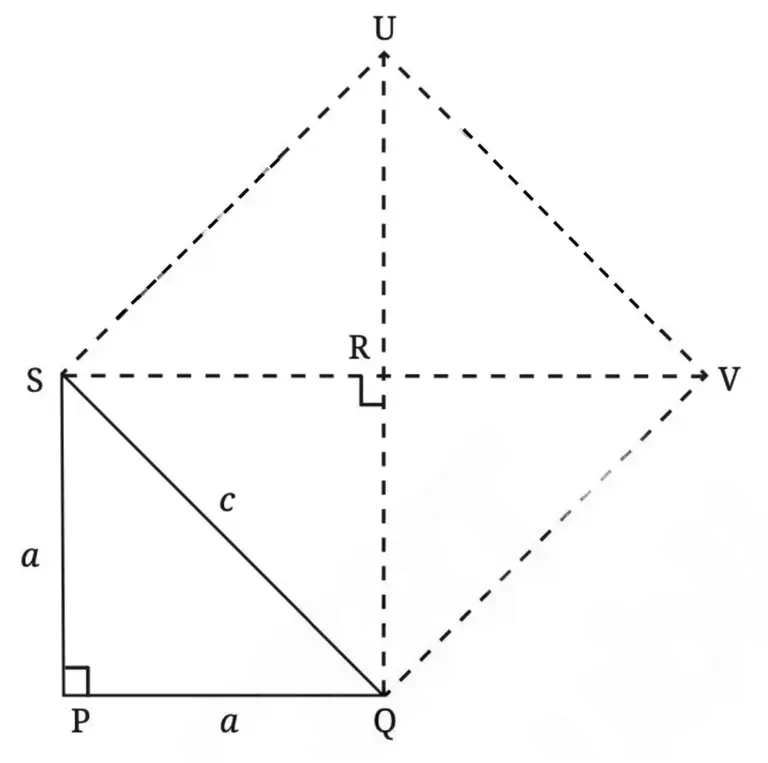
Let a be the length of the equal sides of an isosceles triangle and c the length of the hypotenuse.
Area of SQVU = 2 × Area of PQRS
So, c2 = 2a2.
c = =
(i) a = 3
Using the formula, we get
c = =
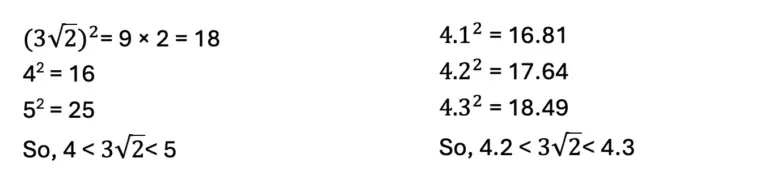
(ii) a = 4
Using the formula, we get
c = =
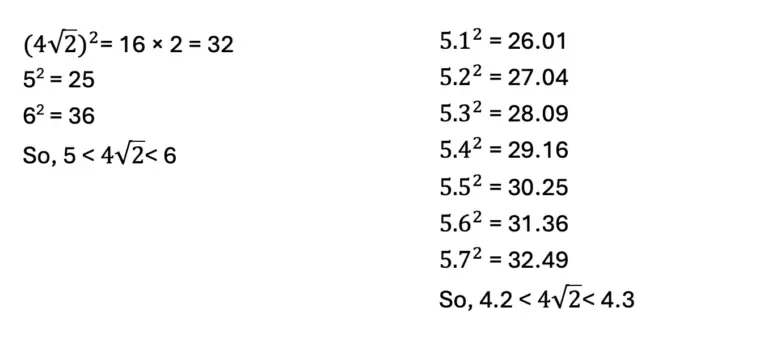
(iii) a = 6
c = =
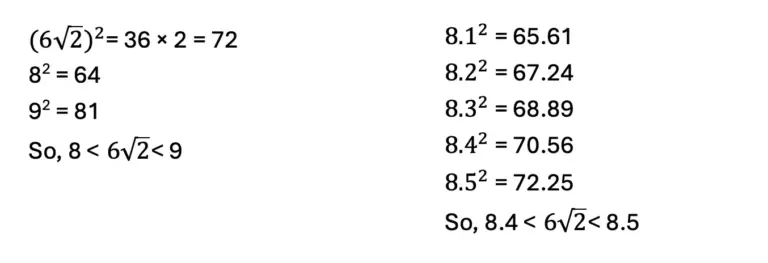
(iv) a = 8
c = =
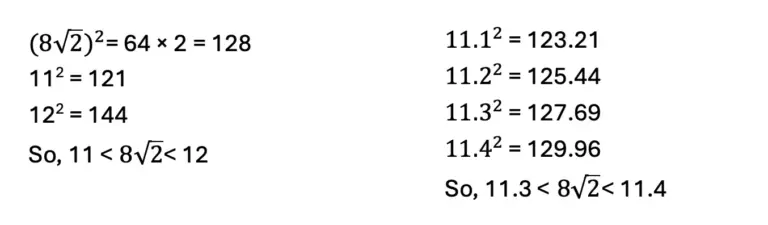
(v) a = 9
c = =
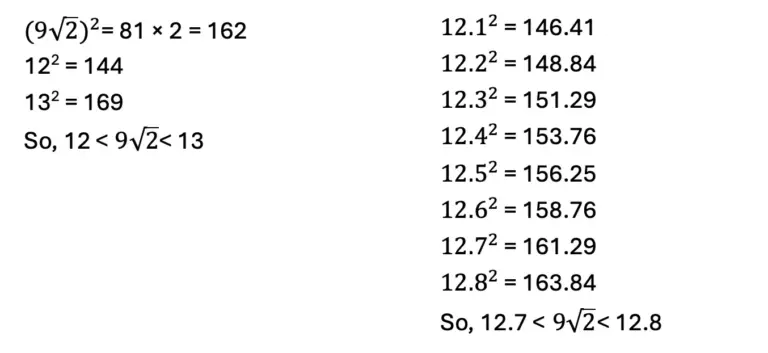
3. The hypotenuse of an isosceles right triangle is 10. What are its other two sidelengths?
[Hint: Find the area of the square composed of two such right triangles.]
Solution:
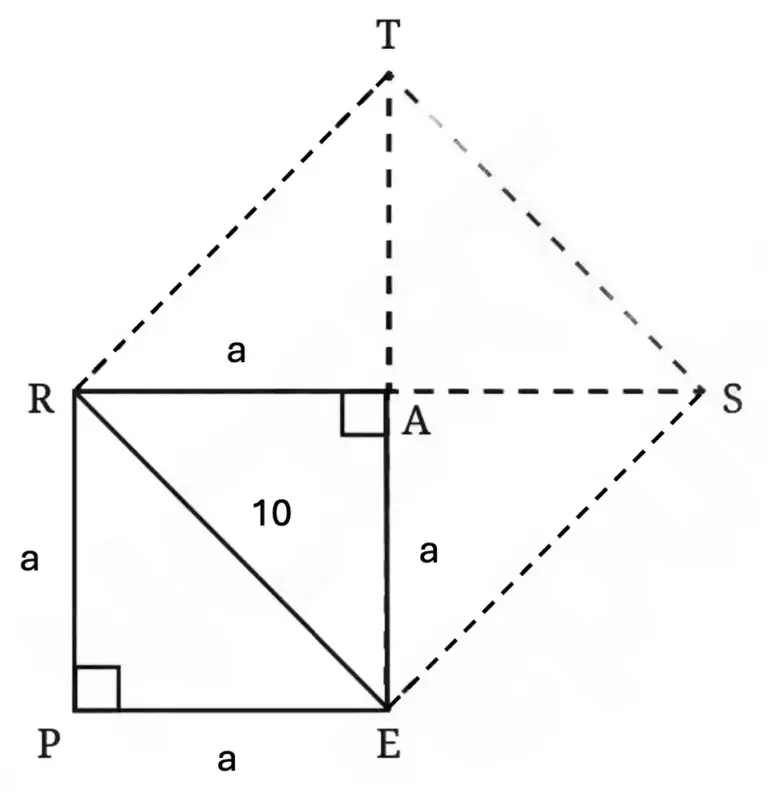
Let a be the length of the equal sides and 10 be the length of the hypotenuse of the isosceles right triangle.
Area of REST = 2 × Area of PEAR
= 2 ×
100 = 2 × a2
50 = a2
a =
a =
a =
Hence, the other two side lengths are each.
Figure it Out (Page 47)
1. If a right-angled triangle has shorter sides of lengths 5 cm and 12 cm, then what is the length of its hypotenuse? First draw the right-angled triangle with these sidelengths and measure the hypotenuse, then check your answer using Baudhāyana’s Theorem.
Solution:
Draw a right-angled triangle with side a = 5 cm and b = 12 cm. On measuring, the hypotenuse (c) is approximately 13 cm.
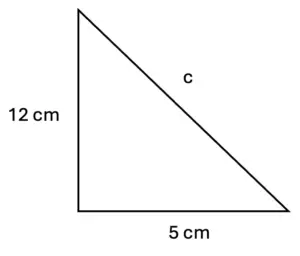
Using Baudhāyana’s Theorem,
a2 + b2 = c2
52 + 122 = c2
25 + 144 = c2
169 = c2
c = 13
Therefore, the hypotenuse is 13 cm.
2. If a right-angled triangle has a short side of length 8 cm and a hypotenuse of length 17 cm, what is the length of the third side? Again, try drawing the triangle and measuring, and then check your answer using Baudhāyana’s Theorem.
Solution:
Draw a right-angled triangle with one side (a) 8 cm and hypotenuse (c) 17 cm. On measuring, the third side (b) will be close to 15 cm.
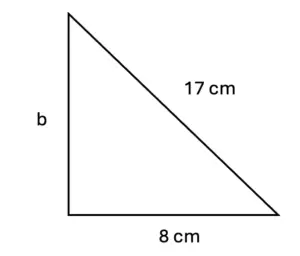
Using Baudhāyana’s Theorem,
a2 + b2 = c2
82 + b2 = 172
64 + b2 = 289
b2 = 289 – 64
b2 = 225
b = 15
Therefore, the third side is 15 cm.
3. Using the constructions you have now seen, how would you construct a square whose area is triple the area of a given square? Five times the area of a given square? (Baudhāyana’s Śulba-Sūtra, Verse 1.10)
Solution:
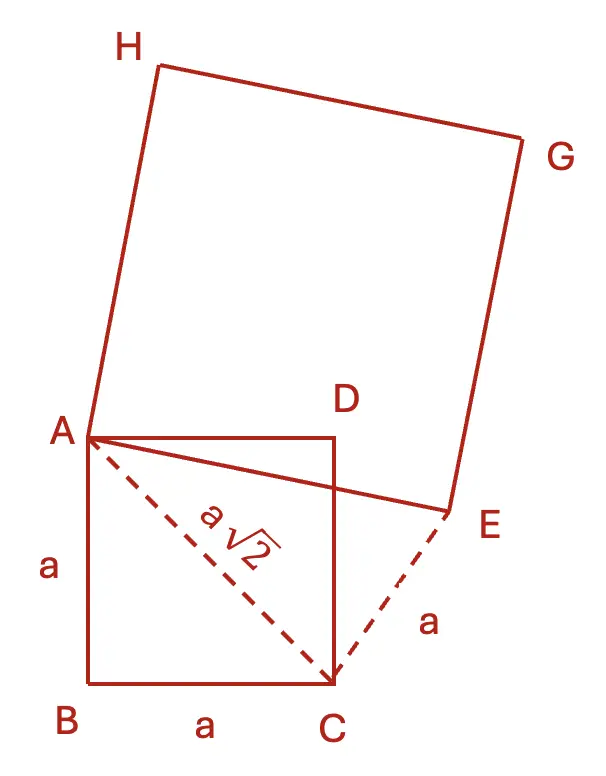
(A) Draw a square ABCD with side a.
Area of ABCD = a²
Join AC.
By Baudhāyana’s Theorem,
AC = = =
At point C, draw a line perpendicular to AC.
Mark a point E such that CE = a
Now in triangle ACE, using Baudhāyana’s Theorem,
AC2 + CE2 = AE2
+ a2 = AE2
2a2 + a2 = AE2
3a2 = AE2
AE = =
Construct square AEGH on side AE.
Area of AEGH = = = 3a2
∴ Area of the new square = 3 × Area of the original square.
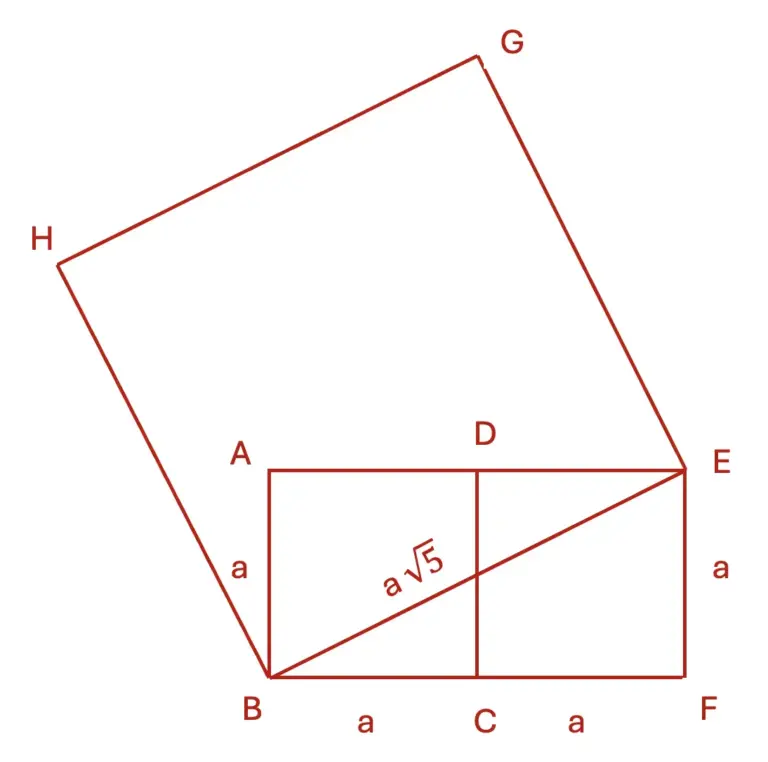
(B) Draw two squares ABCD and DCFE, each of sides a and area a2.
Join them together to form a rectangle ABFE such that
EF = a and BF = BC + CF = a + a = 2a
Draw the diagonal BE of the rectangle ABFE.
In △BFE, using Baudhāyana’s Theorem,
BF2 + EF2 = BE2
(2a)2 + a2 = BE2
4a2 + a2 = AE2
5a2 = BE2
BE = =
Construct a square BEGH using BE as one side.
Area of square BEGH = BE2 = 5a2
∴ Area of BEGH = 5 × Area of ABCD
4. Let a, b and c denote the lengths of the sides of a right triangle, with c being the length of the hypotenuse. Find the missing sidelength in each of the following cases:
(i) a = 5, b = 7
(ii) a = 8, b = 12
(iii) a = 9, c = 15
(iv) a = 7, b = 12
(v) a = 1.5, b = 3.5
Solution:
(i) a = 5, b = 7
Using Baudhāyana’s Theorem,
a2 + b2 = c2
52 + 72 = c2
25 + 49 = c2
c2 = 74
c = .
(ii) a = 8, b = 12
Using Baudhāyana’s Theorem,
a2 + b2 = c2
82 + 122 = c2
64 + 144 = c2
c2 = 208
c = = = .
(iii) a = 9, c = 15
Using Baudhāyana’s Theorem,
a2 + b2 = c2
92 + b2 = 152
81 + b2 = 225
b2 = 225 – 81
b2 = 144
b = 12
(iv) a = 7, b = 12
Using Baudhāyana’s Theorem,
a2 + b2 = c2
72 + 122 = c2
49 + 144 = c2
c2 = 193
c = .
(v) a = 1.5, b = 3.5
Using Baudhāyana’s Theorem,
a2 + b2 = c2
1.52 + 3.52 = c2
2.25 + 12.25 = c2
c2 = 14.5
c = .
Figure it Out (Page 50)
1. Find 5 more Baudhāyana triples using this idea.
Solution:
(i) 49 is an odd square. It is the 25th odd number (49 = 2 × 25 – 1).
So, (1 + 3 + 5 + … + 47) + 49 = 252
242 + 72 = 252 (24, 7, 25)
(ii) 81 is an odd square. It is the 41th odd number (81 = 2 × 41 – 1).
So, (1 + 3 + 5 + … + 79) + 81 = 412
402 + 92 = 412 (40, 9, 41)
(iii) 121 is an odd number. It is the 61th odd number (121 = 2 × 61 – 1).
So, (1 + 3 + 5 + … + 119) + 121 = 612
602 + 112 = 612 (60, 11, 61)
(iv) 167 is an odd number. It is the 85th odd number (169 = 2 × 85 – 1).
So, (1 + 3 + 5 + … + 167) + 169 = 852
842 + 132 = 852 (84, 13, 85)
(v) 225 is an odd number. It is the 113th odd number (225 = 2 × 113 – 1).
So, (1 + 3 + 5 + …+ 223) + 225 = 1132
1122 + 152 = 1132 (112, 15, 113)
2. Does this method yield non-primitive Baudhāyana triples?
[Hint: Observe that among the triples generated, one of the smaller sidelengths is one less than the hypotenuse.]
Solution:
The method is based on the equation (n − 1)2 + (2n − 1) = n2.
If (2n – 1) is a perfect square, say k2, then
(n − 1)2 + k2 = n2
Thus, it generates triples of the form (n − 1, k, n).
Here, n and n − 1 are consecutive integers, so gcd(n, n − 1) = 1.
Also, k2 = 2n − 1 is odd, so k is odd.
Thus, the three numbers have no common factor greater than 1.
Hence, all triples obtained by this method are primitive.
3. Are there primitive triples that cannot be obtained through this method? If yes, give examples.
Solution:
The method is based on the equation (n − 1)2 + (2n − 1) = n2.
If (2n – 1) is a perfect square, say k2, then
(n − 1)2 + k2 = n2
Thus, it generates triples of the form (n − 1, k, n).
So, one side is always one less than the hypotenuse.
However, not all primitive triples satisfy this condition.
For example, (8, 15, 17) and (20, 21, 29) do not satisfy it.
Hence, such triples cannot be generated by this method.
Figure it Out (Page 52)
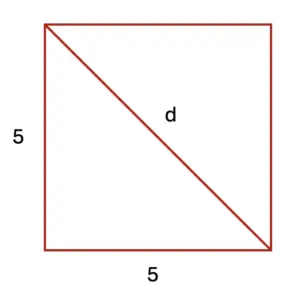
1. Find the diagonal of a square with sidelength 5 cm.
Solution:
Let the sides of the square be 5 cm, and its diagonal be d.
Since the diagonal forms a right triangle with the sides.
Using Baudhāyana’s Theorem,
52 + 52 = d2
25 + 25 = d2
50 = d2
d =
d =
d =
d = 5 × 1.414 = 7.07
Therefore, the diagonal of the square is 7.07 cm.
2. Find the missing sidelengths in the following right triangles:
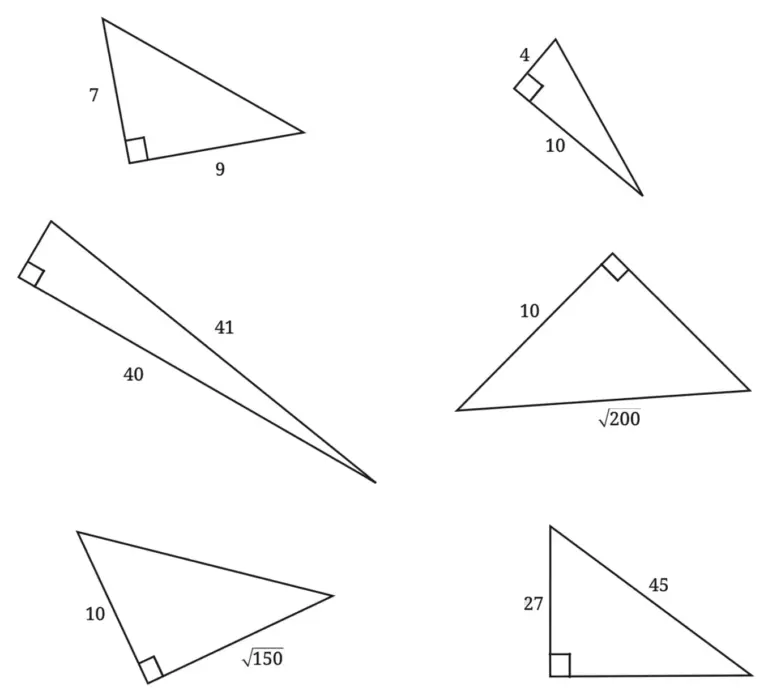
Solution:
(i)
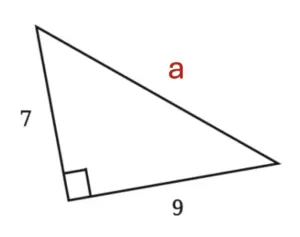
Using Baudhāyana’s Theorem,
72 + 92 = a2
49 + 81 = a2
130 = a2
a =
(ii)
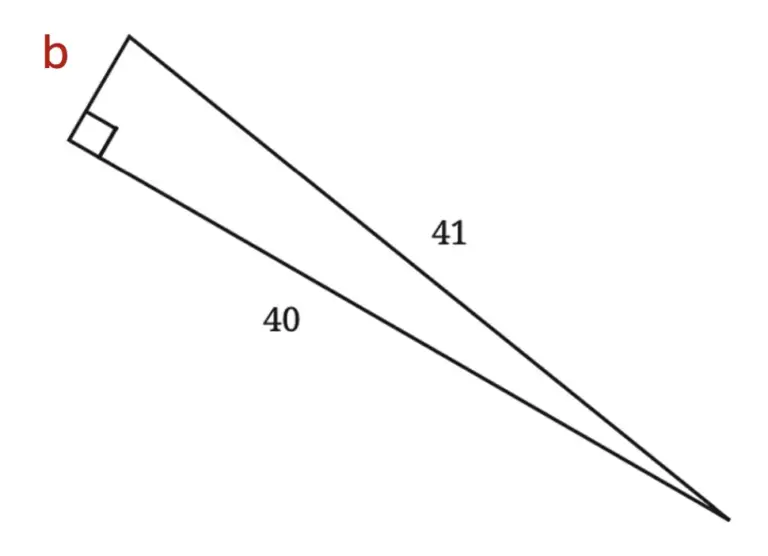
Using Baudhāyana’s Theorem,
b2 + 402 = 412
b2 + 1600 = 1681
b2 = 1681 – 1600
b2 = 81
b = = 9
(iii)
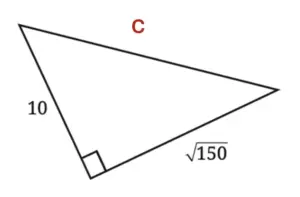
Using Baudhāyana’s Theorem,
102 + = c2
100 + 150 = c2
250 = c2
b =
b =
b = 5
(iv)
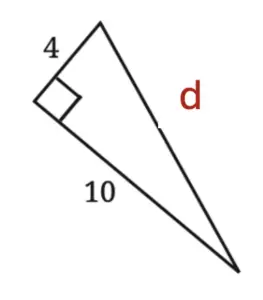
Using Baudhāyana’s Theorem,
42 + 102 = d2
16 + 100 = d2
116 = d2
d =
(v)
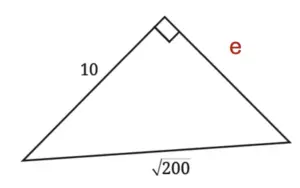
Using Baudhāyana’s Theorem,
102 + e2 =
100 + e2 = 200
e2 = 200 – 100
e2 = 100
e =
b =
b = 5 × 2 = 10
(vi)
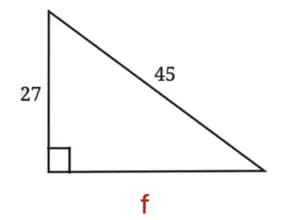
Using Baudhāyana’s Theorem,
f2 + 272 = 452
f2 + 729 = 2025
f2 = 2025 – 729
f2 = 1296
f =
f =
f = 2 × 2 × 3 × 3 = 36
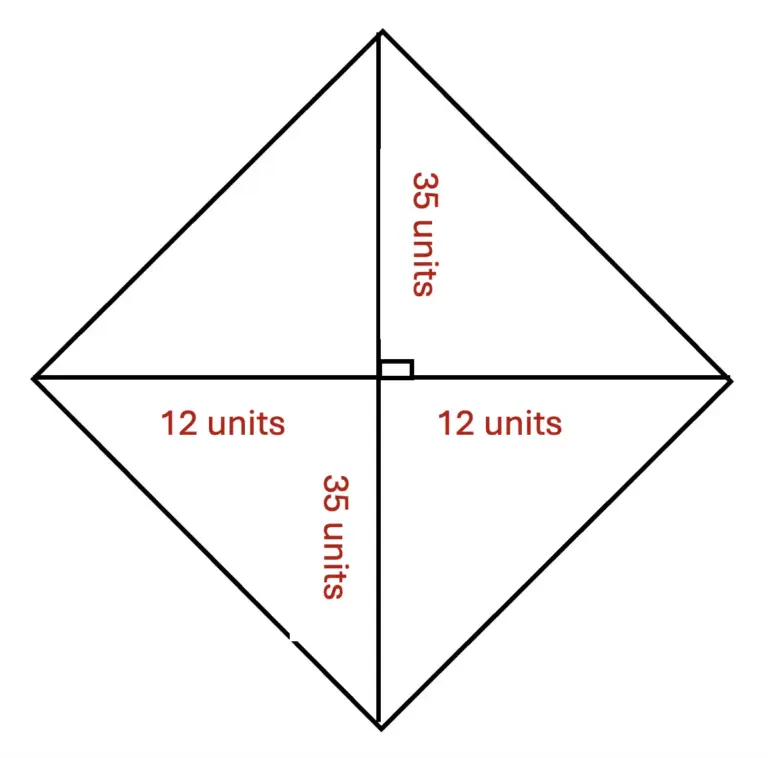
3. Find the sidelength of a rhombus whose diagonals are of length 24 units and 70 units.
Solution:
Diagonal 1 = 24 units
Diagonal 2 = 70 units
In a rhombus, the diagonals bisect each other at right angles.
So, First side = = 12 units
Second side = = 35 units
Using Baudhāyana’s Theorem,
122 + 352 = (Side/Hypotenuse)2
144 + 1225 = Side2
1369 = Side2
Side =
Side = 37
Therefore, the side length of the rhombus is 37 units.
4. Is the hypotenuse the longest side of a right triangle? Justify your answer.
Solution:
If the sides of the right triangle are a and b, and the hypotenuse is c, then:
c2 = a2 + b2
Thus,
c2 > a2 and c2 > b2
Taking square roots,
c > a and c > b
Therefore, the hypotenuse is the longest side.
5. True or False — Every Baudhāyana triple is either a primitive triple or a scaled version of a primitive triple.
Solution:
True.
Every Baudhāyana triple can be written as a primitive triple multiplied by a common factor.
That is, if (a, b, c) is a triple, then there exists a primitive triple (x, y, z) and a positive integer k such that:(a, b, c) = (kx, ky, kz).
Hence, every Baudhāyana triple is either primitive or a scaled version of a primitive triple.
6. Give 5 examples of rectangles whose sidelengths and diagonals are all integers.
Solution:
To find such rectangles, we use Baudhāyana (Pythagoras) triples, since the diagonal d satisfies d2 = l2 + b2
Five examples:
(i) 3 × 4, diagonal = 5
(ii) 5 × 12, diagonal = 13
(iii) 8 × 15, diagonal = 17
(iv) 7 × 24, diagonal = 25
(v) 20 × 21, diagonal = 29
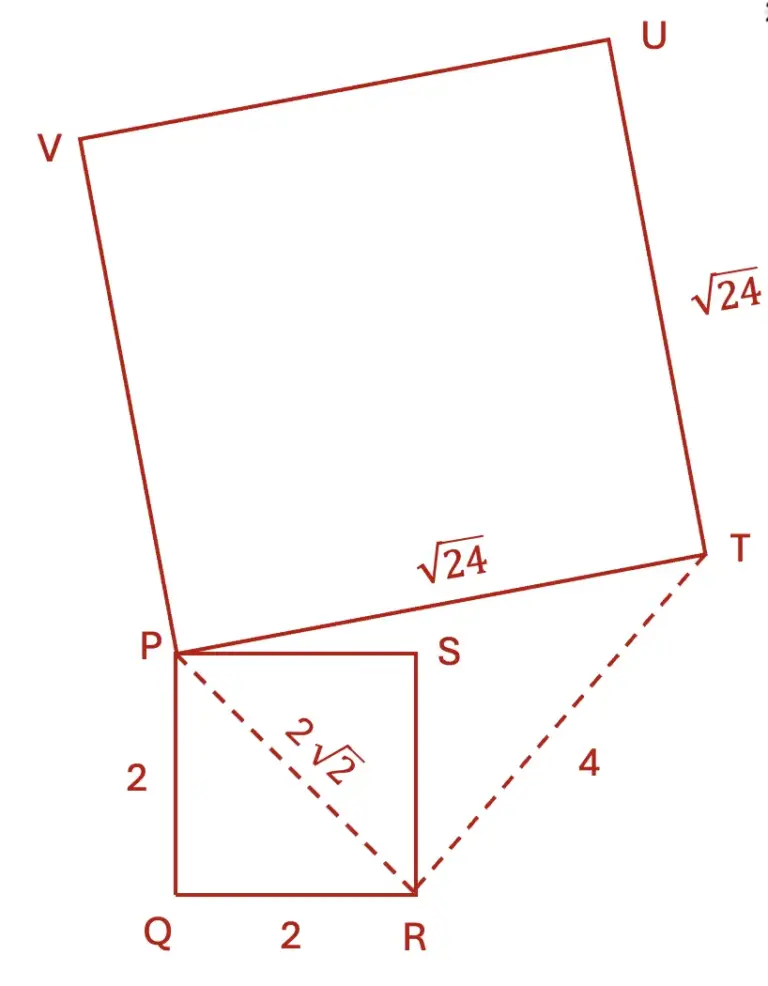
7. Construct a square whose area is equal to the difference of the areas of squares of sidelengths 5 units and 7 units.
Solution:
Area of the required square = 72 – 52
= 49 – 25 = 24 sq. units.
(i) Construct a square PQRS with a side of 2 units, then
Diagonal PR =
= = = units
(ii) At R, draw RT ⟂ PR such that RT = 4 units.
(iii) Join PT
By using Baudhāyana’s Theorem,
PR2 + RT2 = PT2
+ 42 = PT2
8 + 16 = PT2
24 = PT2
PT =
(iv) Construct square PTUV on side PT.
Thus, area of PTUV = (√24)2 = 24 sq. units.
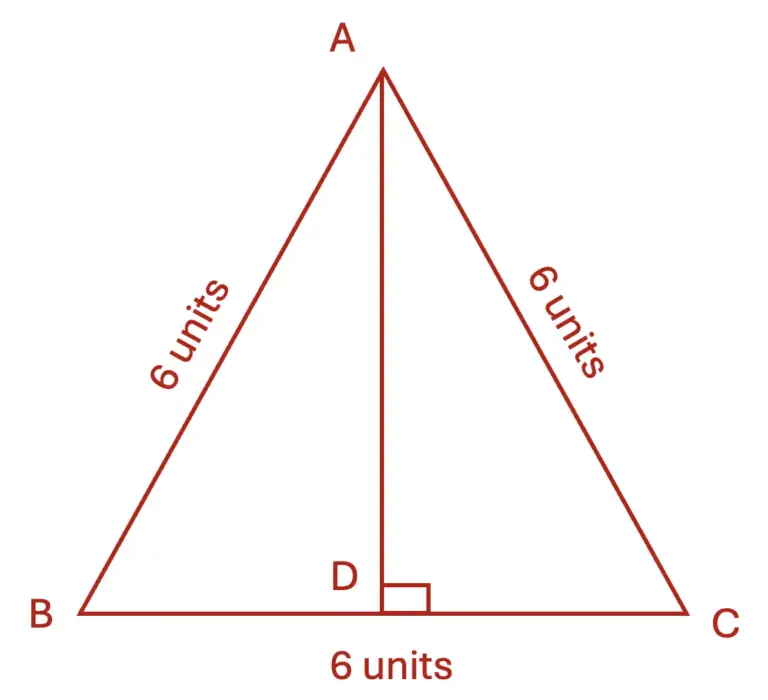
9. Find the area of an equilateral triangle with sidelength 6 units.
[Hint: Show that an altitude bisects the opposite side. Use this to find the height.]
Solution:
Let △ABC be an equilateral triangle such that AB, BC, and AC = 6 units.
Let AD be the altitude on BC.
Now, ∠ADB = ∠ADC (each 90°)
AB = AC (each 6 units)
AD = AD (common)
△ADB = △ADC (RHS congruence rule)
∴ BD = CD (By CPCT)
So, BD = CD = = 3 units
In △ADC, using Baudhāyana’s Theorem,
CD2 + AD2 = AC2
32 + AD2 = 62
9 + AD2 = 36
AD2 = 36 – 9 = 27
AD = = = units
Now,
Area of △ABC = × AD × BC
= × × 6 = 9
Therefore, the area is 9sq. units.
Our detailed NCERT solutions are prepared in simple language, making them easy to understand for every student. Each question is solved step by step according to the latest CBSE syllabus and NCERT guidelines, helping you score better in exams and strengthen your mathematical concepts.
Why Choose Our NCERT Solutions?
- Step-by-step and easy-to-understand explanations
- 100% accurate solutions based on the latest NCERT textbook
- Perfect for homework, revision, and exam preparation
- Designed to improve conceptual understanding
For complete The Baudhayana–Pythagoras Theorem Class 8 Maths Ganita Prakash Part 2 Chapter 2 NCERT Solutions, visit: