Measuring Space: Perimeter and Area Class 9 Maths Ganita Manjari Part 1 Chapter 6 NCERT Solutions Looking for the Measuring Space: Perimeter and Area Class 9 Maths Ganita Manjari Part 1 Chapter 6 NCERT Solutions? You’ve come to the right place. This chapter helps students understand important concepts of perimeter, area, and practical geometry, making it essential for exams and building a strong mathematical foundation.
Exercise Set 6.1
Unless stated otherwise, use the approximation for π.
1. The perimeter of a circle is 44 cm. What is its radius?
Solution:
Let the radius of the circle be ‘x’ cm.
Circumference = 44 cm =
r = =
Using ,
r = = 7 cm
Therefore, the radius is 7 cm.
2. Calculate, correct to 3 significant figures, the circumference of a circle with:
(i) radius 7 cm (ii) radius 10 cm (iii) radius 12 cm.
Solution:
(i) Radius (r) = 7 cm
Circumference =
= 2 × 3.142 × 7 = 43.988 = 44.0 cm
(ii) Radius (r) = 10 cm
Circumference =
= 2 × 3.142 × 10 = 62.84 = 62.8 cm
(iii) Radius (r) = 12 cm
Circumference =
= 2 × 3.142 × 12 = 75.408 = 75.4 cm
3. Calculate the length of the arc of a circle if:
(i) the radius is 3.5 cm, and the angle at the centre is 60°, and
(ii) the radius is 6.3 m, and the angle at the centre is 120°.
Solution:
(i) Radius = 3.5 cm, angle = 60°
Length of the arc = ×
= × 2 × × 3.5
= × 2 × ×
= = 3.67 cm
(ii) Radius = 6.3 m, angle = 120°
Length of the arc = ×
= × 2 × × 6.3
= × 2 × ×
= = 13.2 cm
4. Find the perimeter of a sector (i.e., the curved portion as well as the two straight portions) of a circle of radius 14 cm and sector angle 75°.
Solution:
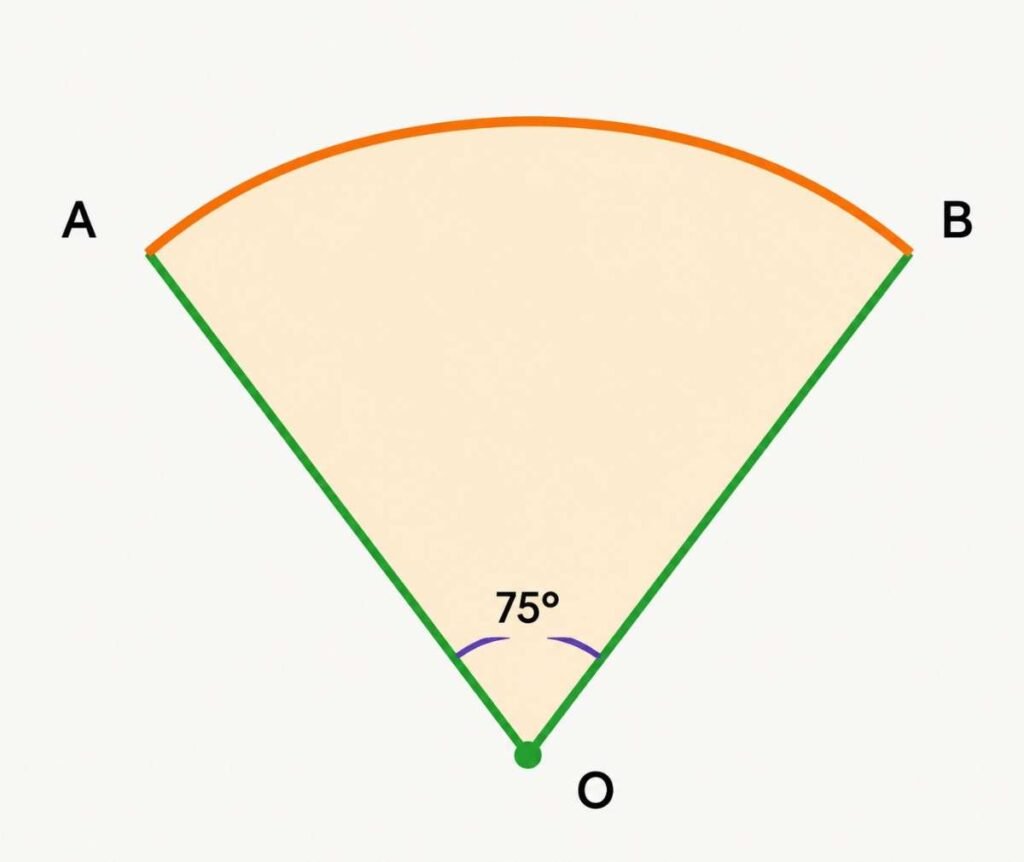
Radius of the circle r = 14 cm
Angle of the sector θ = 75°
Perimeter of a sector = length of arc + 2r
= × + 2r
= 2r
= 2 × 14
= 28
= 28
= 28
= 28
= 28
= cm = 46 cm
Therefore, the perimeter of the sector is 46 cm.
5. Find the perimeters of the following shapes (taking the arcs to be quarter or half or three-quarters of a circle, as appropriate) (Fig. 6.14i to 6.14ix):
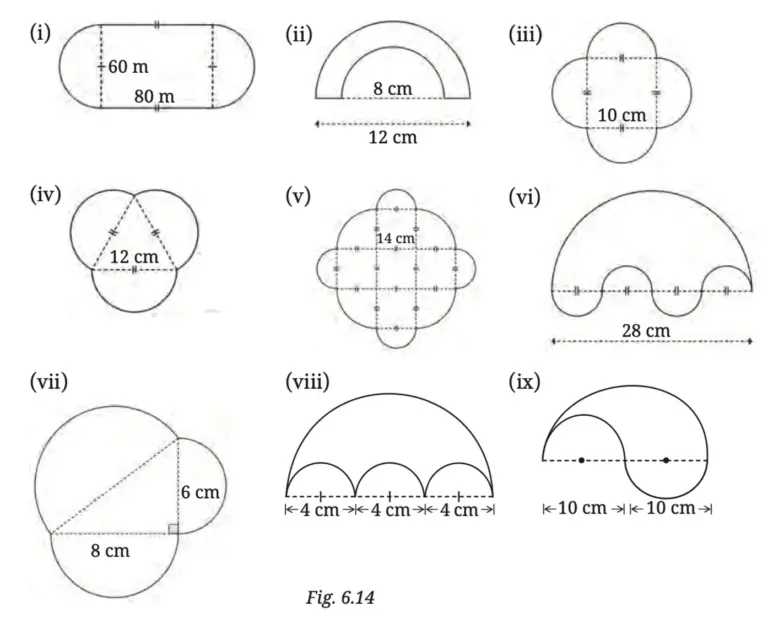
Solution:
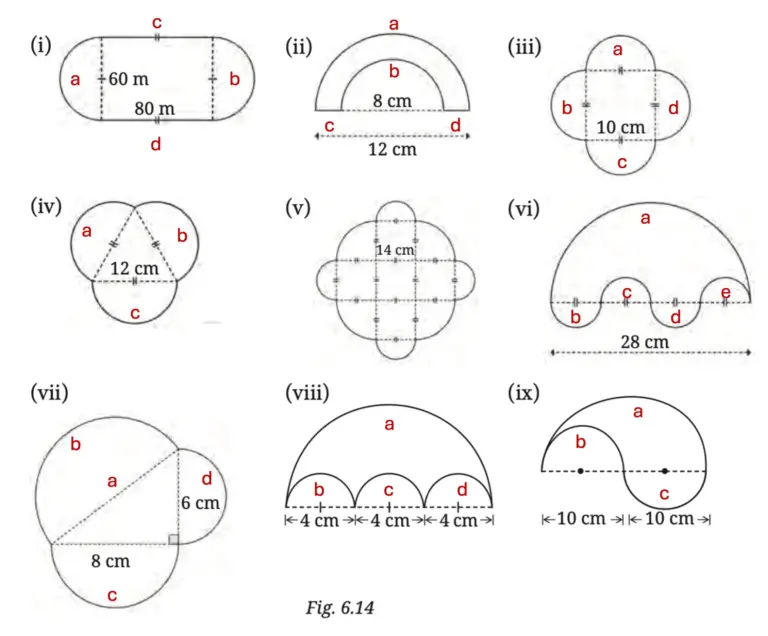
(i) Radius of semicircles a and b = 30 cm
Length of lines c and d = 80 + 80 = 160 cm
Perimeter = Length of semicircles a and b + Length of lines c and d
= + 160
= 2 × × 30 + 160
= +160
= = = 348 m
(ii) Radius of outer semicircle a = 6 cm
Raidus of inner semicircle b = 4 cm
Length of lines c and d = = = 2 + 2 = 4 cm
Perimeter = Length of semicircle a + Length of semicircle b + Length of lines c and d
= + × 4 + 4
= 6 + 4 + 4
= 10 + 4
= 10 × + 4
= + 4
= = = 35 cm
(iii) Radius of semicircles a, b, c and d = 5 cm
Perimeter = Length of 4 semicircles a, b, c and d
= 4 ×
= 4
= 4 × × 5 = = 62 cm
(iv) Radius of semicircles a, b and c = 6 cm
Perimeter = Length of 3 semicircle a, b and c
= 3 ×
= 18
= 18 ×
= = 56 cm
(vi) Radius of semicircle a = 14 cm
Radius of semicircles b, c, d and e = = 3.5 cm
Perimeter = Length of semicircle a + Length of 4 semicircles b, c, d and e
= + 4 ×
= + 14
= 28
= = 88 cm
(vii) Using Pythagoras theorem,
a2 = 62 + 82
a2 = 36 + 64
a2 = 100
a = 10 cm
Thus, diameter of semicircle b = 10 cm
Radius of semicircle b = 5 cm
Radius of semicircle c = 4 cm
Radius of semicircle d = 3 cm
Perimeter = Length of semicircle b + Length of semicircle c + Length of semicircle d
= + +
= + +
=
= = = 35 cm
(viii) Radius of semicircle a = 6 cm
Radius of semicircles b, c and d = 2 cm
Perimeter = Length of semicircle a + Length semicircles b, c and d
= + 3 ×
= +
=
= = = 35 cm
(ix) Radius of semicircle a = 10 cm
Radius of semicircles b, and c = 5 cm
Perimeter = Length of semicircle a + Length of semicircles b and c
= + 2 ×
= +
=
= = = 62 cm
6. If the diameter of a car tyre is 56 cm, then:
(i) How far does the car need to travel for the tyre to complete one revolution?
(ii) How many revolutions does the tyre make if the car travels 10 km?
Solution:
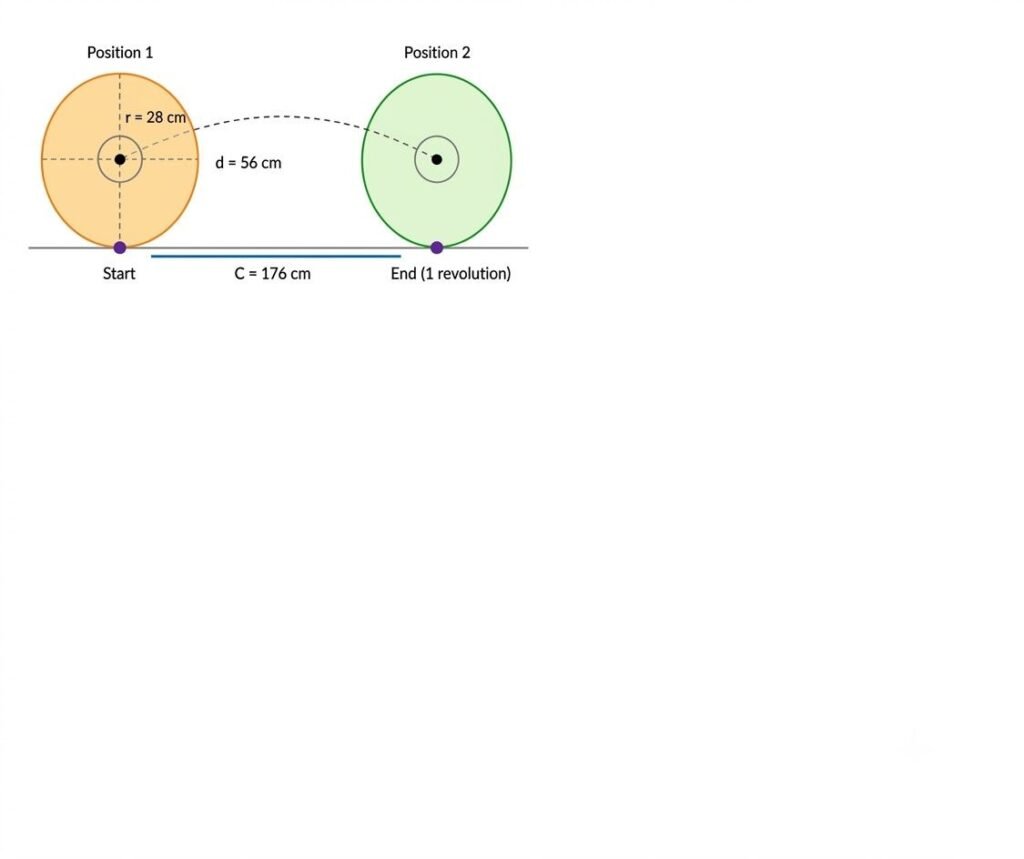
Diameter of the tyre = 56 cm
(i) Distance covered in one revolution = Circumference of the tyre = πd
= × 56 = 176 cm
Therefore, the car needs to travel 176 cm to complete one revolution.
(ii) Distance travelled by the car = 10 km
= 10 × 1000 × 100
= 1000000 cm
Number of revolutions made by the tyre = = 5681.81
Therefore, the tyre makes 5681 revolutions.
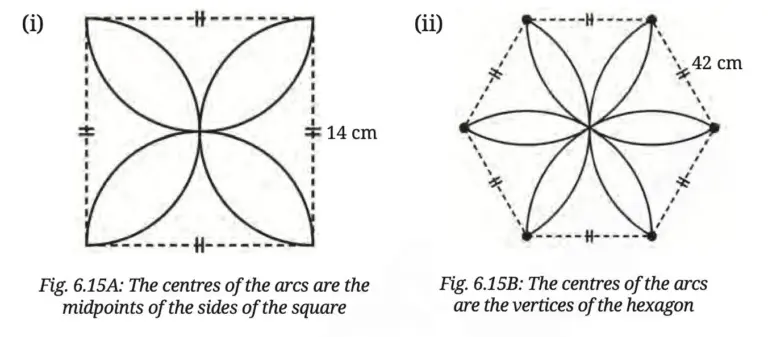
7. Find the total perimeter of all the petals in each of the given flowers.
Solution:
(i) Side of the given square = 14 cm
Radius of each arc = = 7 cm
Each petal consists of two quarter-circles.
∴ Length of one quarter-circle = × = × 2 × × 7 = 11 cm
So, perimeter of one petal = 11 + 11 = 22 cm
There are 4 petals.
Hence, the total perimeter of all petals = 4 × 22 = 88 cm
(ii) Side of the regular hexagon = 42 cm
Radius of each arc = 42 cm
Angle subtended by each arc = = 60°
Length of one arc = ×
= × × 42
= × 44 × 6 = 44 cm
Each petal consists of two such arcs.
So, perimeter of one petal = 44 + 44 = 88 cm
There are 6 petals.
Therefore, total perimeter of all petals = 6 × 88 = 528 cm
8. The ratio of the perimeters of two circles is 5 : 4. What is the ratio of their radii?
Solution:
Let the radii of the two circles be r1 and r2.
Then,
r1 : r2 = 5 : 4
r1 : r2 = 5 : 4
Hence, the ratio of their radii is 5 : 4.
Exercise Set 6.2
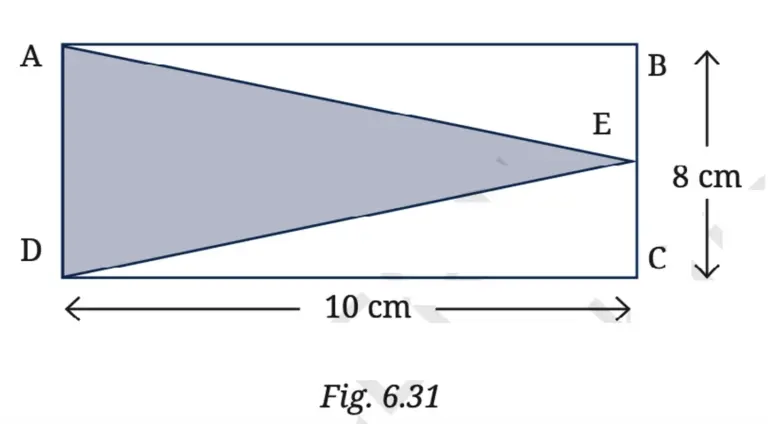
1. Find the area of triangle ADE in Fig. 6.31.
Solution:
Height of △ADE = Length of rectangle ABCD = 10 cm
Base of △ADE = Breadth of rectangle ABCD = 8 cm
Therefore,
Area of △ADE = × Base × Height
= × 8 × 10
= 4 × 10 = 40 cm2
2. The parallel sides of a trapezium are 40 cm and 20 cm. If its non-parallel sides are both equal, each being 26 cm, find the area of the trapezium.
Solution:
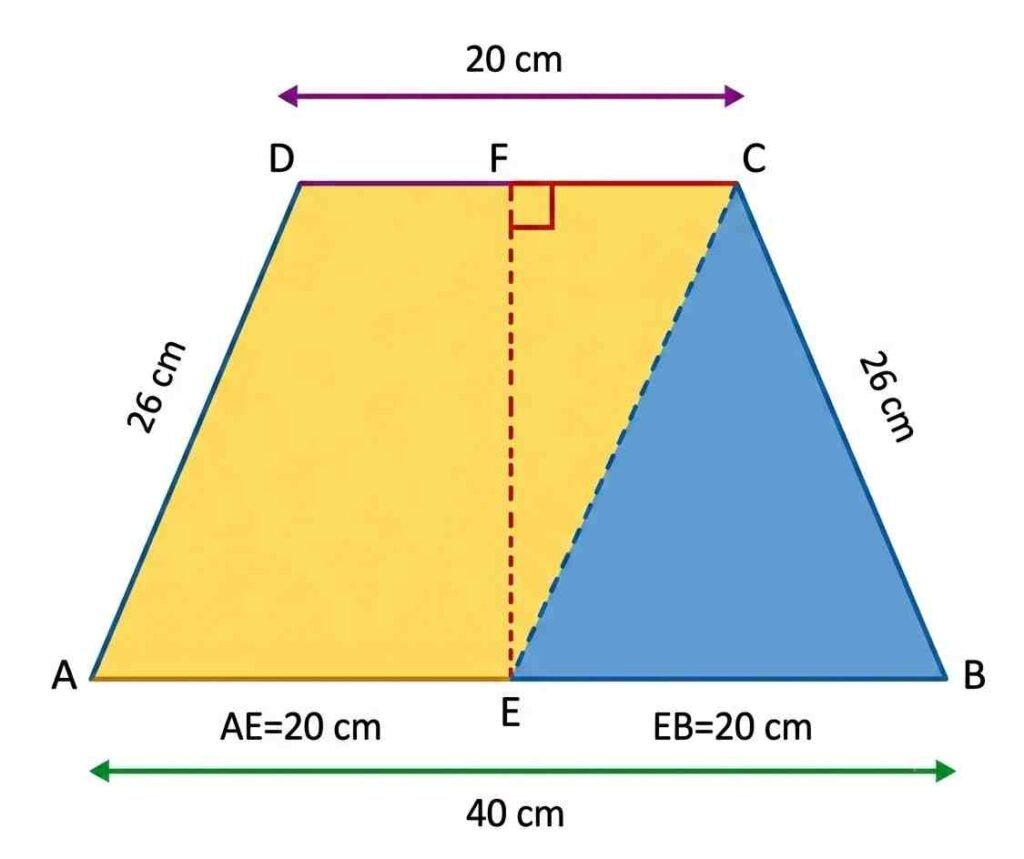
Let ABCD be the given trapezium in which AB = 40 cm, DC = 20 cm, and AD = BC = 26 cm.
Draw CE AD.
Now, ADCE is a parallelogram in which AD CE and AE CD.
AE = DC = 20 cm, CE = 26 cm, and BE = AB – AE = 40 – 20 = 20 cm.
In △BCE,
s = = = 36
Area of △BCE =
=
= = 240 cm2 …………. (1)
Let h be the height of △BCE, then
Area of △BCE = × Base × Height
= × 20 × Height = 10 × h = 10h ………… (2)
From (i) and (ii), we get
10h = 240 ⇒ h = 24 cm
Since the height of trapezium ABCD is same as that of △BCE.
∴ Area of trapezium = (AB + DC) × h = (40 + 20) × 24 = × 60 × 24 = 720 cm2
3. Find the area of a triangle, given that its sides are 8 cm and 11 cm long, and its perimeter is 32 cm.
Solution:
Sides of the triangle a = 8 cm, b = 11 cm.
Perimeter = 32 cm
32 = a + b + c
c = 32 – (a + b)
c = 32 – (8 + 11)
c = 32 – 19 = 13 cm
Now, semi-perimeter = s = = 16 cm
Using Heron’s formula,
Area =
=
=
= = = 8cm2
Therefore, the area of the triangle is 8cm2.
4. The sides of a triangular plot are in the ratio 3: 5: 7; its perimeter is 300 m. Find its area.
Solution:
Let the sides of the triangular plot be 3x, 5x, and 7x.
Perimeter = 300 m
3x + 5x + 7x = 300
15x = 300
x = 20 m
Therefore, the sides are:
3x = 3(20) = 60 cm
5x = 5(20) = 100 cm
7x = 7(20) = 140 cm
Now, s = = = 150
Using Heron’s formula.,
Area =
=
=
= = 1500m2
Hence, the area of the triangular plot is 1500m2.
5. One diagonal of a rhombus is twice as long as the other diagonal. If the rhombus has area 128 cm2, find the length of the shorter diagonal.
Solution:
Let the shorter diagonal of the rhombus be x cm.
Then, the longer diagonal = 2x cm.
Area of the rhombus = × d1 × d2
Given,
128 = × x × 2x
128 = x2
x =
x =
x = 8cm
Therefore, the length of the shorter diagonal is cm.
6. ABCD is a parallelogram. P and Q are any two points on side AB. What can you say about the ratio area (ΔPCD): area (ΔQCD)?
Solution:
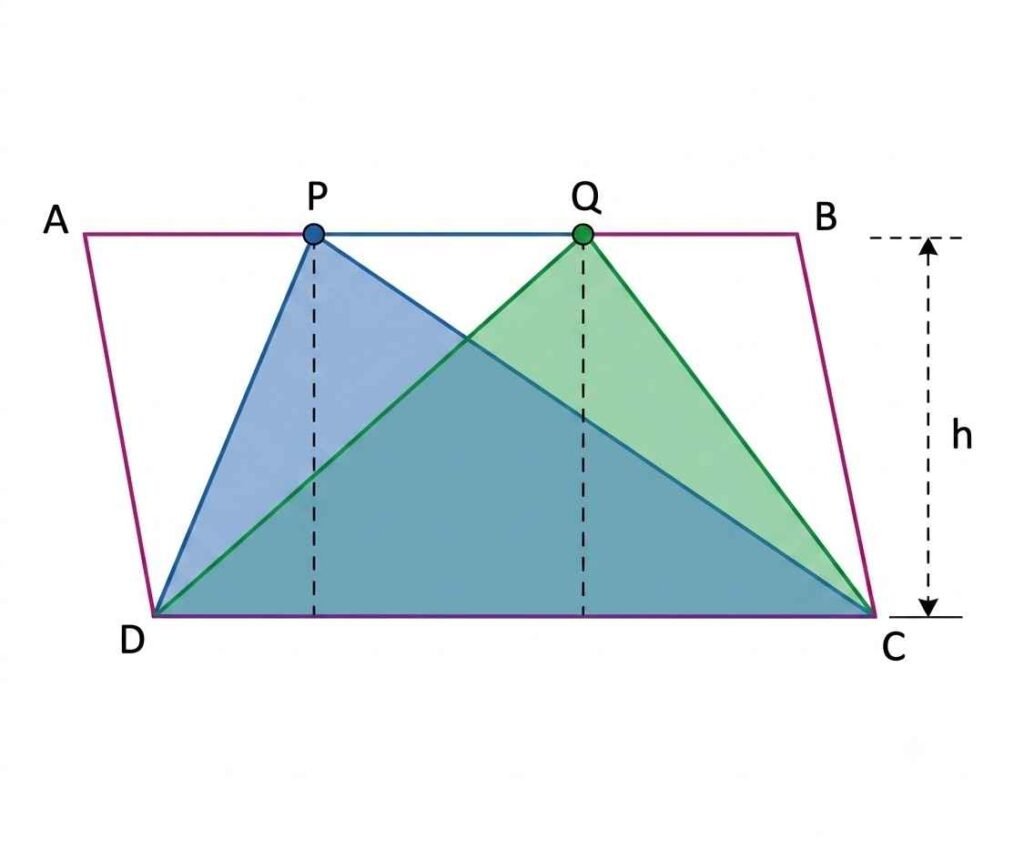
ΔPCD and ΔQCD are on the same base DC and lie between the same parallels AB and DC.
Therefore,
= =
Hence
Area (△PCD) : Area (△QCD) = 1 : 1.
7. O is any point on the diagonal PR of a parallelogram PQRS. Prove that the areas of triangles PSO and PQO are equal.
Solution:
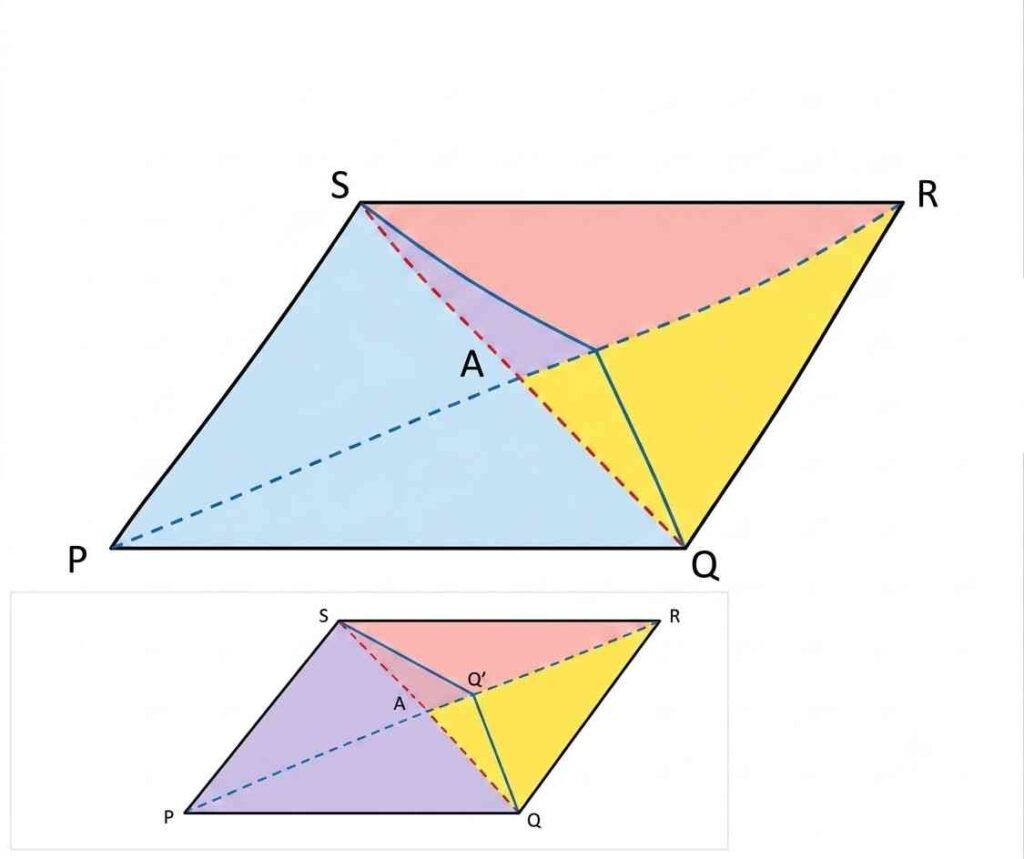
Join SQ.
Let the diagonals PR and SQ intersect at A.
Since the diagonals of a parallelogram bisect each other. Therefore, A is the midpoint of AC and BD.
Since a median of a triangle divides it into two triangles of equal area.
In ΔPQS, PA is median,
area (ΔPSA) = area (ΔPQA) ………. (1)
In ΔOSQ, OA is median,
area (ΔOSA) = area (ΔOQA) …………. (2)
Adding (1) and (2), we get
area (ΔPSA) + area (ΔOSA) = area (ΔPQA) + area (ΔOQA)
area (ΔPSO) = area (ΔPQO).
Hence, verified.
8. If the mid-points of the sides of a 4-gon (also known as a quadrilateral, but we prefer to call it a ‘4-gon’) are joined in order, prove that the area of the parallelogram thus formed will be half of the area of the given 4-gon. (You may wonder whether the 4-gon thus formed is always a parallelogram, and if so, why? These questions will be tackled and answered in the chapter on quadrilaterals.)
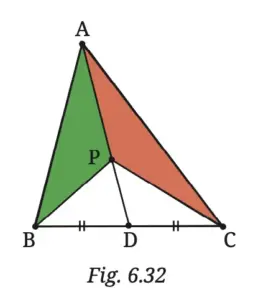
9. In ∆ABC, the midpoint of BC is D (Fig. 6.32). Median AD is drawn. P is any point on AD. Show that area (∆ABP) = area (∆ACP).
Solution:
In ∆ABC, AD is the median, and median divides a triangle into two triangles of equal area.
∴ area (△ABD) = area (△ACD) ……………. (1)
Again, in ∆PBC, PD is the median
∴ area (△PBD) = area (△PCD) ……………… (2)
Subtracting (2) from (1), we get
area (△ABD) – area (△PBD) = area (△ACD) – area (△PCD)
Hence, area (∆ABP) = area (∆ACP)
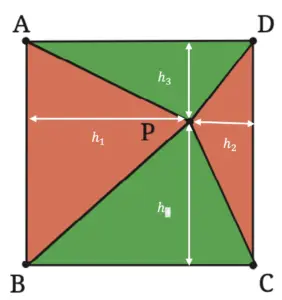
10. Given a square ABCD, let P be a point within it. Join PA, PB, PC, PD (Fig. 6.33). What is the ratio of the areas of the red region (∆PAB and ∆PCD) and the green region (∆PBC and ∆PDA)?
Solution:
Let h1 = perpendicular distance from P to AB, h2 = perpendicular distance from P to CD, h3 = perpendicular distance from P to AD, and h4 = perpendicular distance from P to BC.
Since AB CD and both are sides of the square,
h1 + h2 = a …………… (1)
Since AD BC and both are sides of the square,
h3 + h4 = a …………… (2)
Area of red region:
area (△PAB) + area (△PCD) = ⋅a⋅h1 + ⋅a⋅h2 = a(h1 + h2) = a⋅a =
Area of green region:
area (△PBC) + area (△PDA) = ⋅a⋅h4 + ⋅a⋅h3 = a(h4 + h3) = a⋅a =
Therefore,
area (red) : area (green) = : = 1 : 1.
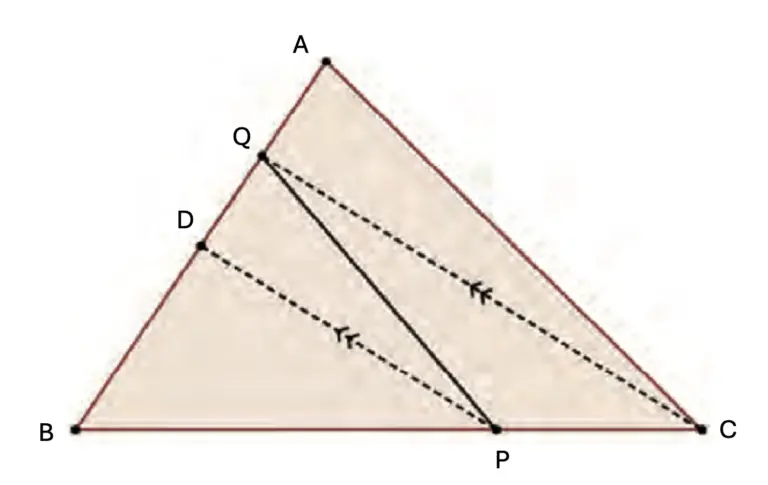
11. In ∆ABC, D is the midpoint of AB. P is any point on BC, and Q is a point on AB such that CQ PD. PQ is joined (Fig. 6.34). Prove that Area (∆BPQ) = Area (∆ABC).
Solution:
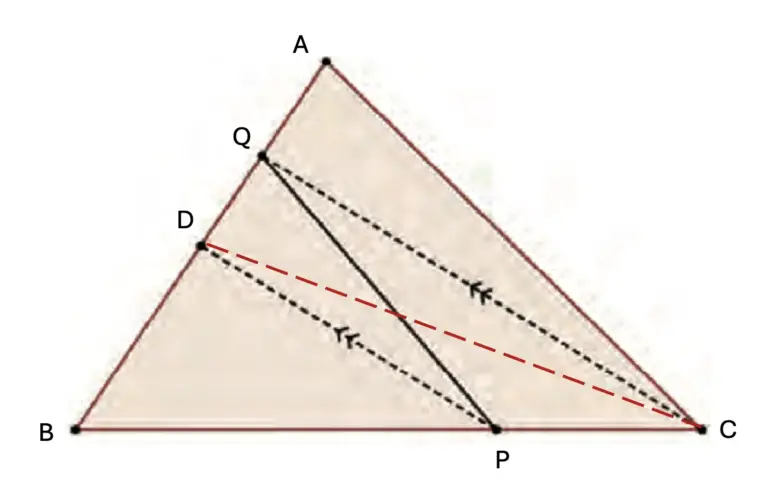
Join CD.
Since ∆PDQ and ∆PDC are on the same base PD and between the same parallels PD and QC.
∴ Area (∆PDQ) = Area (∆PDQ) …………… (1)
Since in △ABC, D is the midpoint of AB, and CD is the median.
∴ Area (∆BCD) = Area (∆ABC)
Area (∆BPD) + Area (∆PDC) = Area (∆ABC)
Area (∆BPD) + Area (∆PDQ) = Area (∆ABC)
Area (∆BPQ) = Area (∆ABC).
Exercise Set 6.3
Unless stated otherwise, use the approximation for π.
1. Find the area of a sector of a circle with radius 7 cm if the angle of the sector is 60°.
Solution:
Radius = 7 cm
Angle of the sector = 60°
Area of the sector = ×
= × 7 × 7 ×
= 22 × 7 ×
= 11 × 7 × = cm2
Therefore, area of the sector is cm2.
2. Find the area of a quadrant of a circle whose circumference is 44 cm.
Solution:
Circumference = 44 cm
∴ 2 = 44
2 × × r = 44
× r = 44
r = 44 × = 7 cm
Since a quadrant divides a circle into 4 equal sectors, and the angle of each sector is 90°.
∴ Area of the quadrant = ×
= × 7 × 7 ×
= 22 × 7 ×
= 11 × 7 × = cm2 = 38.5 cm2
3. The length of the minute hand of a clock is 7 cm. Find the area swept by the minute hand in 10 minutes.
Solution:
Length of minute hand = 7 cm
In 60 minutes, the minute hand sweeps an angle = 360 °.
Therefore, in 10 minutes, the angle swept = = 60°
Area swept by the minute hand = ×
= × 7 × 7 ×
= 22 × 7 ×
= 11 × 7 × = cm2
Hence, the area swept by the minute hand in 10 minutes is cm2.
4. A chord of a circle of radius 10 cm subtends 90° at the centre. Find the area of the corresponding:
(i) minor sector (that subtends 90° at the centre), and
(ii) major sector (that subtends 270° at the centre). (Use π ≈ 3.14.)
Solution:
Radius of the circle (r) = 10 cm
(i) Angle of the minor sector = 90°
Area of the minor sector = = ×
= 3.14 × 10 × 10 ×
= 3.14 × 100 ×
= × 100 ×
= = 78.5 cm2
(ii) Angle of the major sector = 270°
Area of the minor sector = ×
= 3.14 × 10 × 10 ×
= 3.14 × 100 ×
= × 100 ×
= = 235.5 cm2
5. A chord of a circle of radius 15 cm subtends an angle of 60° at the centre of the circle. Find the areas of the corresponding minor and major segments of the circle. (Use π ≈ 3.14 and ≈ 1.73.)
Solution:
Radius of the circle (r) = 15 cm
Angle subtended by the chord at the centre = 60°
Area of the minor sector = ×
= 3.14 × 15 × 15 ×
= 3.14 × 225 ×
= 706.5 ×
= 117.75 cm2
Since OA = OB = 15 cm and ∠AOB = 60°,
△OAB is an equilateral triangle of side 15 cm.
Area of triangle =
= × 15 × 15
= 97.31 cm2
Area of minor segment = Area of sector − Area of triangle
= 117.75 − 97.31 = 20.44 cm2
Area of the circle = 3.14 × 15 × 15 = 706.5 cm2
Area of major segment = 706.5 − 20.44 = 686.06 cm2
6. A car has two wipers which do not overlap. Each wiper has a blade of length 28 cm and sweeps through an angle of 120°. Find the total area cleaned at each sweep of the blades.
Solution:
Length of each wiper blade (r) = 28 cm
Angle swept by each wiper = 120°
Area cleaned by two blades = 2 × ×
= 2 × × 28 × 28 ×
= 44 × 4 × 28 ×
= 4928 ×
= 1642 cm2
Therefore, the total area cleaned at each sweep of the blades is 1642 cm2.
7. A chord of a circle of radius r subtends an angle of 60° at the centre of the circle. Show that the area of the corresponding minor segment of the circle is equal to r2 .
Solution:
Let AB be the chord, and O be the centre of the circle.
Radius of the circle = r
∠AOB = 60°
Area of sector AOB = ×
= × =
Since OA = OB = r and ∠AOB = 60°, △AOB is an equilateral triangle.
Area of △AOB =
Therefore,
Area of the minor segment = –
= .
8. An equilateral triangle is inscribed in a circle of radius r. Show that the ratio of the area of the triangle to the area of the circle is equal to ≈ 0.413.
Solution:
Let the side of the equilateral triangle be a.
Since the triangle is inscribed in a circle of radius r,
r = ⇒ a =
Area of equilateral triangle =
=
=
Area of the circle =
Therefore,
= = ≈ 0.413.
9. A square is inscribed in a circle of radius r. Show that the ratio of the area of the square to the area of the circle is equal to ≈ 0.637.
Solution:
Let the side of the square be a.
Since the square is inscribed in the circle,
Diagonal of square = 2r
But, Diagonal = a
Therefore,
a= 2 r
a =
Area of square = a2 = = 2r2
Area of circle =
Therefore,
= = ≈ 0.637.
10. A hexagon is inscribed in a circle of radius r. Show that the ratio of the area of the hexagon to the area of the circle is equal to ≈ 0.827. Can you see why the answer is exactly twice the answer to Question 8?
Solution:
A regular hexagon can be divided into 6 equilateral triangles.
Each triangle has side r.
Area of one equilateral triangle =
Area of hexagon = 6 × =
Area of circle =
Therefore,
= = ≈ 0.827
At School Learners, we provide accurate, easy-to-understand, and step-by-step NCERT solutions prepared according to the latest CBSE syllabus. Every solution is explained in simple language so that students can easily grasp the concepts and solve similar questions confidently.
👉 Visit our website: https://schoollearners.in/
On School Learners, you’ll also find:
Study Materials for Classes 6–12
Chapter-wise NCERT Solutions
Important Questions
MCQs with Answers
Revision Notes
Previous Year Questions