Area Class 8 Ganita Prakash Part 2 Chapter 7 NCERT Solutions Looking for the best Area Class 8 Ganita Prakash Part 2 Chapter 7 NCERT Solutions? You are in the right place. This chapter helps students understand the concept of Area, including how to calculate the area of different shapes using simple formulas and logical methods. These NCERT solutions are prepared in easy language so that every Class 8 student can understand the concepts and score better in exams.
Figure it Out (Page 150)
1. Identify the missing sidelengths.
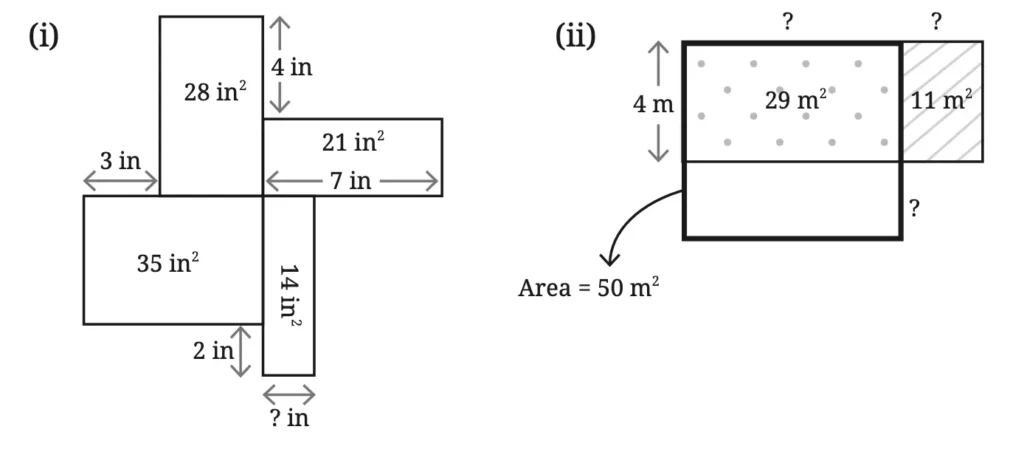
Solution:
(i)
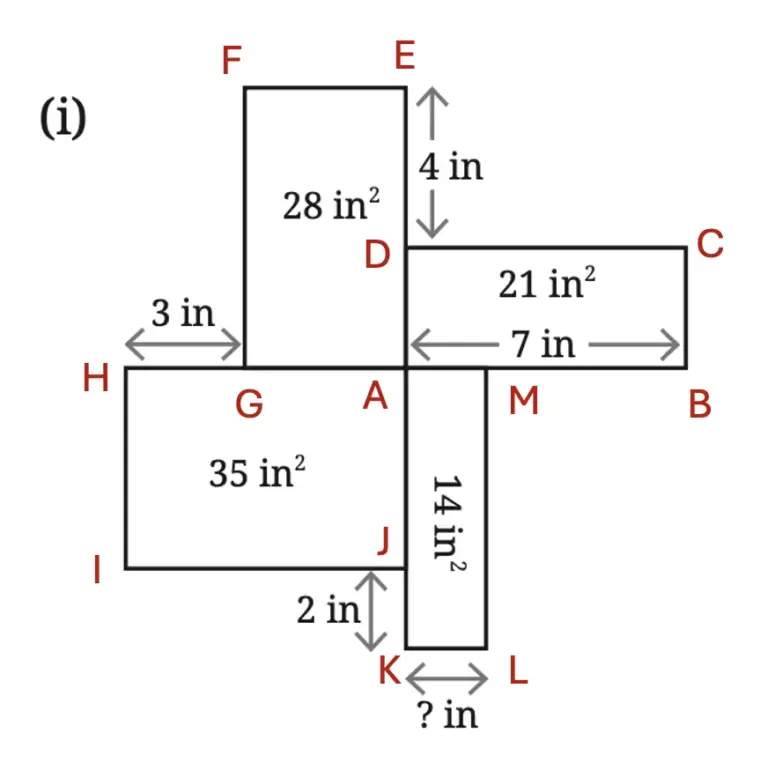
Here,
Area of rectangle ABCD = 21 in2
⇒ 7 × BC = 21 in2
BC = = 3 in
AD = BC = 3 in
AE = AD + DE = 3 + 4 = 7 in
Area of rectangle GAEF = 28 in2
⇒ FE × AE = 28
⇒ FE × 7 = 28
⇒ FE = = 4 in
FE = GA = 4 in
HA = HG + GA = 3 + 4 = 7 in
Area of IJAH = 35 in2
⇒ HI × HA = 35
⇒ HI × 7 = 35
⇒ HI = = 5 in
HI = AJ = 5 in
AK = AJ + JK = 5 + 2 = 7 in
Area of AKLM = 14 in2
AK × KL = 14
7 × KL = 14
KL = = 2 in
Therefore, the missing sidelength is 2 in.
(ii)
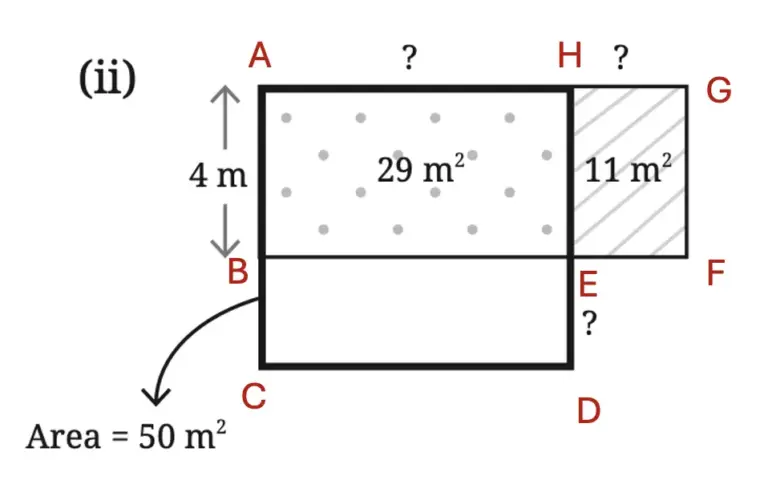
Here,
AB = HE = 4 m
Area of rectangle HEFG = 11 m2
⇒ HE × HG = 11
⇒ 4 × HG = 11
⇒ HG = = 2.75 m
Area of rectangle ABEH = 29 m2
⇒ AB × AH = 29
⇒ 4 × AH = 29
⇒ AH = = 7.25 m
Area of rectangle ACDH = 50 m2
⇒ AH × HD = 50
⇒ 7.25 × HD = 50
⇒ HD = = = 6.9 m
HD = HE + ED
6.9 = 4 + ED
ED = 6.9 – 4 = 2.9 m
Thus,
AH = 7.25 m, HG = 2.75 m, and HD = 6.9 m.
2. The figure shows a path (the shaded portion) laid around a rectangular park EFGH.
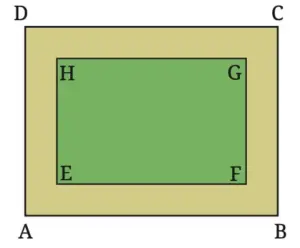
(i) What measurements do you need to find the area of the path? Once you identify the lengths to be measured, assign possible values of your choice to these measurements and find the area of the path. Give a formula for the area.
An example of a formula — Area of a rectangle = length × width.
[Hint: There is a relation between the areas of EFGH, the path, and ABCD.]
Solution:
To find the area of the path, we need:
• Length(L) and breadth(B) of the outer rectangle ABCD.
• Length(l) and breadth(b) of the inner rectangle EFGH.
The area of the path = Area of outer rectangle − Area of inner rectangle
Area of path = (L × B) − (l × b).
Example:
Let L = 20 m, B = 12m, l =14m, b = 8m
Area of path = (20 × 12) – (14 × 8)
⇒ 240 − 112 = 128 m2
Formula: (L × B) − (l × b)
(ii) If the width of the path along each side is given, can you find its area? If not, what other measurements do you need? Assign values of your choice to these measurements and find the area of the path. Give a formula for the area using these measurements.
[Hint: Break the path into rectangles.]
Solution:
If only the width of the path is given, we cannot find its area.
We also need the length and breadth of the inner rectangle (park EFGH).
Let
Length of park = l
Breadth of park = b
Width of path = x
Then,
Outer rectangle breadth = b + 2x
Outer rectangle length = l + 2x
Area of path = Area of outer rectangle − Area of inner rectangle
= (l + 2x)(b + 2x) − (l × b)
Example:
Let l = 10 m, b = 6 m, x = 2m
Outer Length = 10 + 4 = 14m
Outer Breadth = 6 + 4 = 10m
Area of path = Area of outer rectangle – Area of inner rectangle
= (14 × 10) – (10 × 6)
= 140 − 60 = 80 m2
Final Formula:
Area of path = (l + 2x)(b + 2x) − lb = l(b + 2x) + 2x(b + 2x) – lb
= lb + 2lx + 2bx + 4x2 – lb
= 2lx + 2bx + 4x2 = 2x(l + b) + 4x2
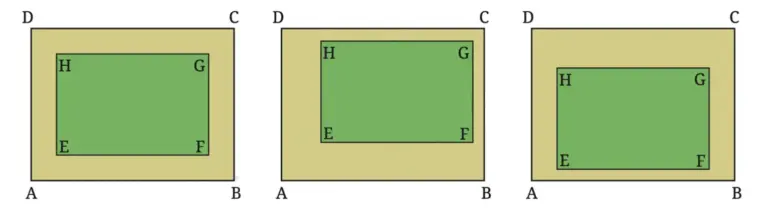
(iii) Does the area of the path change when the outer rectangle is moved while keeping the inner rectangular park EFGH inside it, as shown?
Solution:
No, the area of the path does not change when the outer rectangle is moved because the area depends only on the dimensions, not on the position.
Since both rectangles have the same measurements even after moving, their areas remain unchanged.
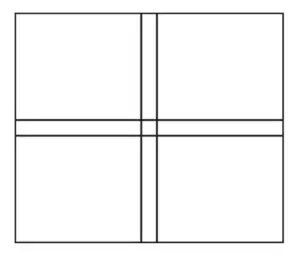
3. The figure shows a plot with sides 14 m and 12 m, and with a crosspath. What other measurements do you need to find the area of the crosspath? Once you identify the lengths to be measured, assign some possible values of your choice and find the area of the path. Give a formula for the area based on the measurements you choose.
Solution:
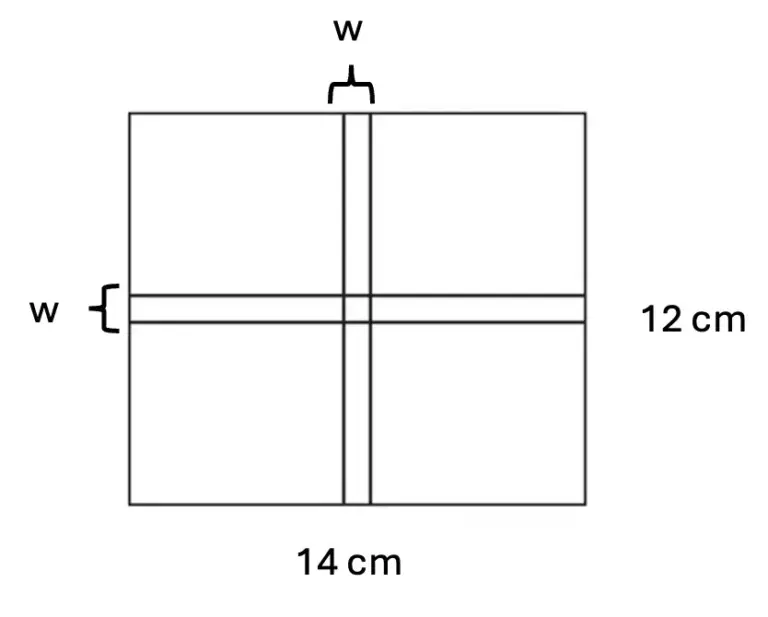
Length (l) of plot = 14 m
Breadth (b) of plot = 12 m
Other measurements needed: Width of the crosspath (w)
Let the width be 2 m.
Area of horizontal path = 14 × 2 = 28 m2
Area of vertical path = 12 × 2 = 24 m2
Area of overlapping square path in the centre = 2 × 2 = 4 m2
Area of the path = 28 m2 + 24 m2 – 4 m2
= 52 m2 – 4 m2 = 48 m2
Formula:
Area of path = (l × w) + (b × w) – (w × w) = lw + bw – w2
4. Find the area of the spiral tube shown in the figure. The tube has the same width throughout.
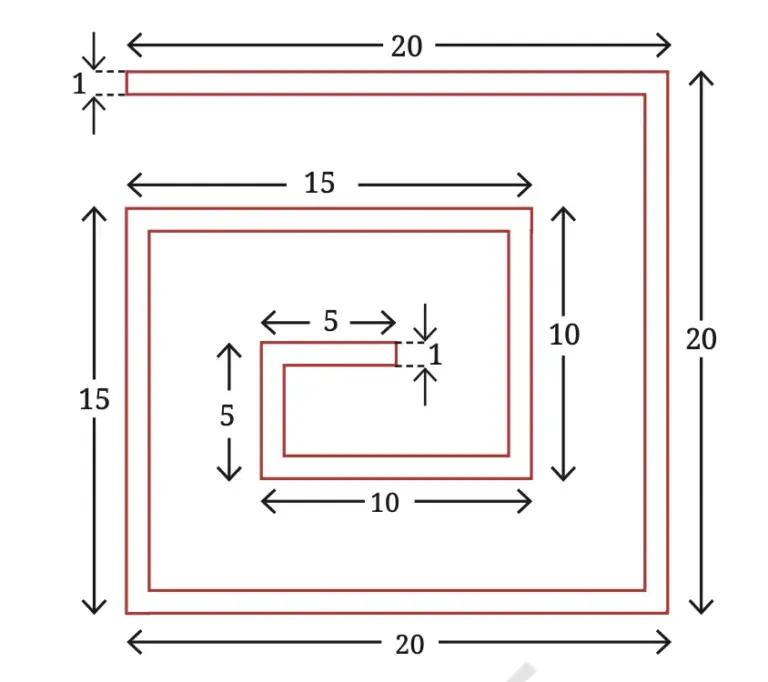
[Hint: There are different ways of finding the area. Here is one method.]
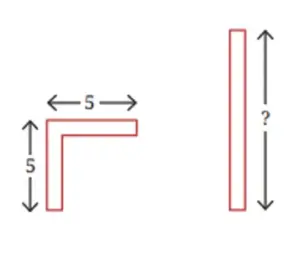
What should be the length of the straight tube if it is to have the same area as the bent tube on the left?
Solution:
Width of tube = 1 unit
The spiral consists of horizontal and vertical segments.
Total length of the spiral tube = 20 + 20 + 20 + 15 + 15 + 10 + 10 + 5 + 5 = 120 unit
Therefore,
Area of the spiral tube = length of the spiral × width = 120 × 1 = 120 sq. unit
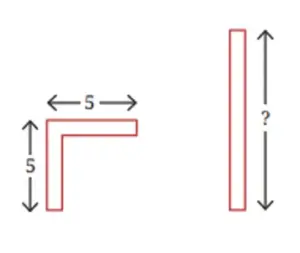
Width of tube = 1 m
Area of bent tube = (5 + 5) × 1 = 10 sq. unit
Let L be the length of the straight tube.
Area of the straight tube = L x 1
Since both tubes are the same,
∴ L × 1 = 10
or L = 10 unit
5. In this figure, if the sidelength of the square is doubled, what is the increase in the areas of the regions 1, 2, and 3? Give reasons.
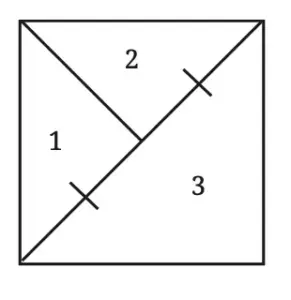
Solution:
Let the side of the square be s.
Area of square = s2
Since the diagonal of a square divides it into two congruent triangles,
Original area of region 3 =
Also, Area of region 1 + region 2 together =
Since regions 1 and 2 have the same measures for height and base.
Original area of region 1 = = =
Original area of region 2 = =
When the side of the square is doubled:
Let new side = 2s
New area of square = (2s)2 = 4s2
New area of region 3 = = 2s2
New area of region 1 and region 2 together = = 2s2
New area of region 1 = = s2
New area of region 2 = = s2
Increase in area of region 1 = s2 ÷
= s2 × = 4 times
Increase in area of region 2 = s2 ÷
= s2 × = 4 times
Increase in area of region 3 = 2s2 ÷
= 2s2 × = 4 times
Therefore, each region’s area becomes 4 times.
6. Divide a square into 4 parts by drawing two perpendicular lines inside the square as shown in the figure. Rearrange the pieces to get a larger square, with a hole inside.
You can try this activity by constructing the square using cardboard, thick chart paper, or similar materials.
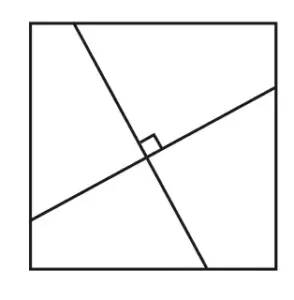
Solution:
Do it yourself.
Figure it Out (Page 157)
1. Find the areas of the following triangles:
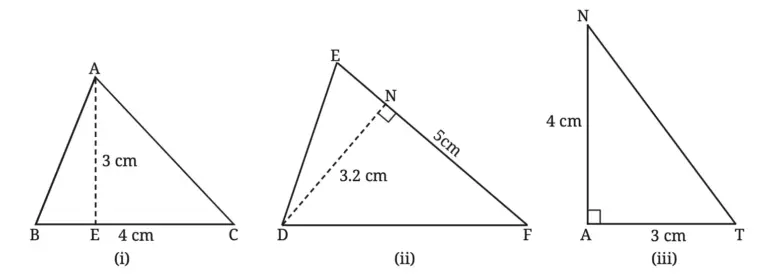
Solution:
(i) Area of △ABC = × base × height
= × BC × AE
= × 4 cm × 3 cm
= 6 cm2
Thus, the area of the △ABC is 6 cm2.
(ii) Area of △DEF = × EF × ND
= × 5 cm × 3.2 cm
= 5 × 1.6 cm2
= 8 cm2
Thus, the area of the △ DEF is 8 cm2.
(iii) Area of ∆NAT = × base × height
= × AT × NA
= × 3 cm × 4 cm
= 6 cm2
Thus, the area of the ∆NAT is 6 cm2.
2. Find the length of the altitude BY.
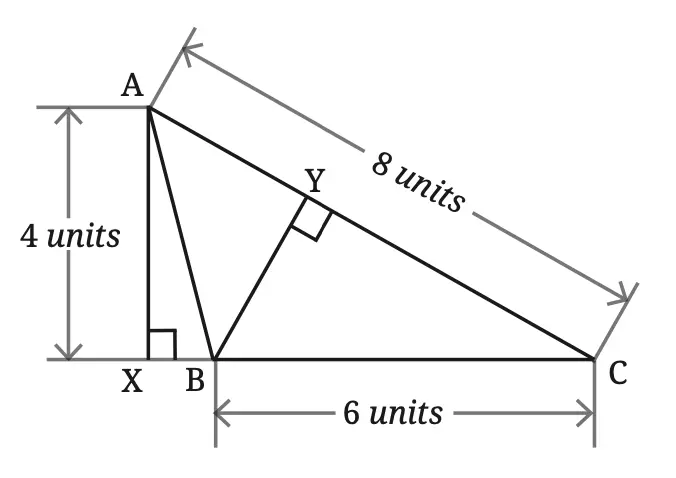
Solution:
Area of △ABC = × AX × BC
= × 4 × 6 = 12 sq. units
Also, Area of △ABC = × AC × BY
⇒ 12 = × 8 × BY
⇒ 24 = 8 × BY
⇒ BY = = 3 cm
Therefore, the length of the altitude BY is 3 cm.
3. Find the area of ∆SUB, given that it is isosceles, SE is perpendicular to UB, and the area of ∆SEB is 24 sq. units.
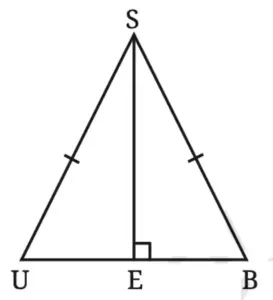
Solution:
SU = SB (Given)
SE = SE (Common)
∠SEU = ∠SEB (Each 90°)
So, △SEU ≅ △SEB (By RHS congruence rule)
∴ Area of ∆SEB = Area of ∆SEU = 24 sq. units
Area of ∆SUB = Area of ∆SEB + Area of ∆SEU = 24 + 24 = 48 sq. units
4. [Śulba-Sūtras] Give a method to transform a rectangle into a triangle of equal area.
Solution:
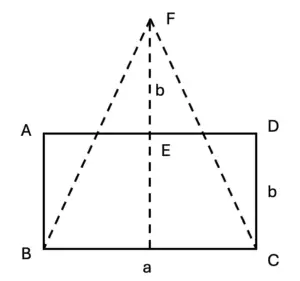
(i) Let ABCD be a rectangle with length a and breadth b.
(ii) Mark E as the midpoint of AD.
(iii) Draw a line perpendicular to AD through E.
(iv) Mark a point F on this perpendicular such that FE = b.
(v) Join F to B and C to form △FBC.
Verification:
Area of rectangle ABCD = a × b = ab
Area of triangle △FBC = × a × 2b = ab
Area of △FBC = Area of rectangle ABCD.
Thus, the rectangle is transformed into a triangle of equal area.
5. [Śulba-Sūtras] Give a method to transform a triangle into a rectangle of equal area.
Solution:
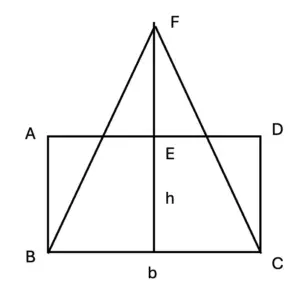
(i) Consider a triangle △ABC with base BC=b and height AD=h.
(ii) Mark M as the midpoint of AD.
(iii) Draw lines through B and C perpendicular to BC.
(iv) Through point M, draw a line parallel to BC.
This line meets the perpendiculars at B and C at points F and G, respectively.
(v) The quadrilateral BCGF is a rectangle
Verification:
Area of rectangle BCGF = b × =
Area of △ABC = × b × h =
Area of rectangle BCGF = Area of △ABC
Thus, the triangle is transformed into a rectangle of equal area.
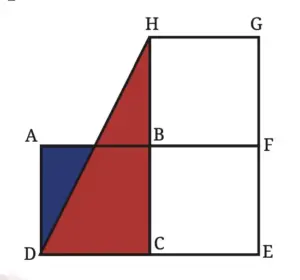
6. ABCD, BCEF, and BFGH are identical squares.
(i) If the area of the red region is 49 sq. units, then what is the area of the blue region?
(ii) In another version of this figure, if the total area enclosed by the blue and red regions is 180 sq. units, then what is the area of each square?
Solution:
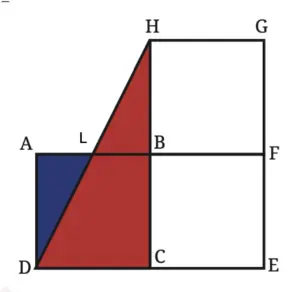
(i) Let the side of each square be a.
Area of the red region, ∆HCD = × DC × HC
= × a × 2a = a2
Given: a2 = 49 ⇒ a = 7 units
AL = = units
Area of the blue region, ∆ADL = × AL × AD
= × × a =
= = 12.25
∴ Area of the blue region is 12.25 sq. units.
(ii) Area of blue region + red region = Area of △HCD + Area of ∆ADL
= a2 + =
Given: = 180
⇒ a2 = = 144
∴ Area of each square is 144 sq. units.
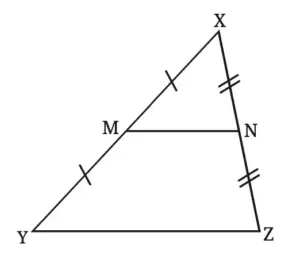
7. If M and N are the midpoints of XY and XZ, what fraction of the area of ∆XYZ is the area of ∆XMN? [Hint: Join NY]
Solution:
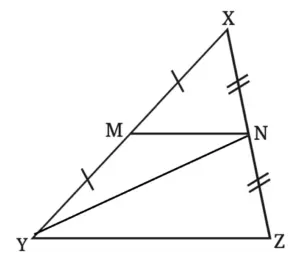
A median divides a triangle into two triangles of equal area.
NM is the median of △XYN,
∴ Area of △XMN = Area of △YMN
Area of △XYN = 2 × Area of △XMN……..(1)
Similarly, NY is the median of △XYZ,
∴ Area of △XYN = Area of △YZN
Area of △XYZ = 2 × Area of △XYN………(2)
Substituting (1) in (2), we get
△XYZ = 2 × Area of △XYN
△XYZ = 2 × (2 × Area of △XMN)
△XYZ = 4 × Area of △XMN.
Now,
=
Therefore, the area of △XMN is of the area of △XYZ.
8. Gopal needs to carry water from the river to his water tank. He starts from his house. What is the shortest path he can take from his house to the river and then to the water tank? Roughly recreate the map in your notebook and trace the shortest path.
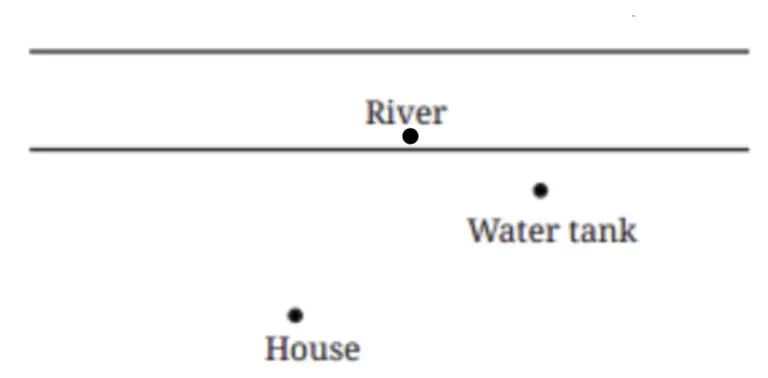
Solution:
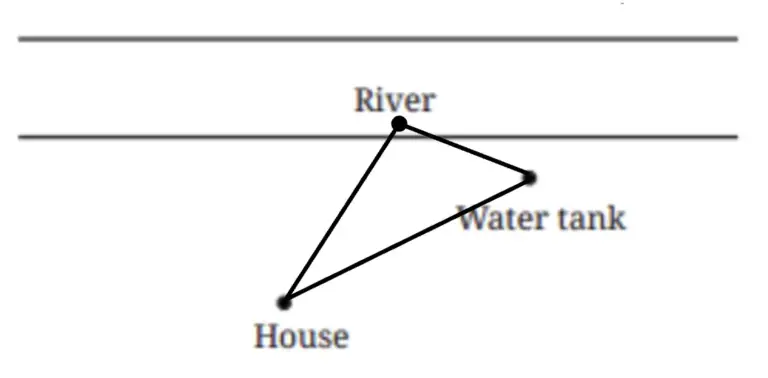
Figure it Out (Page 160)
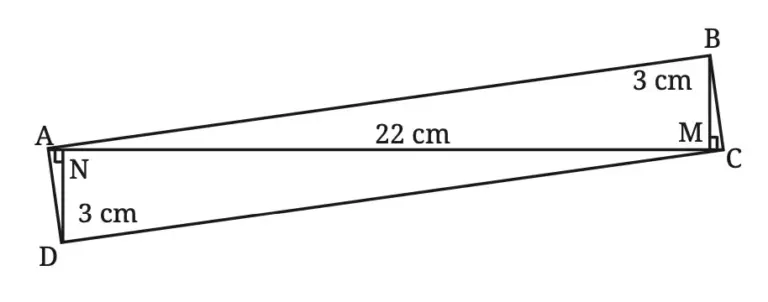
1. Find the area of the quadrilateral ABCD given that AC = 22 cm, BM = 3 cm, DN = 3 cm, BM is perpendicular to AC, and DN is perpendicular to AC.
Solution:
Area of ∆ACB = × AC × BM
= × 22 cm × 3 cm
= 33 cm2
Area of ∆CAD = × AC × DN
= × 22 cm × 3 cm
= 33 cm2
Area of the quadrilateral ABCD = Area of ∆CAD + Area of ∆ACB = 33 + 33 = 66 cm2
∴ Area of the quadrilateral ABCD is 66 cm2.
2. Find the area of the shaded region given that ABCD is a rectangle.
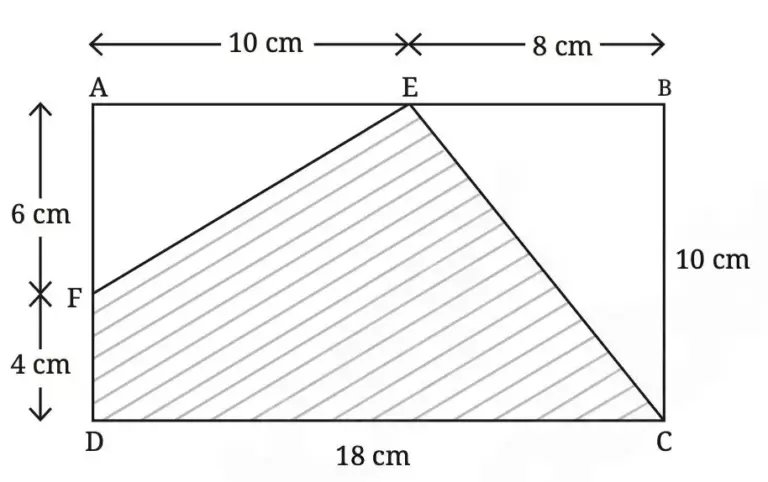
Solution:
Area of rectangle ABCD = AB × AD = 18 × 10 = 180 cm2
Area of △AFE = × AE × AF
= × 10 × 6 = 30 cm2
Area of △EBC = × BE × BC
= × 8 × 10 = 40 cm2
Area of the shaded region = Area of rectangle ABCD – (Area of △AFE + Area of △EBC)
= 180 – (30 + 40)
= 180 – 70 = 110 cm2
Therefore, the area of the shaded region is 110 cm2.
3. What measurements would you need to find the area of a regular hexagon?
Solution:
A regular hexagon can be divided into 6 equal equilateral triangles.
To find its area, we need the length of one side of the hexagon.
Using this, the area of an equilateral triangle can be calculated and then multiplied by 6 to get the total area.
4. What fraction of the total area of the rectangle is the area of the blue region?
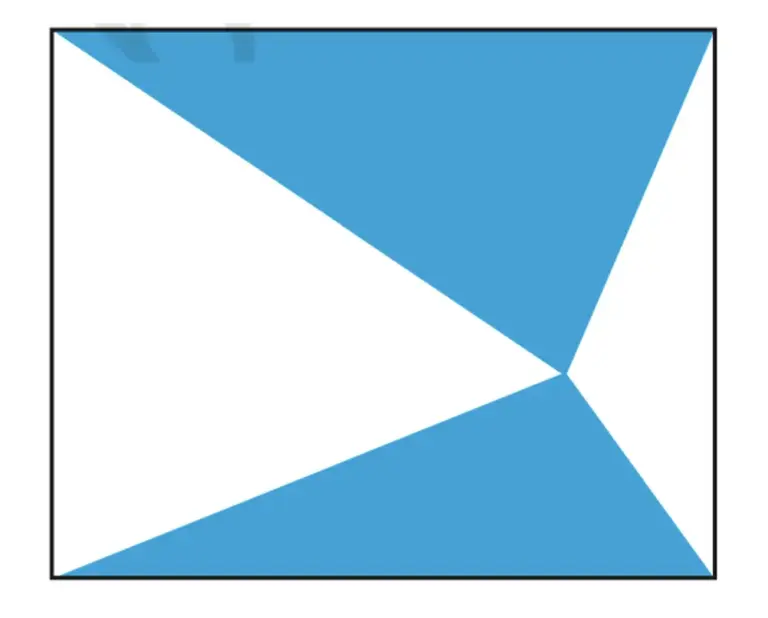
Solution:
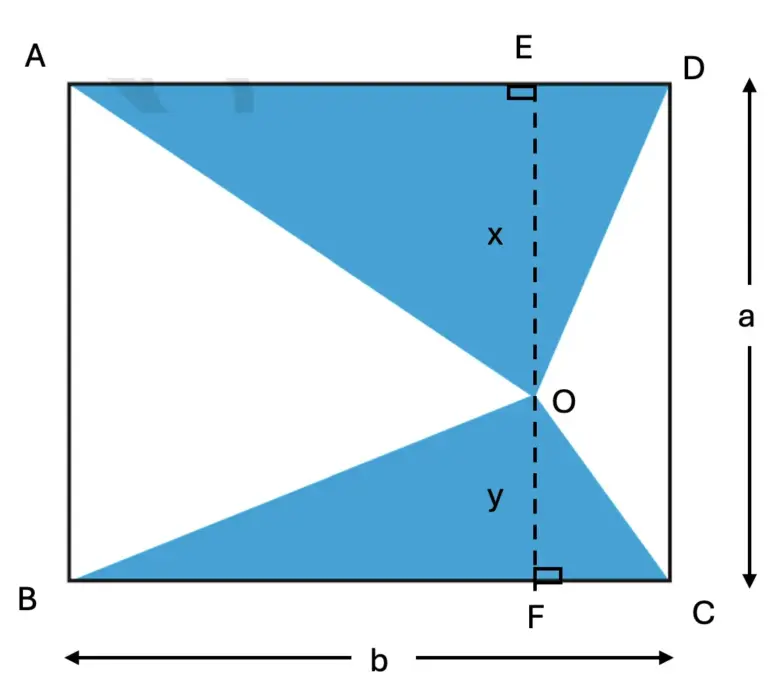
Let the rectangle be ABCD with length a and breadth b.
OE ⟂ AD and OF ⟂ BC
Let OE = x and OF = y
Area of rectangle ABCD = DC × BC = a × b = ab sq units
Area of △AOD = × AD × OE
= × a × x =
Area of △BOC = × BC × OF
= × a × y =
Area of blue region = Area of △AOD + Area of △BOC = +
= = ………. (∵ b = x + y)
= =
Therefore, the blue region is times the area of the rectangle.
5. Give a method to obtain a quadrilateral whose area is half that of a given quadrilateral.
Solution:
Let ABCD be a given quadrilateral.
Mark the midpoints of AB, BC, CD, and DA as P, Q, R, and S.
Join midpoints, then PQRS is the required quadrilateral with half the area of the given quadrilateral ABCD.
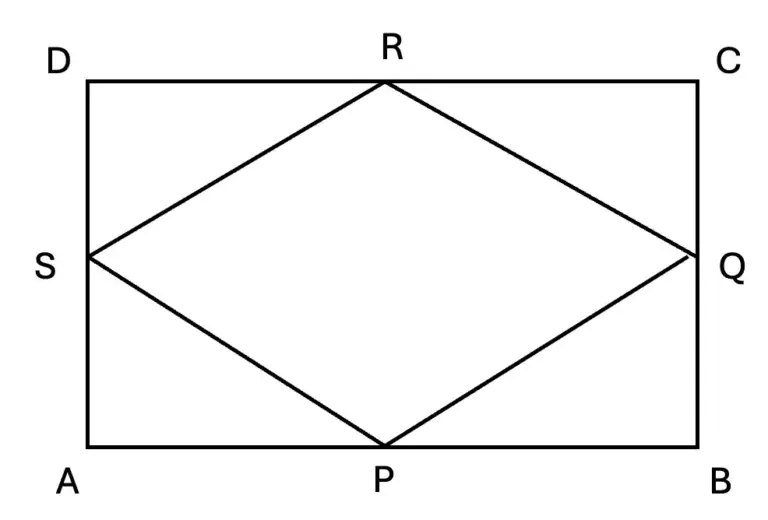
Figure it Out (Page 162)
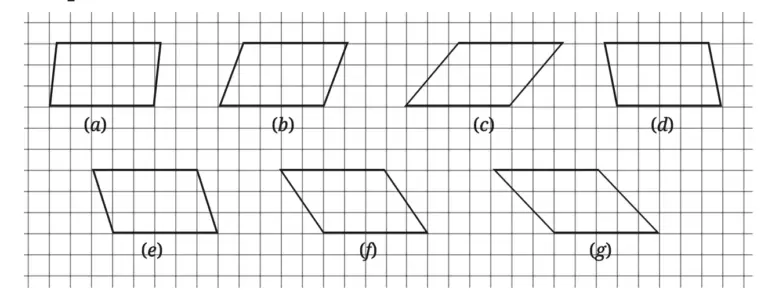
1. Observe the parallelograms in the figure below.
(i) What can we say about the areas of all these parallelograms?
(ii) What can we say about their perimeters? Which figure appears to have the maximum perimeter, and which has the minimum perimeter?
Solution:
(i) All these parallelograms have the same area.
Reason: Each is drawn on the same base and between the same parallel lines (same height).
Since Area = base × height, their areas are equal.
(ii) The perimeters are not the same because as the parallelogram becomes more “tilted,” the slant sides become longer, increasing the perimeter.
Figure (a) has the minimum perimeter, and Figure (g) has the maximum perimeter.
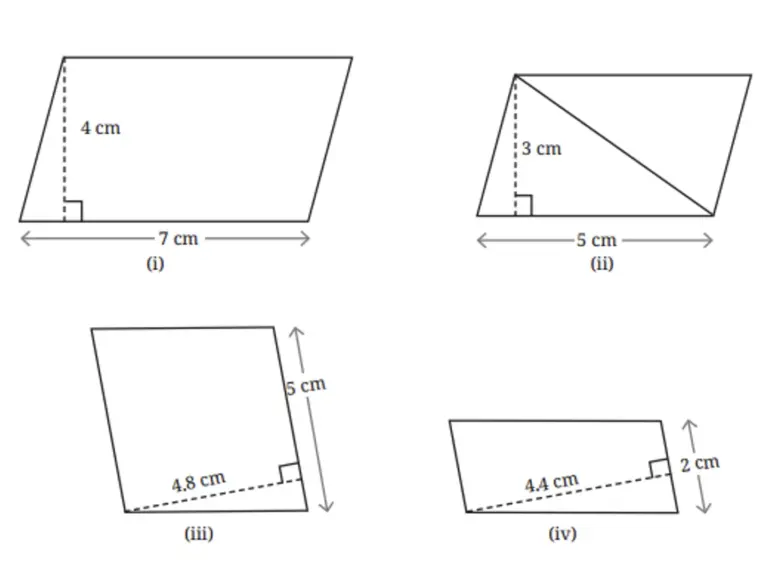
2. Find the areas of the following parallelograms:
Solution:
Area of the parallelogram = base × height
(i) Base = 7 cm and height = 4 cm
Area of the parallelogram = 7 cm × 4 cm = 28 cm2
(ii) Base = 5 cm and height = 3 cm
Area of the parallelogram = 5 cm × 3 cm = 15 cm2
(iii) Base = 5 cm and height = 4.8 cm
Area of the parallelogram = 5 cm × 4.8 cm = 24 cm2
(iv) Base = 2 cm and height = 4.4 cm
Area of the parallelogram = 2 cm × 4.4 cm = 8.8 cm2
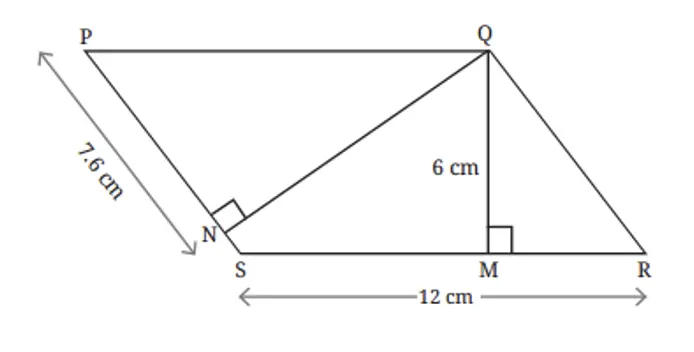
3. Find QN.
Solution:
Since QM ⟂ SR
So, area of parallelogram PQRS = QM × SR = 6 × 12 = 72 cm2
Also, QN ⟂ PS
So area of parallelogram PQRS = PS × QN = 7.6 × QN
Since both represent the same parallelogram,
7.6 × QN = 72
QN =
QN = 9.47 cm
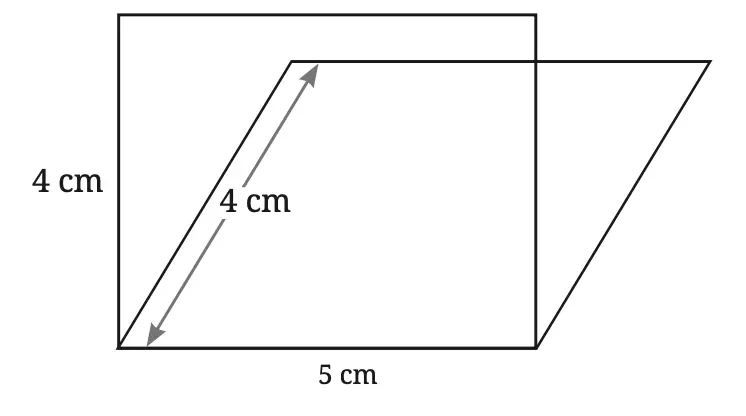
4. Consider a rectangle and a parallelogram of the same sidelengths: 5 cm and 4 cm. Which has the greater area?
[Hint: Imagine constructing them on the same base.]
Solution:
Area of rectangle = 5 × 4 = 20 cm2
In the parallelogram,
One side is 5 cm, and the adjacent side is 4 cm. But, the height corresponding to the base 5 cm is less than 4 cm (since the side is slanted).
So,
Area of parallelogram = base × height < 5 × 4 = 20 cm2
∴ The rectangle has the greater area.
5. Give a method to obtain a rectangle whose area is twice that of a given triangle. What are the different methods that you can think of?
Solution:
Method 1:
1. Take a triangle ABC with base BC and height h.
2. Through vertex A, draw a line parallel to BC.
3. At B and C, draw perpendiculars to BC meeting the parallel line at D and E, respectively.
4. BCED is a rectangle.
Justification:
Area of rectangle = BC × h
Area of triangle
∴ Area of rectangle = 2 × Area of triangle
Method 2:
1. Take triangle ABC.
2. Reflect it across base BC (or rotate it) to form another congruent triangle.
3. The two triangles together form a parallelogram.
4. Convert this parallelogram into a rectangle of equal area (by rearranging a triangular portion).
Result:
The rectangle formed has twice the area of the original triangle.
6. [Śulba-Sūtras] Give a method to obtain a rectangle of the same area as a given triangle.
Solution:
1. Take a triangle ABC with base BC and height h.
2. Find the midpoint D of the height (or of the altitude from A to BC).
3. Through D, draw a line parallel to BC.
4. Complete the figure to form a rectangle on base BC and height .
Justification:
Area of triangle
Area of rectangle
∴ Area of rectangle = Area of triangle.
7. [Śulba-Sūtras] An isosceles triangle can be converted into a rectangle by dissection in a simpler way. Can you find out how to do it?
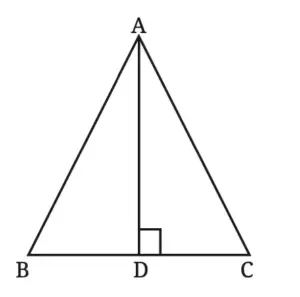
[Hint: Show that triangles ∆ADB and ∆ADC can be made into halves of a rectangle. Figure out how they should be assembled to get a rectangle. Use cut-outs if necessary.]
8. [Śulba-Sūtras] Give a method to convert a rectangle into an isosceles triangle by dissection.
9. Which has greater area — an equilateral triangle or a square of the same sidelength as the triangle? Which has greater area — two identical equilateral triangles together or a square of the same sidelength as the triangle? Give reasons.
Solution:
Let the common side length be a.
(i) Equilateral triangle vs square:
Area of equilateral triangle = a2
Area of square = a2
Since < 1
a2 < a2
∴ Square has the greater area.
(ii) Two equilateral triangles vs square:
Area of equilateral triangle = 2 × a2 = a2
Area of square = a2
Since < 1
a2 < a2
∴ Square still has the greater area.
Figure it Out (Page 169 – 170)
1. Find the area of a rhombus whose diagonals are 20 cm and 15 cm.
Solution:
First diagonal = 20 cm
Second diagonal = 15 cm
Area of rhombus = × first diagonal × second diagonal
= × 20 × 15
= 10 × 15 = 150 cm2
Therefore, area of the given rhombus is 150 cm2.
2. Give a method to convert a rectangle into a rhombus of equal area using dissection.
Solution:
(i) Take a rectangle WXYZ.
(ii) Divide the rectangle into two equal parts by drawing a line parallel to one pair of sides. This gives two rectangles of equal area.
(iii) Draw a diagonal of each of the two rectangles, dividing two rectangles into 4 equal triangles.
(iv) Dissect rectangles along these diagonals.
(v) Rearrange these triangles to form two
3. Find the areas of the following figures:
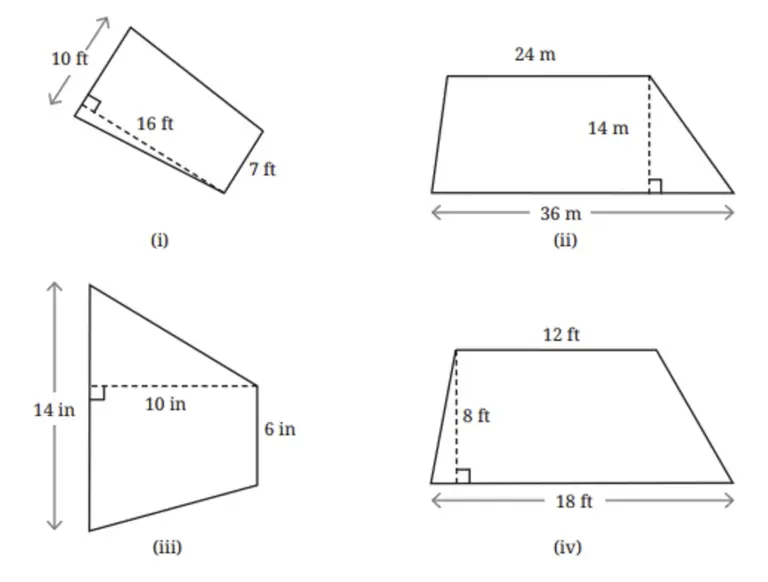
Solution:
The area of the trapezium = × (Sum of parallel sides) × (Distance between them) = × (a + b) × h
(i) Here, a = 10 ft, b = 7 ft and h = 16 ft
Area of trapezium = × (10 + 7) × 16
= 17 × 8 = 136 ft2
(ii) Here, a = 36 m, b = 24 m and h = 14 m
Area of trapezium = × (36 + 24) × 14
= 60 × 7 = 420 m2
(iii) Here, a = 14 in, b = 6 in and h = 10 in
Area of trapezium = × (14 + 6) × 10
= 20 × 5 = 100 in2
(iv) Here, a = 18 ft, b = 12 ft and h = 8 ft
Area of trapezium = × (18 + 12) × 8
= 30 × 4
= 120 ft2
4. [Śulba-Sūtras] Give a method to convert an isosceles trapezium to a rectangle using dissection.
5. Here is one of the ways to convert trapezium ABCD into a rectangle EFGH of equal area —
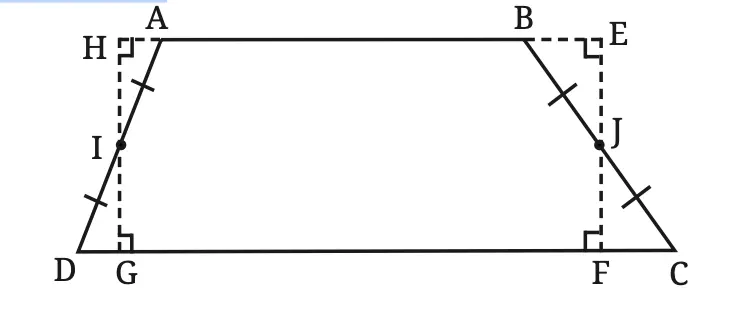
Given the trapezium ABCD, how do we find the vertices of the rectangle EFGH?
[Hint: If ∆AHI ≅ ∆DGI and ∆BEJ ≅ ∆CFJ, then the trapezium and rectangle have equal areas.]
6. Using the idea of converting a trapezium into a rectangle of equal area, and vice versa, construct a trapezium of area 144 cm2.
7. A regular hexagon is divided into a trapezium, an equilateral triangle, and a rhombus, as shown. Find the ratio of their areas.
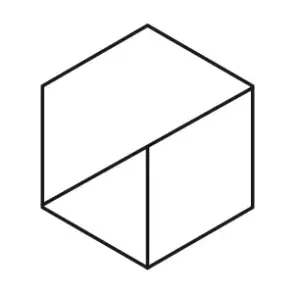
Solution:
Area of equilateral triangle = a2
Area of rhombus = 2 × Area of equilateral triangle
= 2 × a2 = a2
Area of trapezium = 3 × Area of equilateral triangle
= 3 × a2 = 3a2
Trapezium: Equilateral triangle: Rhombus
⇒ 3a2 : a2 : 2a2
⇒ 3 : 1 : 2
Hence, the required ratio is 3 : 1 : 2.
8. ZYXW is a trapezium with ZY ‖ WX. A is the midpoint of XY. Show that the area of the trapezium ZYXW is equal to the area of ∆ZWB.
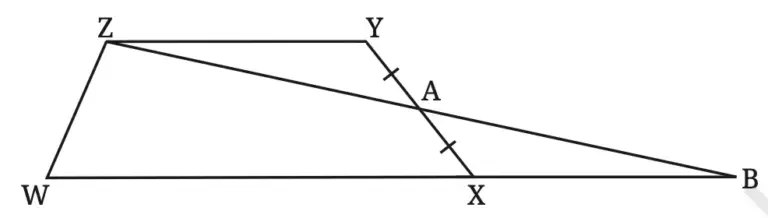
Solution:
∠ZAY = ∠BAX (Vertically opposite angles)
AY = AX (∵ A is mid point of XY)
∠YZB = ∠XBZ (alternate interior angles)
∴ ∆ZAY ≅ ∆BAX (By AAA congruence rule)
So, Area of ∆ZAY = Area of ∆BAX
Area of trapezium ZYXW = Area of quadrilateral ZAXW + Area of ∆ZAY
Area of ∆ZWB = Area of quadrilateral ZAXW + Area of ∆BAX
Since Area of ∆ZAY = Area of ∆BAX
Thus, Area of trapezium ZYXW = Area of triangle ZWB.
Our solutions follow the latest NCERT Class 8 Ganita Prakash Part 2 syllabus and provide step-by-step explanations for every question. Whether you are completing homework, preparing for school tests, or revising before exams, these solutions will help you build a strong foundation in mathematics.
Why Choose Our NCERT Solutions?
- Simple and easy-to-understand explanations
- Step-by-step solutions for every exercise
- Based on the latest NCERT syllabus
- Helpful for homework, revision, and exams
- Free access for all students
If you are searching for reliable and accurate Class 8 Ganita Prakash Part 2 Chapter 7 Area NCERT Solutions, visit School Learners.
Website: https://schoollearners.in/
At School Learners, you can find NCERT Solutions, Notes, Important Questions, Sample Papers, and study materials for Class 6 to Class 12. Our goal is to make learning simple, effective, and accessible for every student.
Start learning today with the best Area Class 8 Ganita Prakash Part 2 Chapter 7 NCERT Solutions and boost your exam preparation with School Learners.