Algebra Play Class 8 Maths Ganita Prakash Part 2 Chapter 6 NCERT Solutions If you are looking for Algebra Play Class 8 Maths Ganita Prakash Part 2 Chapter 6 NCERT Solutions, you are in the right place. This chapter introduces algebra in a fun and interactive way, helping students understand algebraic expressions, patterns, variables, and logical problem-solving. Our step-by-step solutions are prepared according to the latest NCERT Class 8 Maths Ganita Prakash Part 2 syllabus.
Page 137
Q. Find the dates if the final answers are the following:
(i) 1269 (ii) 394 (iii) 296
Solution:
(i) 1269
Let the month be M and the day be D.
Multiply M by 5: 5M
Add 6: 5M + 6
Multiply by 4: 20M + 24
Add 9: 20M + 33
Multiply by 5: 100M + 165
Add the day: 100M + 165 + D
Given Answer = 1269
1269 = 100M + 165 + D
1269 – 165 = 100M + D
1104 = 100M + D
1100 + 4 = 100M + D
∴ M = 11, D = 4 (i.e 4th of November)
(ii) 394
Let the month be M and the day be D.
Multiply M by 5: 5M
Add 6: 5M + 6
Multiply by 4: 20M + 24
Add 9: 20M + 33
Multiply by 5: 100M + 165
Add the day: 100M + 165 + D
Given Answer = 394
394 = 100M + 165 + D
394 – 165 = 100M + D
229 = 100M + D
200 + 29 = 100M + D
∴ M = 2, D = 29 (i.e 29th of February)
(iii) 296
Let the month be M and the day be D.
Multiply M by 5: 5M
Add 6: 5M + 6
Multiply by 4: 20M + 24
Add 9: 20M + 33
Multiply by 5: 100M + 165
Add the day: 100M + 165 + D
Given Answer = 296
296 = 100M + 165 + D
296 – 165 = 100M + D
131 = 100M + D
100 + 31 = 100M + D
∴ M = 1, D = 31 (i.e 31st of January)
Page 139
Q. Fill the following pyramids:
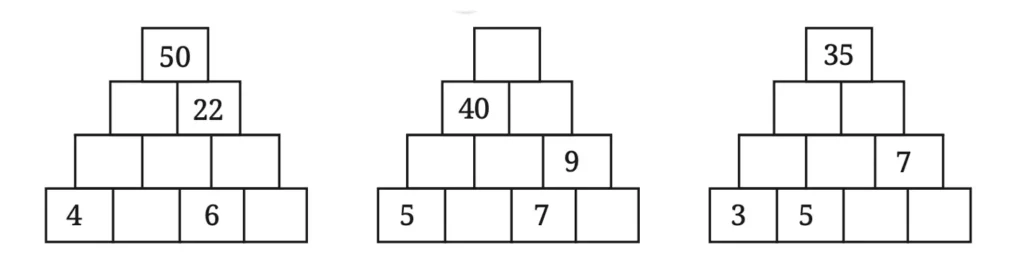
Solution:
(i)
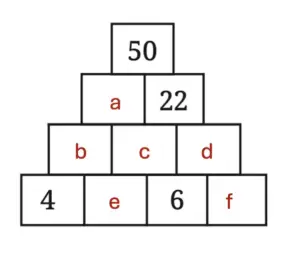
Let us fill the empty boxes with a, b, c, d, e, and f.
Thus,
a + 22 = 50
a = 50 – 22 = 28
b + c = a ⇒ b + c = 28 …………. (i)
c + d = 22 …………… (ii)
4 + e = b …………….. (iii)
6 + f = d ……………… (iv)
6 + e = c ……………… (v)
Substituting (iii) and (v) in (i),
(4 + e) + (6 + e) = b + c = 28
4 + e + 6 + e = 28
10 + 2e = 28
2e = 28 – 10
2e = 18 ⇒ e = 9
Substituting (v) and (iv) in (ii),
(6 + e) + (6 + f) = c + d = 22
(6 + 9) + 6 + f = 22
15 + 6 + f = 22
21 + f = 22
f = 22 – 21 ⇒ f = 1
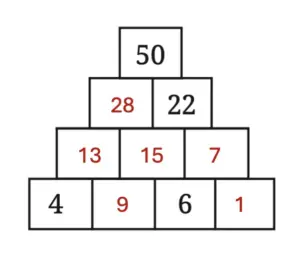
b = 4 + e = 4 + 9 = 13
c = 6 + e = 6 + 9 = 15
d = 6 + f = 6 + 1 = 7
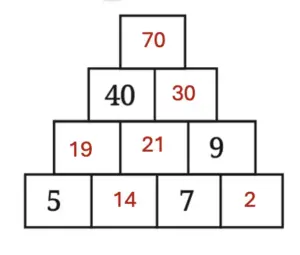
(ii)
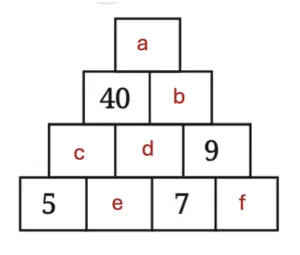
Let us fill the empty boxes with a, b, c, d, e, and f.
Thus,
40 + b = a …………. (i)
c + d = 40 …………. (ii)
d + 9 = b …………… (iii)
5 + e = c …………… (iv)
e + 7 = d …………… (v)
7 + f = 9
f = 9 – 7 ⇒ f = 2
Substituting (iv) and (v) in (ii),
(5 + e) + (e + 7) = c + d = 40
2e + 12 = 40
2e = 40 – 12
2e = 28 ⇒ e = 14
d = e + 7 = 14 + 7 = 21
b = d + 9 = 21 + 9 = 30
c = 5 + e = 5 + 14 = 19
a = 40 + b = 40 + 30 = 70
(iii)
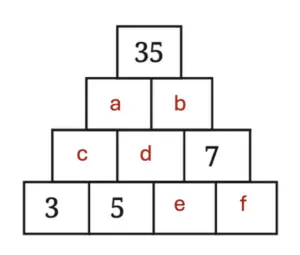
Let us fill the empty boxes with a, b, c, d, e, and f.
Thus,
a + b = 35 ………… (i)
c + d = a …………… (ii)
d + 7 = b …………… (iii)
3 + 5 = c ⇒ c = 8
5 + e = d …………… (iv)
e + f = 7 ……………. (v)
Substituting (ii) and (iii) in (i),
(c + d) + (d + 7) = a = b = 35
c + 2d + 7 = 35
8 + 2d + 7 = 35 ……… (Using c = 8)
2d + 15 = 35
2d = 35 – 15
2d = 20 ⇒ d = 10
Substituting d =10 in (iv),
5 + e = 10
e = 10 – 5 ⇒ e = 5
a = c + d = 8 + 10 = 18
b = d + 7 = 10 + 7 = 17
Substituting e = 5 in (v),
5 + f = 7
f = 7 – 5 ⇒ f = 2
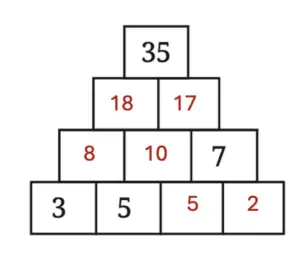
Figure it Out (Page 140)
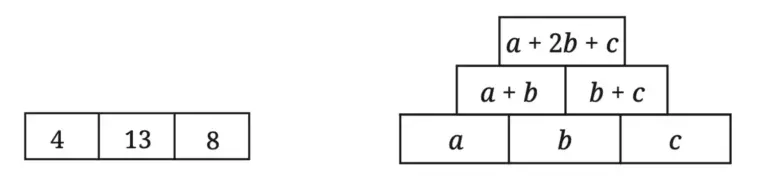
1. Without building the entire pyramid, find the number in the topmost row given the bottom row in each of these cases.
(i)
Solution:
If a = 4, b = 13 and c = 8, then
Top number = a + 2b + c
= 4 + 2 × 13 + 8
= 4 + 26 + 8 = 38
Therefore, the number in the topmost row is 38.
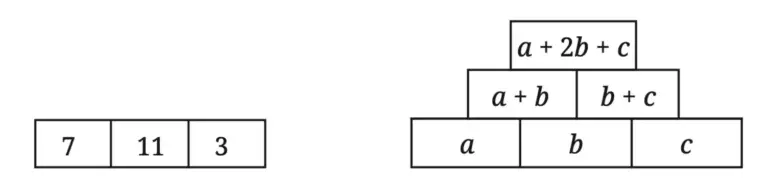
(ii)
Solution:
If a = 7, b = 11, c = 3, then
Top number = a + 2b + c
= 7 + 2 × 11 + 3
= 7 + 22 + 3 = 32.
Therefore, the number in the topmost row is 32.
(iii)
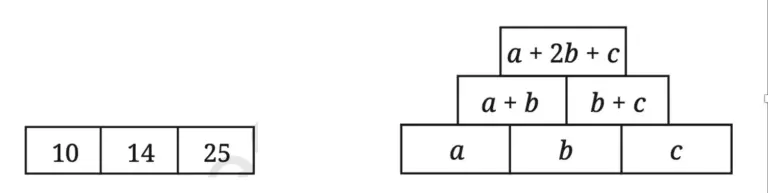
Solution:
If a = 10, b = 14, c = 25, then
Top number = a + 2b + c
= 10 + 2 × 14 + 25
= 10 + 28 + 25 = 63.
Therefore, the number in the topmost row is 63
2. Write an expression for the topmost row of a pyramid with 4 rows in terms of the values in the bottom row.
Solution:
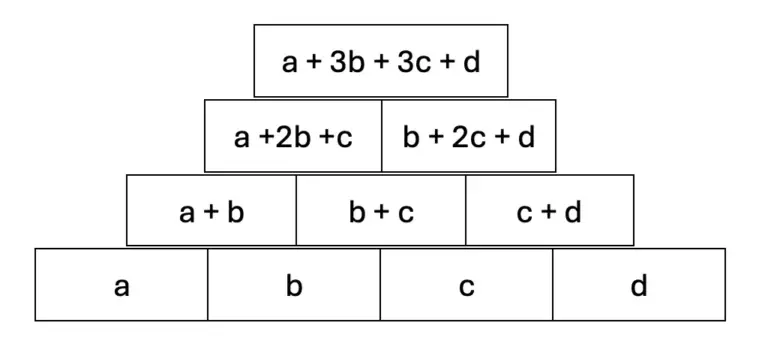
Let the bottom row be: a, b, c, d.
Second row:
• a + b
• b + c
• c + d
Third row:
• (a + b) + (b + c) = a + 2b + c
• (b + c) + (c + d) = b + 2c + d
Top row:
• (a + 2b + c) + (b + 2c + d) = a + 3b + 3c + d
Therefore, the final expression for the topmost value is a + 3b + 3c + d.
3. Without building the entire pyramid, find the number in the topmost row given the bottom row in each of these cases.

Recall the Virahāṅka-Fibonacci number sequence 1, 2, 3, 5, … where each number is the sum of the two numbers before it.
Solution:
(i)
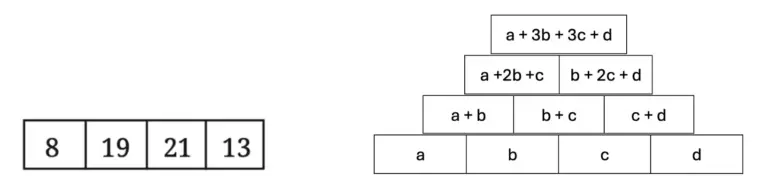
Let the bottom row be a, b, c, d, and the number in the topmost row be (a + 3b + 3c + d).
Given bottom row: 8, 19, 21, 13
If a = 8, b = 19, c = 21, d = 13, then
Top number = a + 3b + 3c + d
= 8 + 3 × 19 + 3 × 21 + 13
= 8 + 57 + 63 + 13 = 141.
Therefore, the number in the topmost row is 141.
(ii)
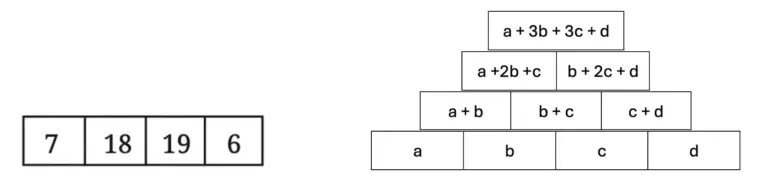
Let the bottom row be: a, b, c, d, and the number in the topmost row be (a + 3b + 3c + d).
Given bottom row: 7, 18, 19, 6
If a = 7, b = 18, c = 19, d = 6, then
Top number = a + 3b + 3c + d
= 7 + 3 × 18 + 3 × 19 + 6
= 7 + 54 + 57 + 6 = 124.
Therefore, the number in the topmost row is 124.
(iii)
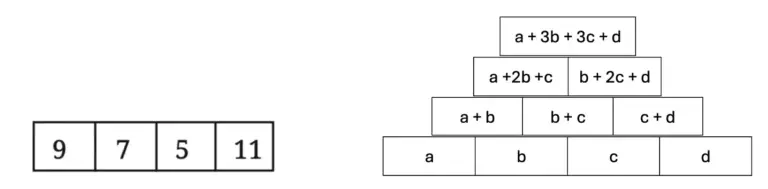
Let the bottom row be a, b, c, d, and the number in the topmost row be (a + 3b + 3c + d).
Given bottom row: 9, 7, 5, 11
If a = 9, b = 7, c = 5, d = 11, then
Top number = a + 3b + 3c + d
= 9 + 3 × 7 + 3 × 5 + 11
= 9 + 21 + 15 + 11 = 56.
Therefore, the number in the topmost row is 56.
4. If the first three Virahāṅka-Fibonacci numbers are written in the bottom row of a number pyramid with three rows, fill in the rest of the pyramid. What numbers appear in the grid? What is the number at the top? Are they all Virahāṅka-Fibonacci numbers?
Solution:
The first three Virahāṅka-Fibonacci numbers are 1, 2, 3.
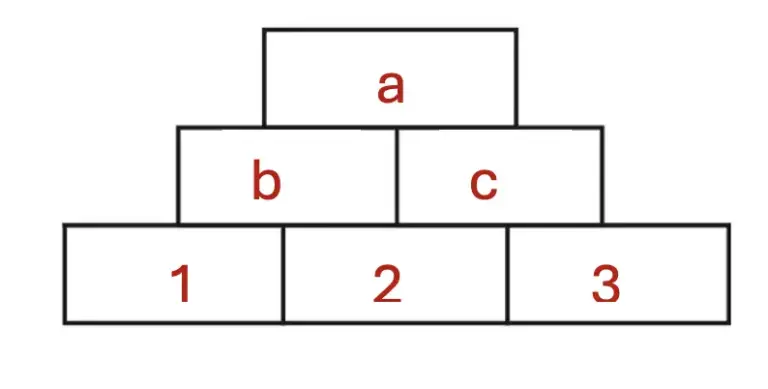
Numbers in the bottom row = 1, 2, 3.
Let the missing numbers be a, b, and c.
b = 1 + 2 = 3
c = 2 + 3 = 5
a = b + c = 3 + 5 = 8
Therefore, the pyramid is:
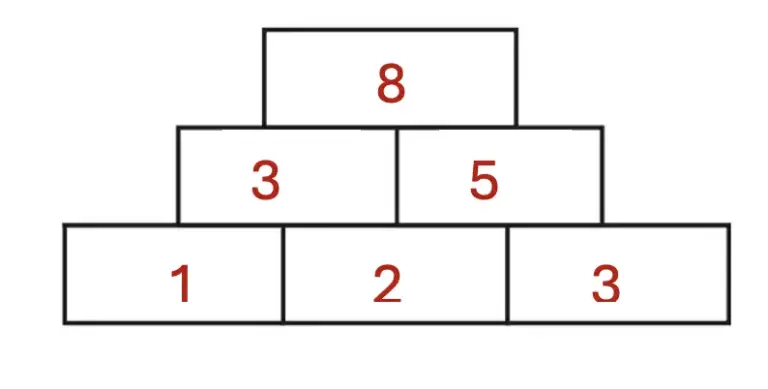
Numbers in the grid: 1, 2, 3, 3, 5, 8
Top number: 8
Yes, 1, 2, 3, 3, 5, 8 are Virahanka-Fibonacci numbers.
5. What can you say about the numbers in the pyramid and the number at the top in the following cases? (i) The first four Virahāṅka-Fibonacci numbers are written in the bottom row of a four-row pyramid.
(ii) The first 29 Virahāṅka-Fibonacci numbers are written in the bottom row of a 29-row pyramid.
Solution:
(i) The first four Virahanka-Fibonacci numbers are 1, 2, 3, 5.
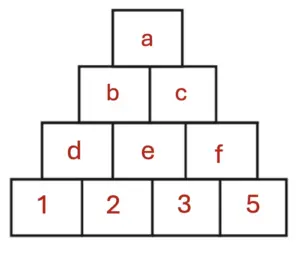
Numbers in the bottom row of the 4-row pyramid = 1, 2, 3, 5.
Let the missing numbers be a, b, c, d, e, and f.
d = 1 + 2 = 3
e = 2 + 3 = 5
f = 3 + 5 = 8
b = d + e = 3 + 5 = 8
c = e + f = 5 + 8 = 13
a = b + c = 8 + 13 = 21
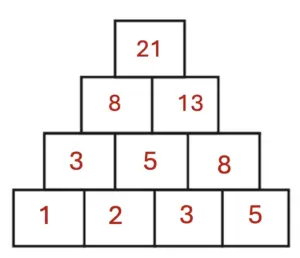
Therefore, the numbers in the pyramid are 1, 2, 3, 5, 3, 5, 8, 8, 13, 21, and the number at the top is 21.
(ii) From the above solution,
The number at the top = 2 × (Numbers at the bottom of the pyramid) – 1
= 2 × 29 – 1
= 58 – 1 = 57
Therefore, the number at the top is the 57th number of the Fibonacci sequence.
6. If the bottom row of an n-row pyramid contains the first n Virahāṅka-Fibonacci numbers, what can we say about the numbers in the pyramid? What can we say about the number at the top?
Solution:
Each number is obtained by adding the two numbers below it, so all entries are sums of the given Fibonacci numbers.
The top number is the (2n − 1)th Virahāṅka–Fibonacci number.
Page 142
Q. Create your own calendar trick. For instance, choose a grid of a different size and shape.
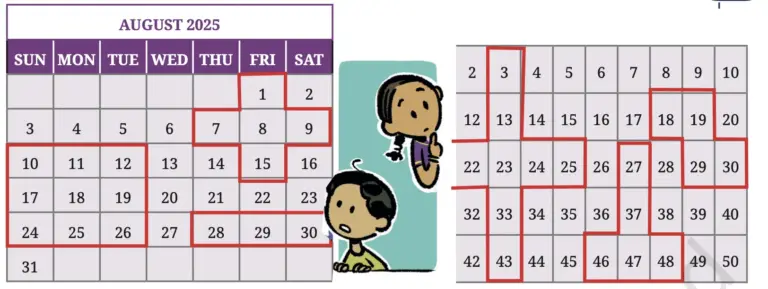
Solution:
(i)
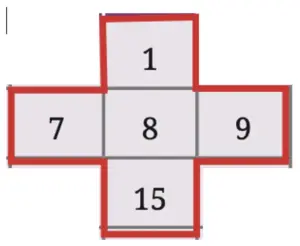
Sum of numbers = 1 + 7 + 8 + 9 + 15 = 40
Let ‘a’ represents the topmost number.
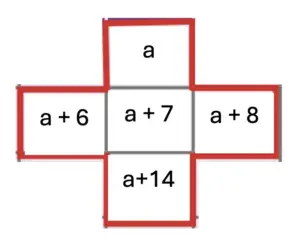
Calendar trick:
Sum = a + (a + 6) + (a + 7) + (a + 8) + (a + 14) = 5a + 35.
(ii)
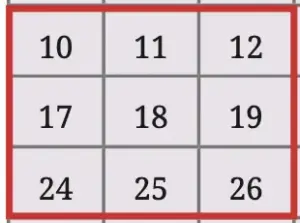
Sum of numbers = (10 + 11 + 12) + (17 + 18 + 19) + (24 + 25 + 26) = 33 + 54 + 75 = 162.
Let ‘a’ represents the top left number.
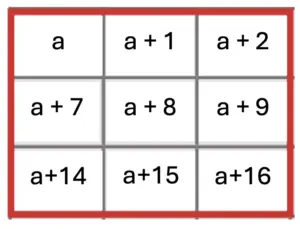
Calendar trick:
Sum = a + (a + 1) + (a + 2) + (a + 7) + (a + 8) + (a + 9) + (a + 14) + (a + 15) + (a + 16)
= 9a + 72 = 9(a + 8)
(iii)
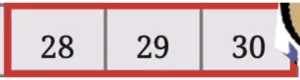
Sum of numbers = 28 + 29 + 30 = 87
Let ‘a’ represents the top left number.
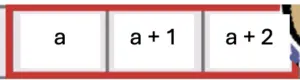
Calender trick:
Sum = a + (a + 1) + (a + 2)
= 3a + 3 = 3(a + 1)
(iv)
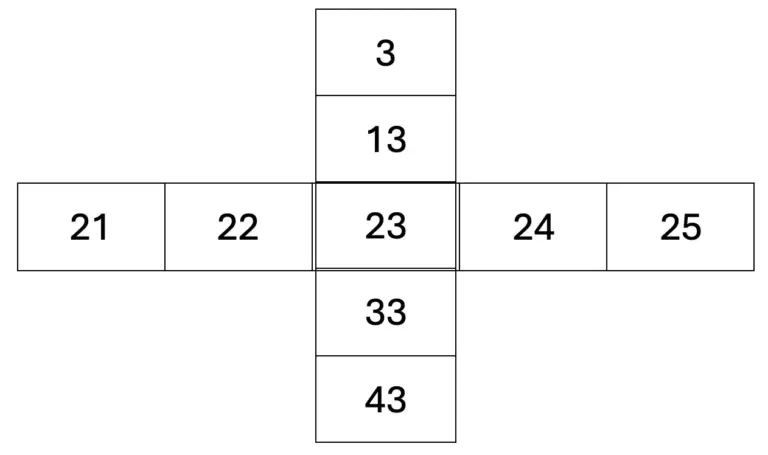
Sum of numbers = 3 + 13 + 23 + 33 + 43 + 21 + 22 + 23 + 24 + 25 = 230
Let ‘a’ represents the top-most number.
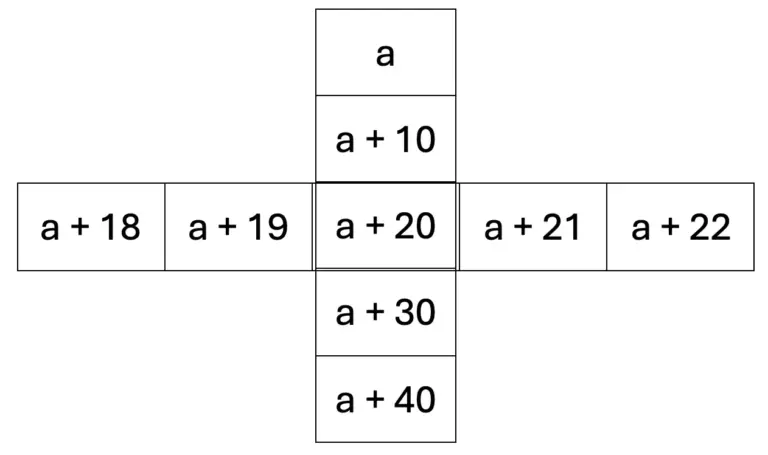
Calendar trick:
Sum = a + (a + 10) + (a + 20) + (a + 30) + (a + 40) + (a + 18) + (a + 19) + (a + 21) +(a + 22)
= 9a + 180 = 9(a + 20)
(v)
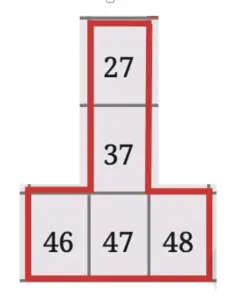
Sum of numbers = 27 + 37 + 47 + 46 + 48 = 205
Let ‘a’ represents the top-most number.
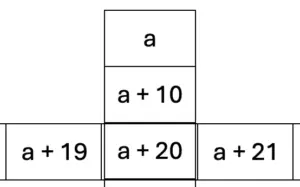
Calendar trick:
Sum = a + (a + 10) + (a + 20) + (a + 19) + (a + 21)
= 5a + 70 = 5(a + 14)
(vi)
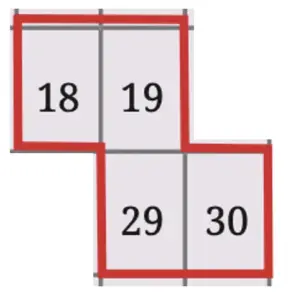
Sum of numbers = 18 + 19 + 29 + 30 = 96
Let ‘a’ represents the top-left number.
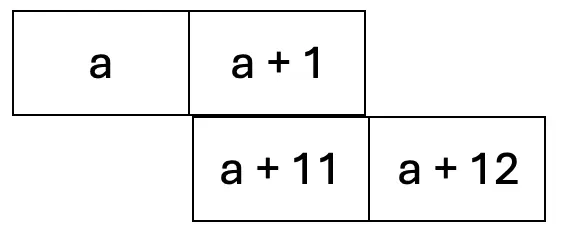
Calendar trick:
Sum = a + (a + 1) + (a + 11) + (a + 12)
= 4a + 24 = 4(a + 6)
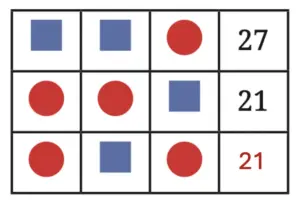
Q. In the following grids, find the values of the shapes and fill in the empty squares:
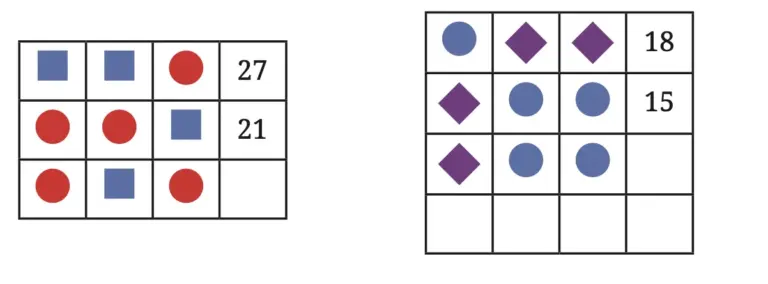
Solution:
(i) Let Red circle = C and Blue square = S
S + S + C = 27 ⇒ 2S + C = 27
C = 27 − 2S ………… (1)
C + C + S = 21 ⇒ 2C + S = 21
2(27 – 2S) + S = 21 ………… (Using 1)
54 – 4S + S = 21
-3S = 21 – 54
-3S = -33
S = 11
C = 27 − 22 = 5
Also, C + S + C = 5 + 11 + 5 = 21
(ii) Let Purple diamond = D and Blue circle = A
A + D + D = 18 ⇒ A + 2D = 18
A = 18 – 2D
D + A + A = 15 ⇒ D + 2A = 15
D + 2(18 – 2D) = 15
D + 36 – 4D = 15
-3D = 15 – 36
-3D = -21
D = 7
A = 18 − 14 = 4
Also, D + A + A = 7 + 4 + 4 = 15
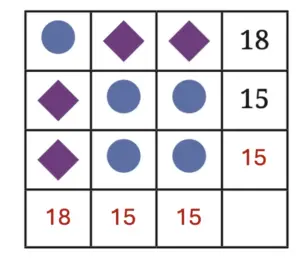
Figure it Out (Page 144)
1. Fill the digits 1, 3, and 7 in ☐☐ × ☐ to make the largest product possible.
Solution:
There are six ways to place three digits:
We can fill the first box with 1, 3, or 7.
For each of these choices, we have 2 ways of filling the remaining 2 digits.
The six options are 13 × 7, 17 × 3, 31 × 7, 37 × 1, 71 × 3, 73 × 1.
We can group them in pairs where the multiplier is the same.
• 13 × 7 and 31 × 7
• 17 × 3 and 71 × 3
• 37 × 1 and 73 × 1
In each pair, the one with the larger multiplicand generates the larger product, so we can reduce the comparison to these three expressions.
• 31 × 7
• 71 × 3
• 73 × 1
It is clear that 71 × 3 is bigger than 73 × 1, so we only need to compare 71 × 3 and 31 × 7. Let us expand these.
71 × 3 = (10 × 7 × 3) + (1 × 3)
31 × 7 = (10 × 3 × 7) + (1 × 7)
The first terms in both expressions are the same. The second term shows that 31 × 7 is the largest product.
2. Fill the digits 3, 5, and 9 in ☐☐ × ☐ to make the largest product possible.
Solution:
There are six ways to place three digits:
We can fill the first box with 3, 5, or 9.
For each of these choices, we have 2 ways of filling the remaining 2 digits.
The six options are 35 × 9, 39 × 5, 53 × 9, 59 × 3, 93 × 5, 95 × 3.
We can group them in pairs where the multiplier is the same.
• 35 × 9 and 53 × 9
• 39 × 5 and 93 × 5
• 59 × 3 and 95 × 3
In each pair, the one with the larger multiplicand generates the larger product, so we can reduce the comparison to these three expressions.
• 53 × 9
• 93 × 5
• 95 × 3
It is clear that 93 × 5 is bigger than 95 × 3, so we only need to compare 93 × 5 and 53 × 9. Let us expand these.
93 × 5 = (10 × 9 × 5) + (3 × 5)
53 × 9 = (10 × 5 × 9) + (3 × 9)
The first terms in both expressions are the same. The second term shows that 53 × 9 is the largest product.
Figure it Out (Page 145 – 146)
1. In the trick given above, what is the quotient when you divide by 9? Is there a relationship between the two numbers and the quotient?
Solution:
Suppose the two-digit number is ab and its reverse is ba.
If b > a, then ba > ab.
So, the difference = (10b + a) – (10a + b) = 10b – b – 10a + a = 9b – 9a = 9 (b – a).
The difference is divisible by 9.
Quotient = = (b – a).
Relationship: The quotient is equal to the difference between the digits of the two-digit number and the number reversed.
2. In the trick given above, instead of finding the difference of the two 2-digit numbers, find their sum. What will happen? For example:
We start with 31. After reversing we get 13. Adding 31 and 13, we get 44.
We start with 28. After reversing we get 82. Adding 28 and 82, we get 110.
We start with 12. After reversing we get 21. Adding 12 and 21, we get 33. Observe that all these numbers are divisible by 11. Is this always true? Can we justify this claim using algebra?
Solution:
Yes, this is always true, and it can be justified by using algebra.
Let the two-digit number be ab, where a is the tens digit and b is the units digit.
Then the number is 10a + b, and its reverse is 10b + a.
Their sum = (10a + b) + (10b + a) = 10a + b + 10b + a = 11a + 11b = 11(a + b).
This shows that the sum is always a multiple of 11.
Hence, the sum of a two-digit number and its reverse is always divisible by 11.
3. Consider any 3-digit number, say abc (100a + 10b + c). Make two other 3-digit numbers from these digits by cycling these digits around, yielding bca and cab. Now add the three numbers. Using algebra, justify that the sum is always divisible by 37. Will it also always be divisible by 3?
[Hint: Look at some multiples of 37.]
Solution:
Let the three-digit numbers be:
abc = 100a + 10b + c
cab = 100c + 10a + b
bca = 100b + 10c + a
Sum of abc + cab + bca = (100a + 10b + c) + (100c + 10a + b) + (100b + 10c + a)
= (100a + 10a + a) + (10b + 100b + b) + (c + 100c + 10c)
= 111a + 111b + 111c
= 111 (a + b + c)
Since 111 = 37 × 3
So the sum becomes: 111 (a + b + c) = 37 × 3 (a + b + c)
The sum is always divisible by 37.
It is also always divisible by 3, since 111 is a multiple of 3.
4. Consider any 3-digit number, say abc. Make it a 6-digit number by repeating the digits, that is abc. Divide this number by 7, then by 11, and finally by 13. What do you get? Try this with other numbers. Figure out why it works.
[Hint: Multiply 7, 11 and 13.]
Solution:
Let the 3-digit number be: abc = 100a + 10b + c
Then the 6-digit number be: abcabc = 100000a + 10000b + 1000c + 100a + 10b + c
= 100100a + 10010b + 1001c
= 1001(100a + 10b + c)
Since 1001 = 7 × 11 × 13
∴ abcabc = 1001(100a + 10b + c) is divisible by 7, 11 and 13.
Example:
Take abc = 352. Then the 6-digit number is 352352.
Divide step by step: 352352 ÷ 7 ÷ 11 ÷ 13 = 352.
You get back the original number.
5. There are 3 shrines, each with a magical pond in the front. If anyone dips flowers into these magical ponds, the number of flowers doubles. A person has some flowers. He dips them all in the first pond and then places some flowers in shrine 1. Next, he dips the remaining flowers in the second pond and places
some flowers in shrine 2. Finally, he dips the remaining flowers in the third pond and then places them all in shrine 3. If he placed an equal number of flowers in each shrine, how many flowers did he start with? How many flowers did he place in each shrine?
Solution:
Let the person start with x flowers, and places k flowers in each shrine.
At the first pond, flowers double = 2x.
After placing k flowers, the remaining flowers = 2x − k
At the second pond, flowers double = 2(2x – k) = 4x – 2k
After placing k flowers, the remaining flowers = 4x – 2k – k = 4x – 3k
At the third pond, flowers double = 2(4x – 3k) = 8x – 6k
After placing all the flowers,
8x – 6k = k
8x = k + 6k
8x = 7k
x = .
For x to be a whole number, k must be a multiple of 8.
Let k = 8, then x = = 7.
Therefore, the person started with 7 flowers and placed 8 flowers in each shrine.
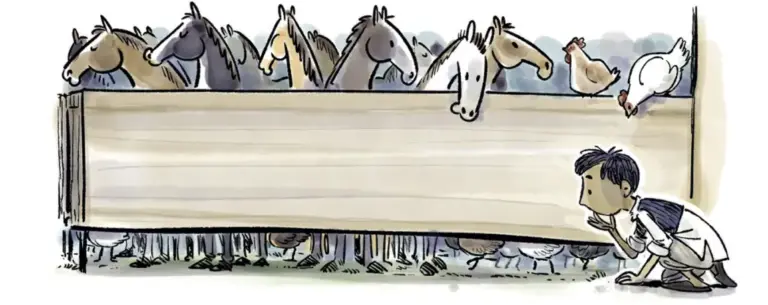
6. A farm has some horses and hens. The total number of heads of these animals is 55, and the total number of legs is 150. How many horses and how many hens are on the farm?
Can you solve this without letter-numbers?
[Hint: If all the 55 animals were hens, then how many legs would there be? Using the difference between this number and 150, can you find the number of horses?]
Solution:
Total animals = 55
If all 55 animals were hens, then the total number of legs = 2 × 55 = 110
Actual number of legs = 150
Extra legs = 150 -110 = 40
Since each horse contributes 2 extra legs compared to a hen.
Number of horses = 40 ÷ 2 = 20
Actual number of hens = 55 – 20 = 35
7. A mother is 5 times her daughter’s age. In 6 years’ time, the mother will be 3 times her daughter’s age. How old is the daughter now?
Solution:
Let x be the present age of the daughter, and y be the present age of the mother.
According to the question,
5x = y ………….. (1)
After 6 years,
3(x + 6) = y + 6
3x + 18 = y + 6
3x + 18 = 5x + 6 ……….. (Using 1)
3x – 5x = 6 – 18
-2x = -12
x = = 6.
Therefore, the present age of the daughter is 6 years.
8. Two friends, Gauri and Naina, are cowherds. One day, they pass each other on the road with their cows. Gauri says to Naina, “You have twice as many cows as I do”. Naina says, “That’s true, but if I gave you three of my cows, we would each have the same number of cows”. How many cows do Gauri and Naina have?
Solution:
Let the number of cows Gauri and Naina have be x and y.
According to the question,
2x = y ………..…(1)
Also,
x + 3 = y – 3
x + 3 = 2x – 3 …………… (Using 1)
2x – x = 3 + 3
x = 6
y = 2 × 6 = 12
Therefore, Gauri and Naina have 6 and 12 cows, respectively.
9. I run a small dosa cart, and my expenses are as follows:
• Rent for the dosa cart is ₹5000 per day.
• The cost of making one dosa (including all the ingredients and fuel) is ₹10.
(i) If I can sell 100 dosas a day, what should be the selling price of my dosa to make a profit of ₹2000?
(ii) If my customers are willing to pay only ₹50 for a dosa, how many dosas should I aim to sell in a day to make a profit of ₹2000?
Solution:
Rent for dosa cart ₹5000 per day
Cost per dosa = ₹10
Desired profit = ₹2000
So,
Total revenue needed = Total cost + Profit
(i) Cost of 100 dosas = 100 × 10 = 1000
Total cost = 5000 + 1000 = 6000
Required revenue= 6000 + 2000 = 8000
Price per dosa = = ₹80
(ii) Let the number of dosas = n
Revenue = 50n
Profit = 50n − (5000 + 10n) = 2000
50n – 5000 – 10n = 2000
40n – 5000 = 2000
40n = 2000 + 5000
40n = 7000
n = 175
10. Evaluate the following sequence of fractions:
, ,
What do you observe? Can you explain why this happens?
[Hint: Recall what you know about the sum of the first n odd numbers.]
Solution:
=
= =
= =
Thus, all fractions are equal to .
Since the sum of the first n odd numbers = n2.
Numerators:
1 = 12
4 = 22
9 = 32
Denominators:
3 = 3 × 12
12 = 3 × 22
27 = 3 × 32
Therefore, the fraction is = .
11. Karim was taking a nap under a tree. He had a dream about a magical lamp and a genie. He heard a voice saying, “I have come to serve you, Oh master”. He woke up and to his surprise, it was a genie!
“Do you want to make money?”, asked the genie. Karim nodded dumbly in bewilderment. The genie continued, “Do you see the banyan tree over there? All you have to do is go around it once. The money in your pocket will double”.
Karim immediately started towards the tree, only to be stopped by the genie. “One moment!”, said the genie. “Since I am bringing you great riches, you should share some of your gains with me. You must give me 8 coins each time you go around the tree.”
Thinking that was a trifling amount, Karim readily agreed.
He went around the tree once. Just as the genie had
said, the number of coins in his pocket doubled! He gave
8 coins to the genie. He made another round. Again the
number of coins doubled. He gave 8 more coins to the
genie. He went around the tree for the third time. The
number of coins doubled again, but to his horror, he was left with only 8 coins, exactly the number of coins he owed the genie!
As Karim began to wonder how the genie tricked him, the genie let out a loud laugh and disappeared.
(i) How many coins did Karim initially have?
(ii) For what cost per round should Karim agree to the deal, if he wants to increase the number of coins he has?
(iii) Through its magical powers, the genie knows the number of coins that Karim has. How should the genie set the cost per round so that it gets all of Karim’s coins?
Each answer is explained in simple language so that students can easily understand the concepts and score better in exams. Whether you are completing homework, revising for tests, or clearing doubts, these NCERT solutions will help you learn faster and more effectively.
Why Choose Our NCERT Solutions?
- ✅ 100% Accurate and Easy-to-Understand Solutions
- ✅ Based on the Latest NCERT Syllabus
- ✅ Step-by-Step Explanations
- ✅ Perfect for Homework, Revision, and Exam Preparation
- ✅ Free Access for All Students
For complete solutions and more NCERT study material, visit School Learners:
At schoollearners.in/, you can find NCERT Solutions, Notes, MCQs, Important Questions, Sample Papers, Previous Year Questions, and study resources for Classes 6–12. Bookmark the website and make your learning easier with high-quality educational content updated regularly.