How Nature Works in Harmony Chapter 12 Class 8 Science NCERT Solutions Looking for the How Nature Works in Harmony Chapter 12 Class 8 Science NCERT Solutions? At School Learners, we provide accurate, easy-to-understand, and exam-oriented NCERT solutions that help students learn concepts quickly and score better in exams.
Probe and ponder (Page 190)
1. How might the loss of forest cover and changes in rainfall patterns lead to elephants to enter human farms and villages?
Answer:
The loss of forest cover destroys the natural habitat of elephants. Changes in rainfall patterns, such as irregular or reduced rainfall, further reduce the growth of forest vegetation and dry up natural water sources. As a result, elephants are forced to move out of forests in search of food and water. Farms and villages provide easily available crops, stored grains, and water, which attract elephants and may lead to human-elephant conflict.
2. Imagine you are a tree in a dense forest. What kind of relationships would you have with water, sunlight, other animals, and other components of the forest?
Answer:
If I were a tree in a dense forest, I would depend on sunlight for photosynthesis to prepare my food and on water and minerals from the soil for growth. In return, I would release oxygen into the air.
I would provide food and shelter to many animals, birds, and insects, and they would help in pollination and seed dispersal.
The soil organisms would help in decomposing fallen leaves into humus, enriching the soil around my roots. I would also help in maintaining soil moisture, preventing soil erosion, and regulating the climate.
3. Do you think the Earth can thrive without humans? Can humans survive without the earth?
Answer:
Yes, the Earth can thrive without humans. The Earth existed for millions of years before humans appeared, and natural ecosystems can function and regenerate without human interference.
However, humans cannot survive without the Earth. Humans depend on the Earth for air, water, food, land, and all natural resources necessary for life.
4. If two kinds of birds compete for the same fruit, how might their way of living change over time?
Answer:
If two kinds of birds compete for the same fruit, they might change their way of living to reduce competition and survive. One type of bird may start feeding on the fruit at a different time of the day, or may choose fruits from different parts of the tree, or may adapt to eat a different type of food.
5. Can human actions cause natural disasters?
Answer:
Yes, human actions can cause or worsen natural disasters. Activities such as deforestation, excessive mining, construction on riverbanks, blocking natural drainage, and emission of greenhouse gases disturb the natural balance of the environment. These actions can lead to floods, landslides, droughts, and climate change related disasters.
Keep the curiosity alive (Page 207 – 208)
1. Refer to the given diagram (Fig. 12.19) and select the wrong statement.
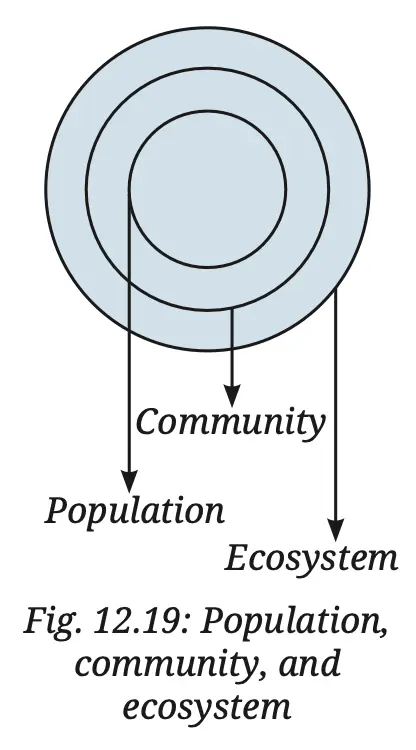
(i) A community is larger than a population.
(ii) A community is smaller than an ecosystem.
(iii) An ecosystem is part of a community.
Answer:
(iii) An ecosystem is part of a community.
2. A population is part of a community. If all decomposers suddenly disappear from a forest ecosystem, what changes do you think would occur? Explain why decomposers are essential.
Answer:
If all decomposers suddenly disappear from a forest ecosystem, dead plants and animals would start accumulating in the forest. Nutrients present in the dead matter would not be recycled back into the soil. As a result, plants would not grow properly, affecting herbivores and, in turn, carnivores.
Decomposers are essential because they break down dead plants and animals into simpler substances, recycling important nutrients back into the soil.
3. Selvam from Cuddalore district, Tamil Nadu, shared that his village was less affected by the 2004 Tsunami compared to nearby villages due to the presence of mangrove forests. This surprised Sarita, Shabnam, and Shijo. They wondered if mangroves were protecting the village. Can you help them understand this?
Answer:
Yes, mangrove forests can protect coastal villages from disasters like tsunamis. Mangroves have dense roots and thick vegetation that act as a natural barrier. They reduce the speed and force of sea waves and absorb the impact of strong waves, causing less damage. Therefore, the presence of mangrove forests helped protect Selvam’s village during the 2004 Tsunami.
4. Look at this food chain: Grass → Grasshopper → Frog → Snake
If frogs disappear from this ecosystem, what will happen to the population of grasshoppers and snakes? Why?
Answer:
If frogs disappear from this ecosystem, the population of grasshoppers will increase because there will be no predator to feed on them. On the other hand, the population of snakes will decrease because snakes depend on frogs for food. Thus, the disappearance of frogs will disturb the balance of the food chain.
5. In a school garden, students noticed fewer butterflies the previous season. What could be the possible reasons? What steps can students take to have more butterflies on campus?
Answer:
Possible reasons for fewer butterflies:
(i) Reduction in green cover around the campus.
(ii) Loss of flowering plants that provide nectar.
(iii) Excessive use of pesticides or insecticides in the garden.
(iv) Lack of host plants needed by caterpillars.
Steps students can take to attract more butterflies:
(i) Plant more flowering plants and native species.
(ii) Avoid or reduce the use of chemical pesticides.
(iii) Maintain a clean and green garden with adequate water.
(iv) Grow host plants for caterpillars.
6. Why is it not possible to have an ecosystem with only producers and no consumers or decomposers?
Answer:
It is not possible to have an ecosystem with only producers and no consumers or decomposers because producers alone cannot maintain the balance of an ecosystem. Consumers are needed to feed on producers and transfer energy through the food chain. Decomposers are essential to break down dead plants and animals and recycle nutrients back into the soil. Without decomposers, nutrients would get locked in dead matter and would not be available to producers.
7. Observe two different places near your home or school (e.g., a park and a roadside). List the living and non-living components you see. How are the two ecosystems different?
Answer:
(a) Park
Living components: Trees, shrubs, grass, birds, butterflies, insects, squirrels and microorganisms in the soil.
Non-living components: Rocks, soil, water, air and sunlight.
(b) Roadside
Living components: A few trees, weeds, birds, insects, humans and domestic animals.
Non-living components: Vehicles, dust, air, sunlight, road and stones.
A park has more plants and animals, richer biodiversity, cleaner air, and better soil and water conditions. A roadside has fewer plants and animals, more pollution, and more human disturbance. Thus, the park ecosystem is healthier and more balanced than the roadside ecosystem.
8. ‘Human-made ecosystems like agricultural fields are necessary, but they must be made sustainable.’ Comment on the statement.
Answer:
Human-made ecosystems such as agricultural fields are necessary because they provide food and raw materials for a growing population. However, excessive use of fertilizers, pesticides and water can degrade soil, reduce biodiversity, and pollute the environment. Therefore, these ecosystems must be made sustainable by using eco-friendly farming practices, conserving soil and water, reducing chemical inputs, and maintaining biodiversity so that they can continue to support human needs without harming the environment.
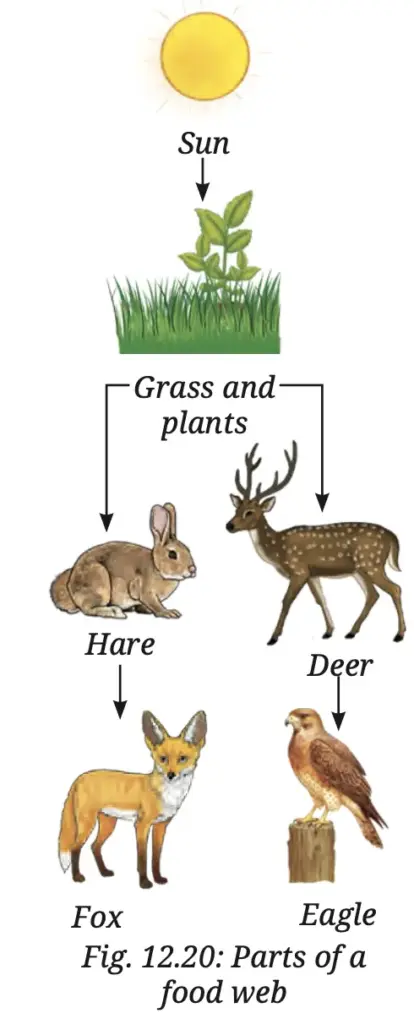
9. If the Indian hare population (Fig. 12.20) drops because of a disease, how would it affect the number of other organisms?
Answer:
If the Indian hare population drops due to a disease, animals that feed on the hare, such as the fox, will have less food available, so their population may decrease. At the same time, grass and plants may increase due to reduced grazing by hares. This may lead to an increase in the deer population as more food becomes available, and an increase in deer population would provide more food for eagles.
Our solutions are prepared in simple language according to the latest NCERT syllabus. Whether you’re completing homework, revising for exams, or clearing doubts, our step-by-step answers make learning easier.
Why Choose School Learners?
- ✅ 100% Free NCERT Solutions
- ✅ Simple and Student-Friendly Explanations
- ✅ Updated According to the Latest NCERT Syllabus
- ✅ Perfect for Homework and Exam Preparation
Visit School Learners to access the complete How Nature Works in Harmony Chapter 12 Class 8 Science NCERT Solutions and many more study resources:
Start learning smarter with School Learners and boost your confidence in Science with reliable, high-quality study materials.