Keeping Time with the Skies Chapter 11 Class 8 Science NCERT Solutions Looking for Keeping Time with the Skies Chapter 11 Class 8 Science NCERT Solutions? You’ve come to the right place! This chapter explains how people have used the Sun, Moon, and stars to measure time since ancient times. It helps students understand the relationship between astronomy and timekeeping in an easy and interesting way.
Probe and ponder (Page 170)
1. Have you ever seen the Moon during the day? Why do you think it is sometimes visible when the Sun is up?
Answer:
Yes, we can sometimes see the Moon during the day. The Moon does not produce its own light and reflects the light of the Sun. When the reflected sunlight from the Moon is bright enough, it becomes visible even though the Sun is also shining.
2. Imagine you lived on the Moon instead of Earth. What would you mean by a day, a month or a year?
Answer:
If we lived on the Moon, a day would mean the time taken by the Moon to rotate once on its axis. A month would mean the time taken by the Moon to complete one revolution around the Earth. A year would mean the time taken by the Earth–Moon system to complete one revolution around the Sun.
3. What would happen if Earth had two moons instead of one? How would that change the night sky?
Answer:
If the Earth had two moons, then the nights could be brighter due to extra reflected sunlight. Sometimes one moon or both moons might be visible together. Their phases would also differ, showing distinct shapes simultaneously, and tides on Earth would be affected due to the combined pull of both moons.
4. If we didn’t have clocks or calendars, how else could we measure time?
Answer:
If we did not have clocks or calendars, we could measure time by observing natural events. The rising and setting of the Sun could be used to mark day and night. The changing phases of the Moon could be used to identify days and count months. The change of seasons could be used to measure years.
Keep the curiosity alive (Page 187 – 188)
1. State whether the following statements are True or False.
(i) We can only see that part of the Moon which reflects sunlight towards us.
(ii) The shadow of Earth blocks sunlight from reaching the Moon causing phases.
(iii) Calendars are based on various astronomical cycles which repeat in a predictable manner.
(iv) The Moon can only be seen at night.
Answer:
(i) We can only see that part of the Moon which reflects sunlight towards us – True.
(ii) The shadow of Earth blocks sunlight from reaching the Moon causing phases – False.
(iii) Calendars are based on various astronomical cycles which repeat in a predictable manner – True.
(iv)The Moon can only be seen at night – False.
2. Amol was born on 6th of May on a full Moon day. Does his birthday fall on the full Moon day every year? Explain your answer.
Answer:
No, Amol’s birthday will not fall on a full Moon day every year. A full Moon occurs after about 29.5 days, which is one lunar month. Twelve lunar months make a lunar year of about 354 days, whereas a solar year has 365 days. Since the lunar months are not synchronised with the solar year, the dates of the full Moon keep changing every year.
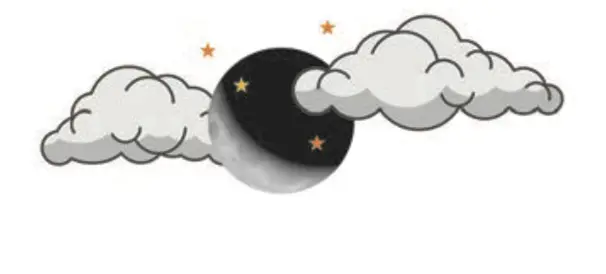
3. Name two things that are incorrect in Fig. 11.10.
Answer:
Two incorrect things are:
(i) Clouds are shown near the Moon. Clouds are found in the Earth’s atmosphere, not in space around the Moon.
(ii) Stars are shown very close to the Moon and are visible clearly. When the Moon is visible in the sky, especially during daytime or near bright moonlight, stars are generally not seen so clearly.
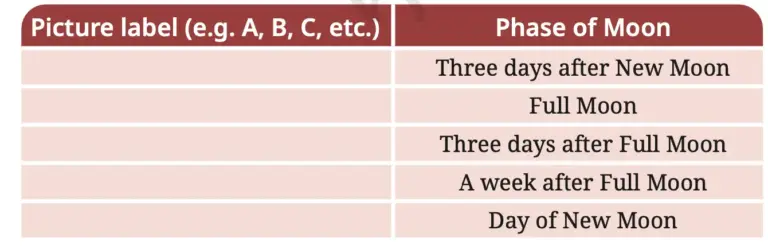
4. Look at the pictures of the Moon in Fig. 11.11, and answer the following questions.

(i) Write the correct panel number corresponding to the phases of the Moon shown in the pictures above.
Answer:
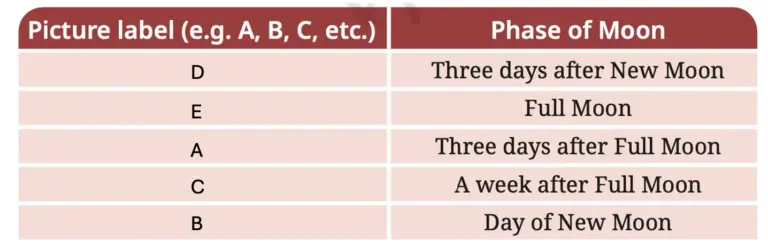
(ii) List the picture labels of the phases of the Moon that are never seen from Earth. Hint: You can use your observations from Activity 11.1 or Fig. 11.2 as a reference.
Answer:
Picture B: On a new moon day, the non-illuminated side of the moon faces the Earth, so it is not visible from the Earth.
5. Malini saw the Moon overhead in the sky at sunset.
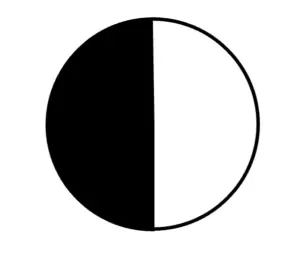
(i) Draw the phase of the Moon that Malini saw.
(ii) Is the Moon in the waxing or the waning phase?
Answer:
(i) If the Moon is seen overhead at sunset, it must be the first quarter phase of the Moon. In this phase, half of the Moon is visible, with the right half illuminated.
(ii) The Moon is in the waxing phase because it occurs after the new Moon and the bright part is increasing.
6. Ravi said, “I saw a crescent Moon, and it was rising in the East, when the Sun was setting.” Kaushalya said, “Once I saw the gibbous Moon during the afternoon in the East.” Who out of the two is telling the truth?
Answer:
Kaushalya is telling the truth.
A gibbous Moon can be seen in the sky during the afternoon, rising in the East before sunset. Therefore, Kaushalya’s observation is correct.
A crescent Moon is seen close to the Sun in the sky and either rises shortly after sunrise (waning crescent) or sets shortly after sunset (waxing crescent). It is not seen rising in the East at sunset, so Ravi’s statement is incorrect.
7. Scientific studies show that the Moon is getting farther away from the Earth and slower in its revolution. Will luni-solar calendars need an intercalary month more often or less often?
Answer:
As the Moon moves farther away from the Earth, its period of revolution increases, making the lunar month longer. Consequently, the lunar year becomes closer in length to the solar year. Therefore, the difference between the lunar and solar years reduces, and luni-solar calendars will need an intercalary month less often.
8. A total of 37 full Moons happen during 3 years in a solar calendar. Show that at least two of the 37 full moons must happen during the same month of the solar calendar.
Answer:
Number of months in 3 years of a solar calendar = 12 × 3 = 36 months
Number of full Moons in 3 years = 37
Since the number of full Moons is more than the number of months, at least two full Moons must occur in the same month of the solar calendar.
9. On a particular night, Vaishali saw the Moon in the sky from sunset to sunrise. What phase of the Moon would she have noticed?
Answer:
If the Moon is visible in the sky from sunset to sunrise, it must be a full Moon. This is because a full Moon rises at sunset, remains visible throughout the night, and sets at sunrise.
10. If we stopped having leap years, in approximately how many years would the Indian Independence day happen in winter?
Answer:
If we stopped having leap years, dates would shift by about 1 day every 4 years.
Since winter is about 120 days after 15 August, it would take approximately 120 × 4 = 480 years.
So, the Indian Independence Day would happen in winter after about 480 years.
11. What is the purpose of launching artificial satellites?
Answer:
Artificial satellites are launched for purposes such as communication, navigation, weather monitoring, disaster management, and scientific research.
12. On which periodic phenomenon are the following measures of time based:
(i) day (ii) month (iii) year?
Answer:
(i) Day – based on the rotation of the Earth on its axis.
(ii) Month – based on the revolution of the Moon around the Earth.
(iii) Year – based on the revolution of the Earth around the Sun.
At School Learners, we provide accurate, easy-to-understand, and exam-oriented NCERT Solutions that help students prepare quickly and score better in exams. Every answer is written in simple language according to the latest CBSE syllabus.
Visit now: https://schoollearners.in/
On schoollearners.in/, you will find:
- Complete NCERT Solutions for Class 8 Science
- Step-by-step answers in simple English
- CBSE exam preparation material
- Chapter-wise notes, important questions, and study resources
If you’re searching for the best Keeping Time with the Skies Chapter 11 Class 8 Science NCERT Solutions, bookmark schoollearners.in/ and make your studies easier with reliable, high-quality educational content.